
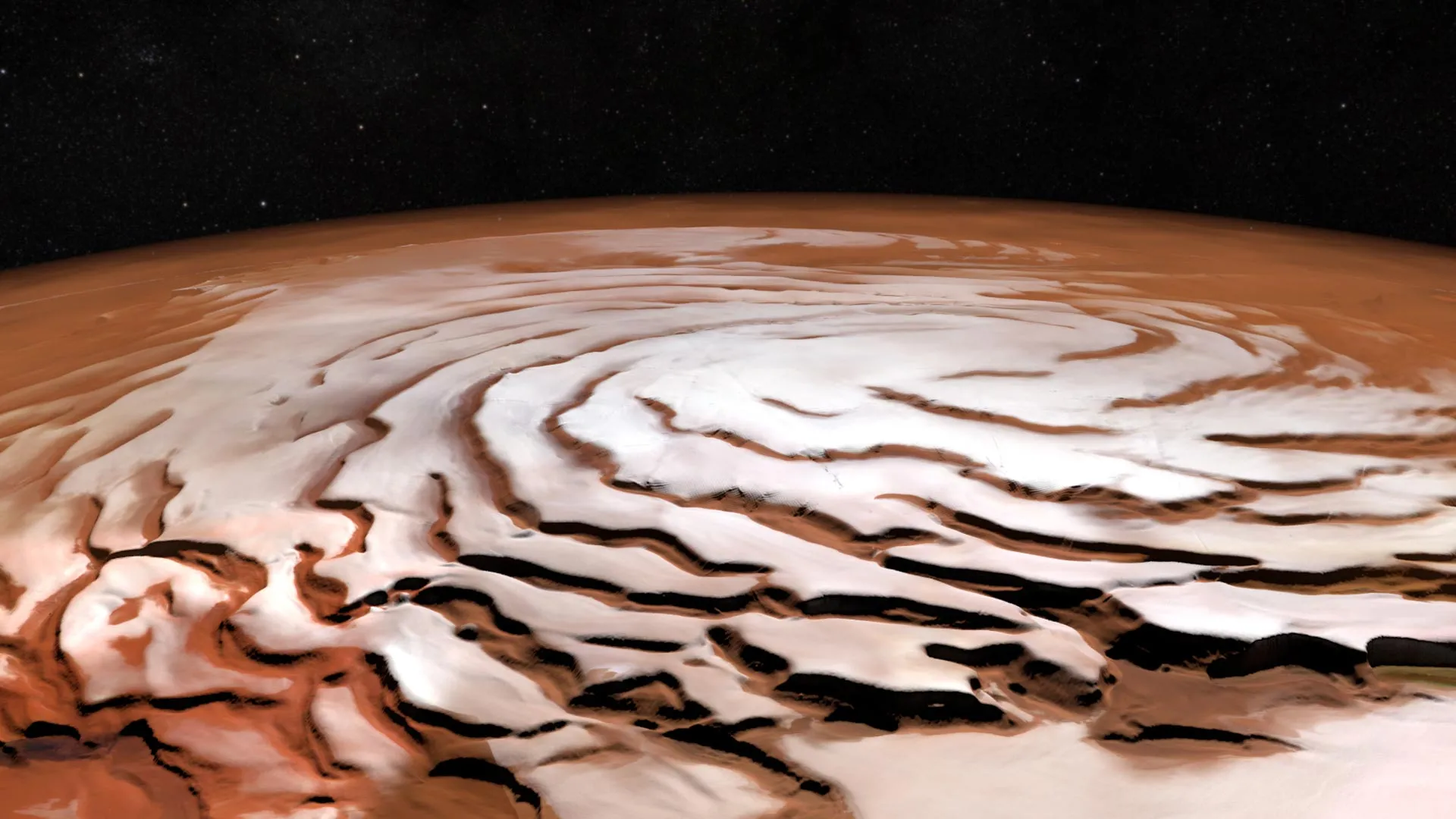
Mars may once have shared many similarities with Earth, but today the rocky red planet appears largely inhospitable. However, its deposits of frozen water continue to fascinate scientists. As on Earth, ice can preserve evidence of ancient climate conditions, potentially offering clues to whether Mars could support life today or might have harbored it in the past. Most Martian ice lies beneath a blanket of surface dust, although some is exposed in the polar regions. Dust plays an important role in shaping the planet's climate because it darkens ice and reduces the amount of sunlight reflected back into space. Now, a University of Washington (UW) study published in npj Space Exploration has revealed that ice at Mars' north pole contains considerably less dust than previously estimated. "We know there is water ice in the area surrounding the north pole of Mars, but there has been widespread disagreement as to how dusty that ice is," said Aditya Khuller, a senior research scientist at the UW's Applied Physics Laboratory. "If it is dustier, the ice will be darker. Just like a dark T-shirt in the sun makes you warmer, dusty ice gets warmer and vaporizes faster on Mars." Unlocking Mars' Frozen Climate History Ice samples have provided much of our understanding of how Earth's climate has changed over thousands of years. By drilling into polar ice sheets and extracting long cylindrical samples, researchers can reconstruct atmospheric conditions from the distant past. Much like the growth rings of a tree, layers within the ice allow scientists to look back at different periods in Earth's history. Collecting these samples is challenging enough on our own planet, and doing so on Mars presents even greater difficulties. NASA's first successful mission to Mars took place 50 years ago. In 2008, its Mars Phoenix mission successfully collected ice samples near the planet's north pole. The achievement was particularly significant following the loss of the Polar Lander near the south pole in 1999. For the new study, the UW team combined Phoenix mission data with observations collected by spacecraft orbiting Mars. Several years earlier, Khuller had identified a potential problem with the technique commonly used to determine the physical characteristics of Martian ice. The method was originally designed to investigate lunar soil. When Khuller tested it against observations from Earth, however, the results appeared inconsistent. A New Way To Study Martian Ice For the latest investigation, Khuller teamed up with Pari Mohan, a recent UW graduate with a degree in geoscience, to recalculate the properties of Martian ice using an alternative technique. Their approach builds on research by Steve Warren, a UW professor emeritus of Earth and space science who specializes in the study of snow and ice. "His methods had been used successfully to study snow and ice on Earth for decades. So I thought it would be interesting to adapt these Earth-tested methods to Mars," Khuller said. The findings indicate that the northern polar ice is arranged "like an ice-cream sandwich," with relatively dusty layers sandwiched between thicker sections of cleaner ice. During each Martian winter, dusty frost accumulates on the surface. As summer arrives, this frost disappears, exposing older ice with considerably lower dust concentrations. Earlier calculations estimated that dust could account for as much as 25% of the uppermost polar ice by mass. The revised analysis suggests that the figure for the exposed older ice is closer to just 3%. "By looking at how the brightness changed over time, we figured out that there is a frost that forms in the winter and it's more dusty. In the Martian summer it goes away, exposing cleaner, older ice," Khuller said. The Legacy of Mars' Extreme Ice Ages Scientists believe these ice deposits originated from snowfall thousands of years ago, preserving important evidence of the climate conditions that existed at the time. Mars undergoes dramatic ice ages that have left deposits of ice near the surface across approximately one-third of the planet. The gravitational influence of Earth's moon helps stabilize our planet's axial tilt. Mars, by contrast, has only two small moons and experiences much larger variations in its axial tilt. The planet "oscillates wildly," Khuller said, driving extreme shifts in its climate and triggering major ice ages. Could Martian Ice Support Life? In a previous study published in Communications Earth, Khuller and his colleagues proposed that alternating layers of ice and dust might produce environments suitable for life on Mars. Darker, dust-rich layers could absorb sunlight and generate enough heat to produce small pockets of liquid water within the ice. Minerals and other nutrients supplied by the dust could potentially make these pockets suitable habitats for bacteria and other simple organisms. Comparable environments exist on Earth, where shallow pools of meltwater within dusty ice frequently support abundant microbial life during the summer. When temperatures drop in winter, the water freezes, and the microorganisms enter a dormant state until warmer conditions return. "The fact that Mars and Earth both have these similar layers of water ice and dust is interesting," Khuller said. "Why does one planet have life and the other doesn't?" Learning more about Mars' climate history brings researchers closer to addressing that fundamental question, although finding an answer could still take years. Khuller hopes to extend the investigation by using the improved analytical techniques to examine ice deposits in other parts of the red planet.
Ice at Mars’ north pole is far cleaner than scientists thought
Full Article
Original Source
Read the full article at Sciencedaily →KhanList aggregates and links to publicly available news content. We do not host full articles from third-party sources. Always verify important information with original sources.