
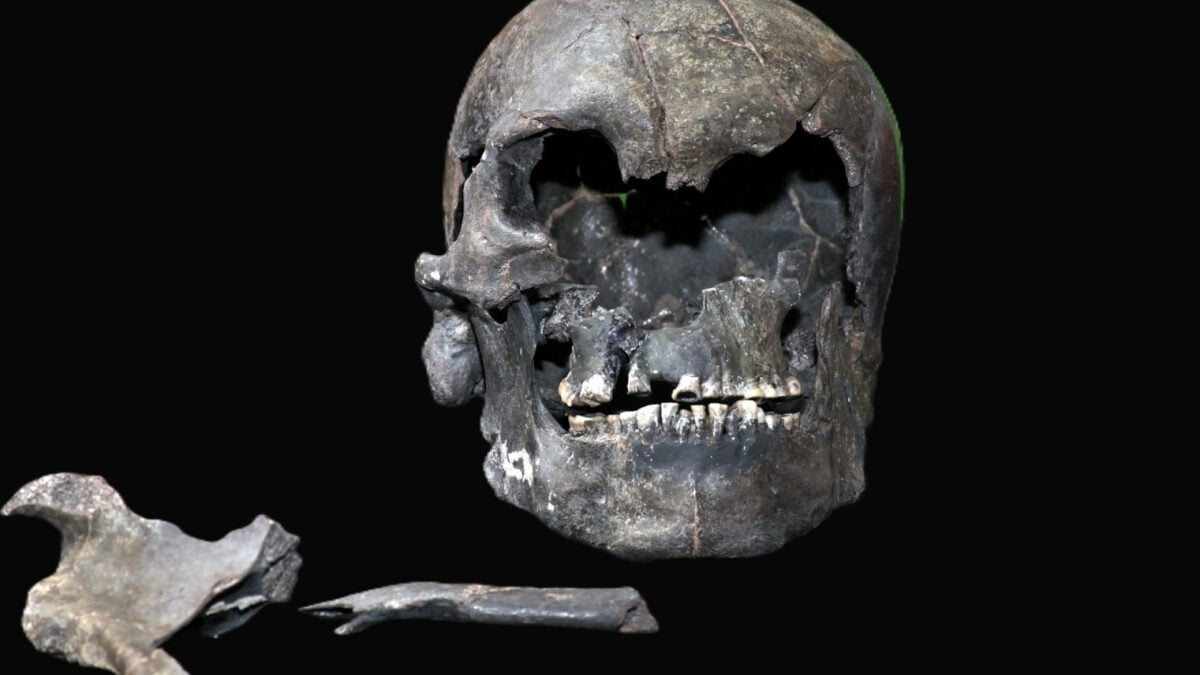
During construction work in 2021 for the Felipe Ángeles International Airport in Mexico, authorities found fragments of a blackened skeleton. Experts now have the specifics on the remains’ features—and its age may address one of archaeology’s greatest mysteries. In a recent statement, Mexico’s National Institute of Anthropology and History (INAH) reported that two separate dating analyses placed the individual’s age between 13,087 and 11,700 years old, roughly around the late Pleistocene and the end of the last glacial period. According to a previous statement from 2024 on the discovery of “Yotzin” (which means “unique” in the Nahuatl language), the individual’s skeleton is roughly 80% complete with a partial skull. If the latest dating is correct, it would make Yotzin among the earliest inhabitants of the Americas, as well as one of the oldest human skeletons retrieved from the Valley of Mexico. “Yotzin is one of the oldest known human remains from the Valley of Mexico,” Claudia Curiel de Icaza, Mexico’s secretary of culture, said in the latest statement (translated via Google). “Its dating brings us closer to a period in our history for which there is very little evidence and opens new possibilities for investigating how these populations lived and where they came from.” Prehistoric hotspot, now airport The Felipe Ángeles International Airport formally opened for civilian use in 2022. But the region itself was a known for milestone preshistoric discoveries in the 1940s and 1960s, according to the 2024 statement. It appears those 20th-century excavations didn’t get to fully explore the site, as the round of investigations in the 2020s uncovered new items of archaeological significance, including the Yotzin man. The skeleton of the Yotzin man. Credit: Melitón Tapia, INAH “At first, I thought they belonged to a camel skeleton, since its bones are roughly the same size,” Israel Peña, an INAH archaeologist who first discovered the skeleton, said in the latest statement. “We extended the excavation to recover it, and as we progressed, we realized they were human remains.” The initial osteometry revealed an adult male between 25 and 30 years old who was roughly 5 feet and 9 inches (175 centimeters) tall. When the team found his remains, his ribcage was destroyed, and his skull showed a fracture around the nose and left eye. The stratigraphic layer his body was in was likely filled with wet, swampy sediments that turned his bones into a blackish color. His teeth showed signs of heavy wear, but he had no cavities. Further interpretations, the team said during the 2024 investigation, would have to wait until the radiocarbon dates came back. Between the ages Given known stratigraphy dates of comparable sites, the team hypothesized that Yotzin lived during the last ice age. The team commissioned two separate labs to date two different materials. One lab in Belgium sent back a range of 13,087 to 12,987 years ago, whereas another in the U.S. gave a range of between 12,050 and 11,700 years ago. So, Yotzin was at least living in what’s now Mexico (or its airport) at the end of the Pleistocene and the beginning of the Holocene. Additional dental analysis confirmed that he didn’t have cavities. Arturo Talavera González, an INAH physical anthropologist involved in the project, said that pre-ceramic hunter-gatherers probably didn’t consume sugars. Instead, they likely chewed on roots or hard bark, and their teeth perhaps served as a makeshift cutting tool. A reimagination of the Yotzin man. Credit: Arturo Talavera González Importantly, Yotzin showed traits distinct from other osteological collections found at the site, suggesting that the area was home to different populations over different time periods. The study is ongoing, and González added that genomic results for Yotzin may arrive as early as the first quarter of 2027. “Because the most important thing is not to have an ancient date but to know where it comes from, to know its lineage,” González said. That could “shed new light on human migrations in the Americas,” he concluded.
Ice Age Skeleton Found at a Mexican Airport May Be Among the Oldest Human Remains in the Americas
Full Article
Original Source
Read the full article at Gizmodo →KhanList aggregates and links to publicly available news content. We do not host full articles from third-party sources. Always verify important information with original sources.