
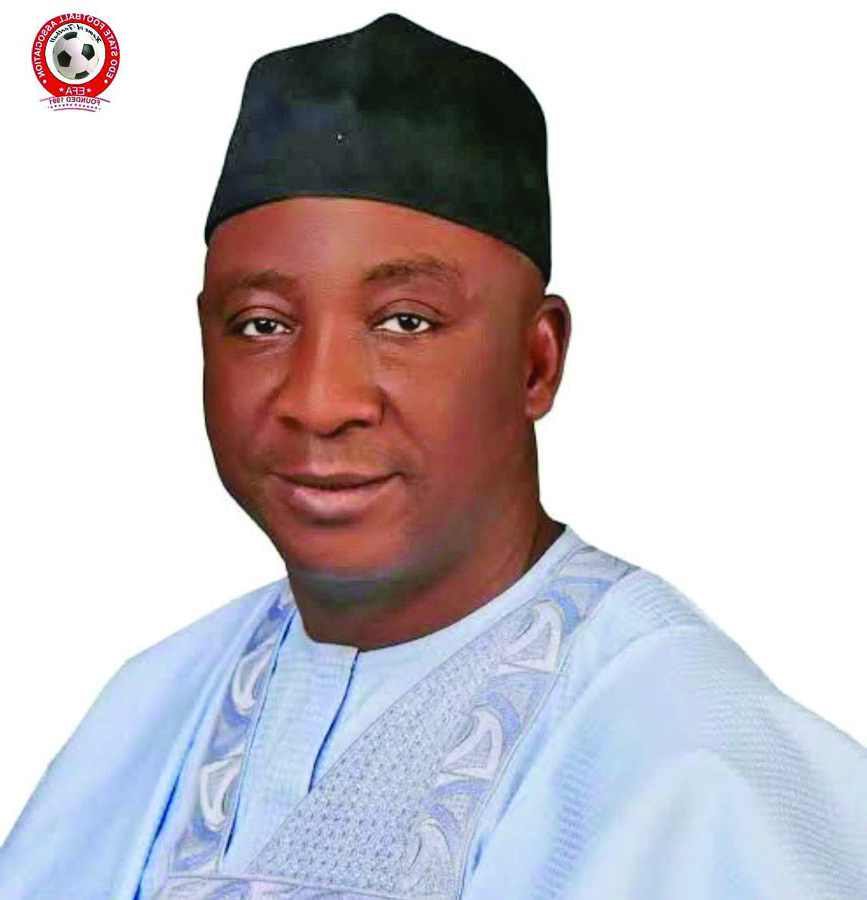
Nigeria Football Federation (NFF) President, Ibrahim Musa Gusau’s administration is facing unprecedented criticism following the Super Eagles’ World Cup qualifying failure and the Super Falcons’ elimination from the Women’s World Cup, marking a collapse in Nigerian football administration. Critics accuse the “Glass House” leadership of fostering a toxic, unaccountable system that sidelines talent to protect bureaucratic interests, with mounting pressure from the National Sports Commission and the Senate for accountability. With the EFCC and the ICPC having commenced investigations into the utilisation of the N12bn Federal Government intervention fund released to the federation for players’ wages and bonuses, Gusau’s leadership of the country’s football governing body is hanging in the balance, writes Kunle Adewale The atmosphere in the hallways of the Nigeria Football Federation (NFF) secretariat in Abuja—affectionately known as the “Glass House”—has never felt heavier. For Alhaji Ibrahim Musa Gusau, the federation’s 40th president, the structure is beginning to feel less like a bastion of sports governance and more like a real-time pressure cooker. Just days ago, Gusau stood at the International Conference Centre in Abuja, flanked by traditional rulers, receiving the “Football Infrastructure Icon of the Year” award from Blueprint Newspaper. He spoke of his milestone achievements: implementing FIFA Forward-funded pitches, upgrading player hostels, and introducing under-20 referees into the local premier league. But in the unforgiving court of Nigerian public opinion, infrastructural plaques do not score goals. While Gusau held his trophy, a larger, administrative storm was breaking over his head. With the Super Eagles’ catastrophic failure to qualify for the 2026 FIFA World Cup and the Super Falcons missing out on the 2027 Women’s World Cup in Brazil, Nigerian football has hit a modern nadir. The National Sports Commission (NSC), led by Shehu Dikko, stepped in to pause the NFF’s scheduled September 27 election in Lafia, rather contemplating a three-month Normalisation Committee to step in. Facing a sudden summons by the Senate Committee on Sports chaired by Senator Abdul Ningi, Gusau finds himself completely cornered, fighting an uphill battle to protect his presidency and his legacy. EFCC, ICPC on NFF’s Heels The Economic and Financial Crimes Commission and the Independent Corrupt Practices and Other Related Offences Commission have commenced investigations into the utilisation of the N12bn Federal Government intervention fund released to the Nigeria Football Federation for players’ wages and bonuses. The fund was approved by President Bola Tinubu in 2024 to clear outstanding payments owed to Nigeria’s national teams. Sources have alleged that some officials linked to the matter had been invited by investigators and had provided statements. “They have been under our radar before now. We invited some officials over to our offices, and they gave their statements. Presently, they are on administrative bail. We have not ended our investigation,” the source said. According to the report, the request was made under the Freedom of Information Act and sought access to financial records and other documents concerning the N12bn Federal Government intervention fund reportedly released to the NFF for players’ wages and bonuses. However, the NFF is said to have declined to release the requested records, citing ongoing investigations by the two anti-corruption agencies. Danladi Bako Calls for Gusau’s Removal In his reaction, former Sokoto State FA Chairman, Dr Danladi Bako, has described the continued stay in office of the Gusau-led board of the NFF as an aberration. The former DG of the Nigeria Broadcasting Commission (NBC) stressed that it was self-serving, immoral and insensitive to throw the emotions of over 200 million football loving Nigerian fans into a ping-pong, ding-dong and topsy-turvy clanger. “I imagine the pain of the country and a football loving President Bola Tinubu that the Super Eagles have not qualified for the FIFA World Cup since 2018, losing out in 2022 and 2026 even when Cape Verde, a country of less than a million people qualified, even when a small Caribbean country like Curacao qualified, even when FIFA increased the (CAF) African slots to 10. “That we lost out at the quarter final is embarrassing enough, we simply did not play well, we scrapped through the whole tournament unconvincingly. Now, we are not going to be in Brazil next year.” Bako further put these poor handling of the country’s football as the reason why Nigeria’s age group national teams have all underperformed. “And the sad issue is that there seems to be no hope ahead.” He described the free money inherent in the federation as the reason why every successive administration at the NFF always resort to using FIFA’s threat that any government funding a country’s sports should not interfere in its affairs. The former Sokoto FA boss therefore wants President Tinubu to direct relevant government agencies to call for the exit of the NFF board instead of the so-called attempt to perpetuate themselves in office for another four years through the flawed electoral congress slated for September 27 in Lafia. The Accountant in the Eye of the Storm Unlike his charismatic, globe-trotting predecessor, Amaju Pinnick, Gusau is a quiet, bureaucratically minded administrator. An accountant by training who spent decades climbing the civil service ladder to become a Director of Finance in Zamfara State, Gusau understands institutional machinery. He served two terms as Pinnick’s “Chairman of Chairmen” and headed the NFF’s internal Security Committee. When he won a landslide victory in Benin City in 2022 to claim the NFF presidency, supporters believed his backroom competence would bring quiet stability after years of theatrical controversies. Instead, critics argue that his bureaucratic approach morphed into institutional inertia. While Gusau focused on technical training—such as organising Nigeria’s first CAF B coaching courses in 16 years—the crown jewels of the nation’s footballing identity began to fall apart on the pitch. The math is brutal. For a country of over 200 million people that treats football as a secular religion, missing back-to-back Senior Men’s World Cups is more than a sporting disappointment; it is a full-blown national trauma. When the Super Falcons were eliminated prematurely at the WAFCON stage, wiping out their unblemished record of attending every single FIFA Women’s World Cup since 1991, the public’s patience snapped completely. Prominent sports voices and millions of passionate fans across social media began calling his tenure “the worst administrative era in NFF history.” “Autonomy Is Not Immunity” Gusau’s defense has remained firm, focused heavily on resisting the “polluted environment” of modern football punditry. In a recent address on player selection allegations, he vehemently denied ever interfering with national team handlers, including current coach Eric Sékou Chelle. “People should be careful about what is going on, especially on social media,” Gusau warned. “I will never tell a coach to pick this player or that player. I have never stayed in the same hotel with the national team since I became President. I don’t want to be a distraction.” His allies strongly argue that the NFF provided the coaches and players with everything they required, shifting the blame entirely to poor player execution and bad luck on the pitch. They point out that Gusau shouldn’t be vilified for tactical errors made by athletes who play in elite European leagues. However, the National Sports Commission (NSC) and the Senate aren’t buying the bad-luck narrative. The core problem, according to critics, is a deep-seated culture of institutional non-disclosure and a total lack of accountability. For decades, the NFF has utilised FIFA’s strict “anti-government interference” rules as a protective shield against any financial or performance auditing from the state. When the government asks to see where billions of Naira in tournament allocations went, the NFF has historically hinted at the threat of an immediate FIFA ban. But in 2026, that old storyline has lost its teeth. Commentators and lawmakers are making it clear that autonomy is not a blank check for administrative failure. The NSC’s aggressive move to cancel the Lafia elective congress and the Senate’s emergency summons represent a changing dynamic: the government is no longer afraid to demand answers for the public funds injected into the federation. The Ex-International Revolt The administrative crisis has also reignited an ideological war over who should run Nigerian football. Legendary ex-internationals, led by former Super Eagles captain Austin Jay Jay Okocha, have openly criticized the current NFF structure, calling it a system built to stifle progress. Okocha recently revealed his deep frustration with the federation’s inner workings, citing past experiences where comprehensive recommendations from expert panels were left to gather dust on NFF shelves. Okocha even highlighted his brief tenure as Chairman of the Delta State Football Association, explaining that the systemic obstacles forced him to walk away. “I took the chairmanship position, but when I saw what was going on, I left. It’s not worth it,” Okocha stated. He noted that while fans constantly beg ex-players to save the game, the underlying system makes it impossible to function effectively. This sentiment highlights a structural flaw in the NFF’s composition. The federation’s voting congress is heavily dominated by state-level political appointees rather than technical football minds. Consequently, icons like Nwankwo Kanu, Segun Odegbami, and Daniel Amokachi are left on the sidelines as passive onlookers, while career politicians retain full control of the boardroom. Can the Glass House Be Rebuilt? As Ibrahim Gusau prepares to face the Senate Committee, rumour mills across Nigeria are spinning out of control. Unverified reports hint at internal pressure for his resignation, alongside counter-claims that the embattled president is determined to run for a second four-year term if the NSC allows the elective congress to proceed. Fixing the crisis legally requires far more than merely replacing one president with another. True reform demands a complete overhaul of the NFF statutes. Football enthusiasts and analysts are calling for a system where voting rights are given to the entities that actually drive the sport—such as the domestic Premier League clubs and players’ unions—rather than regional state chairmen. To cool the rising tensions, Gusau recently inaugurated an official Fact-finding Committee on Nigeria Football Setbacks, urging its members to investigate the root causes of recent tournament failures with complete sincerity. Whether this move will appease the NSC, the Senate, and a furious fanbase remains to be seen. Running football isn’t rocket science, but it does require absolute transparency, technical expertise, and an alignment of purpose. As the dark clouds gather over the Glass House, Ibrahim Musa Gusau faces the ultimate test of his administrative career. He must either successfully prove that his infrastructure projects are laying the groundwork for a brighter future, or watch the spinning gears of Nigerian sports politics grind his presidency to a premature halt. Meanwhile, reports have it that the NSC is seeking President Bola Tinubu’s approval to halt the election and establish a normalisation committee that would oversee reforms within the federation. However, a member of the Gusau-led NFF board dismissed reports that the election had been cancelled, insisting that the process remained on course. “It is all rumours, there is nothing like that and there is no such thing as a threat of FIFA ban. The person heading the NSC, Shehu Dikko, knows the statutes very well, so I believe he will only take steps in accordance with the rules guiding us,” the board member said. Interestingly, the Senate Committee on Sports has on Wednesday summoned the leadership of the NFF and the NSC for an emergency meeting over the worsening fortunes of Nigeria’s national football teams. The committee expressed concern over the Super Eagles’ failure to qualify for the 2026 FIFA World Cup and the Super Falcons’ inability to secure qualification for the 2027 FIFA Women’s World Cup in Brazil. The emergency meeting with the Chairman of the NSC, Shehu Dikko, and President of the NFF, Gusau, was presided over by the Chairman of the Senate Committee on Sports, Senator Abdul Ningi (Bauchi Central). In a statement on Wednesday Ningi said the session was convened at the prompting of the President of the Senate, Senator Godswill Akpabio, who demanded an explanation for the declining fortunes of Nigerian sports, particularly football. How well Gusau survives this storm remains to be seen.–
Ibrahim Gusau: Sword of Damocles Dangles
Full Article
Original Source
Read the full article at Thisdaylive →KhanList aggregates and links to publicly available news content. We do not host full articles from third-party sources. Always verify important information with original sources.