
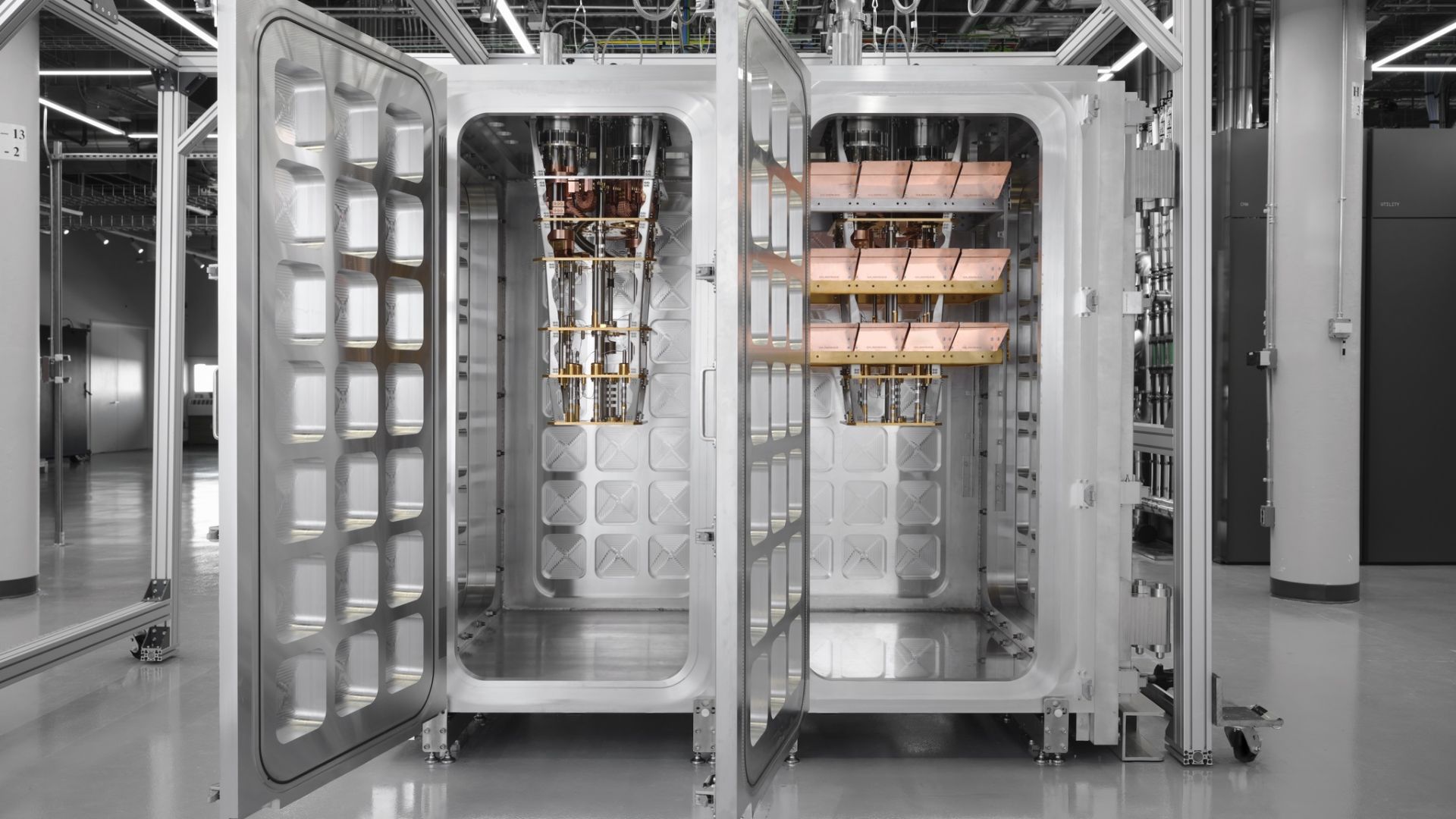
Computing major IBM has unveiled its first modular cryogenic quantum fridge, which can be joined to create a single cooled environment that can handle hundreds of quantum chips. The cryogenic system, capable of cooling below 15 milliKelvin, is an important milestone as IBM works to release its large-scale fault-tolerant quantum computer by 2029. Quantum computers are regarded as the next frontier of computing, promising large-scale computations in a fraction of the time needed by the fastest supercomputers today. Unlike silicon-based computers that use binary bits, which can store only 0 or 1, quantum computers use quantum bits, which can store multiple values between 0 and 1 and carry out computations in parallel, exponentially increasing their computing power. Quantum bits, or qubits, usually work at extremely low temperatures, near absolute zero. Achieving this is a challenge but one that researchers have perfected using multi-stage devices called dilution refrigerators. The qubits operate inside chambers where temperatures are ultra-low, but the complex architecture of refrigeration and computing infrastructure make it difficult to build large-scale quantum computers. How IBM is solving this problem IBM has made a major design change to its existing cryogenic systems by moving to a rectangular form factor. The change is meant to enable denser integration of readout and control wiring and simplify coupling between adjacent cells, giving more room for quantum processors. The design change is also intended to separate components and subsystems so that they can be independently optimized in the future, even as the density of wiring, refrigeration, and quantum devices increases. In a recent demonstration, IBM combined two operational modules of its new cryogenic quantum refrigeration systems and showed how they could join forces to cool down to 4 Kelvin in under five days and final temperature of below 15 milliKelvin soon after. These are temperatures 180 times colder than deep space, and the module still delivers 12 times more wiring space than previous iterations of IBM’s systems, facilitating more chip-to-chip connections, within and outside the modules. Standing more than eight feet (2.4 m) tall and eight feet wide, these modules also use IBM’s L-coupler technology to link directly with the quantum processors. The technology allows multiple quantum chips to communicate, share information and operate together as part of a larger quantum computer. The L-coupler technology is key in IBM’s quantum roadmap as it looks to build a larger quantum computer with at least a 1,000 programmable qubits by 2027. Working towards this goal, IBM will install its NightHawk quantum processors into these new cryogenic modules later this year and begin operational testing. For its plan to release a large-scale quantum computer by 2029, IBM intends to house thousands of qubits in each of these cryogenic modules. “Bringing fault-tolerant quantum computers to industries depends on several fundamental advances,” said Jay Gambetta, Director of IBM Research in a press release shared with Interesting Engineering. “The successful connection and operation of these cryogenic modules signals a leap forward in that direction and will accelerate our progress alongside continued innovation in quantum hardware, software, and algorithms.” In addition to hardware, IBM is also focused on software required for a fault-tolerant quantum computer. Last year, it released a new error correction code that reduces the physical resources needed to achieve fault tolerance, the press release added. Get the latest in engineering, tech, space & science - delivered daily to your inbox.Ameya is a science writer based in Hyderabad, India. A Molecular Biologist at heart, he traded the micropipette to write about science during the pandemic and does not want to go back. He likes to write about genetics, microbes, technology, and public policy.
IBM’s cryogenic system can link hundreds of quantum chips, 180 times colder than deep space
Full Article
Original Source
Read the full article at Interestingengineering →KhanList aggregates and links to publicly available news content. We do not host full articles from third-party sources. Always verify important information with original sources.