
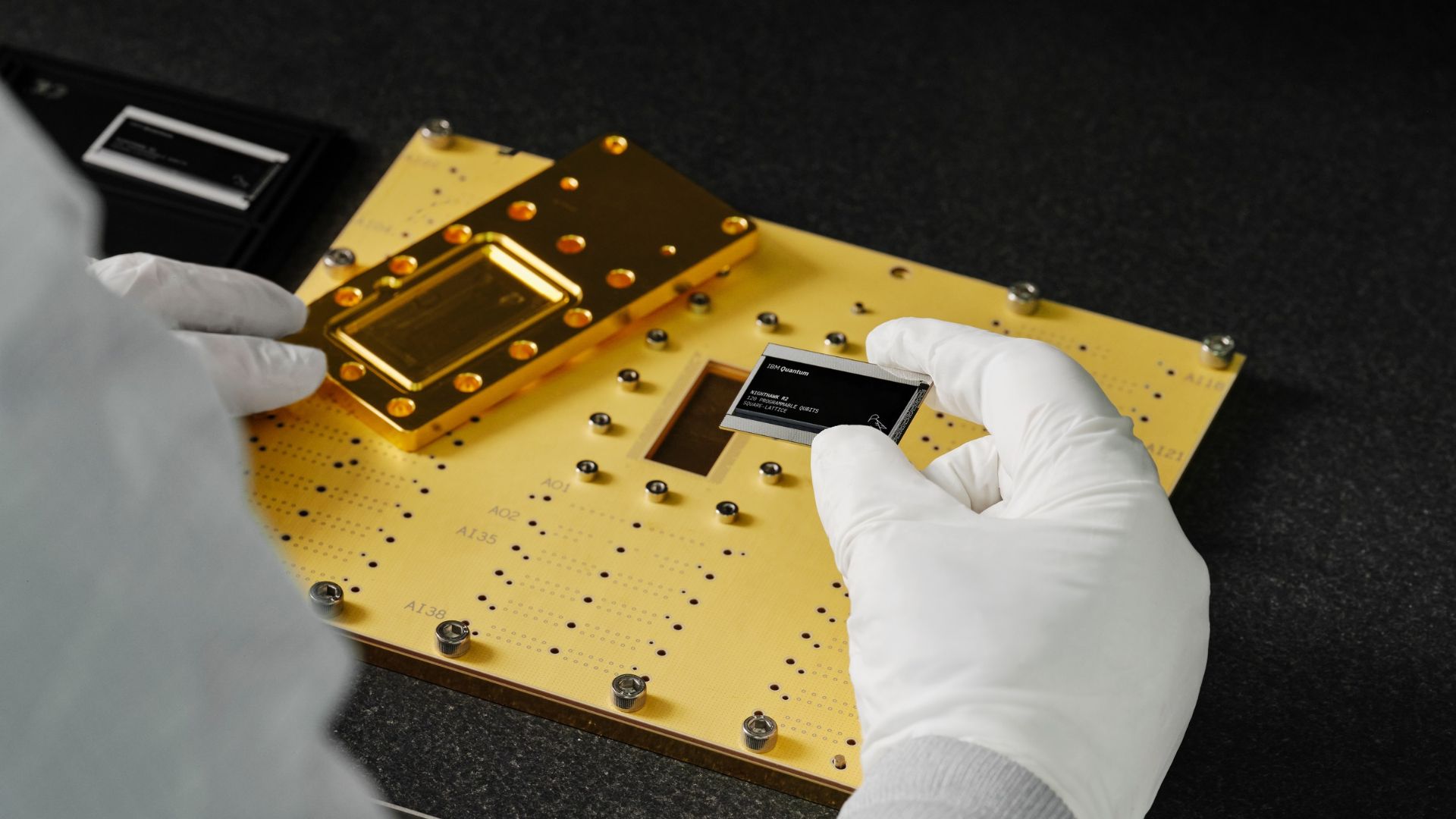
IBM plans to connect two next-generation quantum processors into a single system with 1,040 qubits in 2027. The proposed system will use the company’s upcoming Nighthawk r3 architecture. Each processor will support 520 programmable qubits and execute up to 10,000 quantum operations. The announcement signals IBM’s push toward larger quantum systems capable of handling increasingly demanding computational workloads. The company also reported substantial performance gains from its existing Nighthawk r2 processor. Industry partners have already executed more than 34 billion circuits on the hardware. Nighthawk pushes performance IBM’s current Nighthawk r2 processor has demonstrated significant improvements in quantum execution speed. Introduced in September 2026, the system can deliver up to 100,000 samples per second. It also supports computations involving more than 7,500 quantum operations across 120 qubits. Quantum applications often require millions or billions of samples to produce useful results. Faster execution allows researchers to complete demanding experiments without spending excessive time running individual circuits. Partners including German energy company E.ON, Algorithmiq, and Q-CTRL have reported improvements of up to 19 times. E.ON, for instance, achieved a 15-fold speedup in quantum machine learning for electricity grid optimization. IBM also used Nighthawk r2 to accelerate a magnetic materials simulation conducted with Oak Ridge National Laboratory. The experiment ran 12 times faster than its earlier implementation on IBM’s Heron processor. An experiment with Algorithmiq delivered another notable result. Nighthawk r2 executed circuits eight times faster than the original Heron-based experiment. The updated computations also presented a greater challenge for classical simulation methods. Connecting quantum processors Nighthawk r3 will introduce additional hardware capabilities to support larger systems. Its design includes 2,034 physical qubits, alongside 520 programmable qubits. IBM will retain the square-grid connectivity found in the previous generation. The processor will also feature 10 chip-to-chip connections called l-couplers. These components allow separate quantum processors to exchange quantum states. That capability could help IBM expand computing capacity without relying on a single increasingly large chip. IBM has already demonstrated the technology through an earlier connection between two Nighthawk r1 processors. Four l-couplers achieved 99.3% quantum state transfer fidelity. The company is working toward a target of 99.9%. Its next milestone involves connecting two Nighthawk r3 processors in 2027. The resulting 1,040-qubit system would represent another step toward larger quantum architectures. Quantum joins classical computing IBM is also changing how researchers access computing resources through its enhanced Quantum Platform. The environment now brings quantum processors and classical high-performance computing resources together. Researchers can coordinate quantum workloads with conventional computing systems. These resources help handle error correction, noise analysis, and processing after quantum measurements. Early results suggest the integration can improve research efficiency. IBM and RIKEN scientists completed an existing sample-based quantum diagonalization workflow roughly five times faster. They also performed 100 times more computations than their original study. Cleveland Clinic and RIKEN used the platform to process 608 million samples for modeling biological structures. Workflow automation helped complete the task 33 times faster.IBM’s broader roadmap targets fault-tolerant quantum computing. Reaching that goal will require increasingly capable processors and tighter integration with classical computing infrastructure.Get the latest in engineering, tech, space & science - delivered daily to your inbox.Aamir is a seasoned tech journalist with experience at Exhibit Magazine, Republic World, and PR Newswire. With a deep love for all things tech and science, he has spent years decoding the latest innovations and exploring how they shape industries, lifestyles, and the future of humanity.
IBM to merge two powerful quantum chips into a 1,040-qubit system for bigger workloads
Full Article
Original Source
Read the full article at Interestingengineering →KhanList aggregates and links to publicly available news content. We do not host full articles from third-party sources. Always verify important information with original sources.