
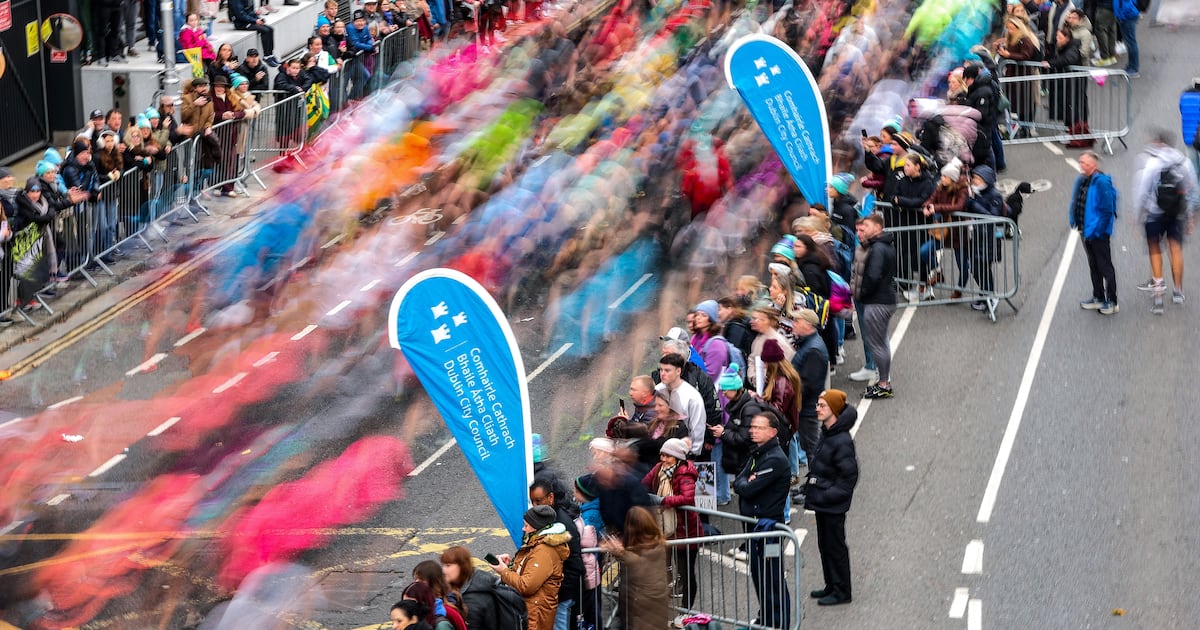
Some people might be slightly better off, others possibly even worse off, but typically not by much. And that, most insiders will tell you, is everything there is to know about Tuesday’s budget.Even with that overall package of €8.5 billion – with €7 billion in additional spending, and €1.5 billion in tax reductions – it probably won’t amount to anything much to begin with. Especially when set against the daily reminders that the price of everything is going up and in most cases is never coming back down.That doesn’t mean there isn’t still some value to be found. Particularly in the sporting realm. The announcement earlier this week that the Dublin Marathon entry fee for next year was going up by €20, the first price hike in five years, was probably met by most runners with reluctant acceptance. At €130, it still represents relatively good value compared with the $358 (€318) international entry fee for next month’s New York Marathon. Or the £225 (€265) international entry fee for the 2027 London Marathon. Which, incidentally, includes a carbon-offset fee for international travel. READ MOREThe Dublin organisers have again capped the race entry at 22,500 runners, keen to retain some level of quality over quantity, even if demand for running entries is far outpacing supply. At €130, most runners would also see that entry fee as a reasonably small investment in their own health and wellbeing, both physical and mental. Not everyone would see running (42.2km) that way, although most runners must be perfectly content they are getting a positive return on that investment. Otherwise, they wouldn’t keep coming back for more.Perhaps it’s time for the Government to also take that considered view when looking at the bigger picture of sporting investment in this country. There’s been enough talk about the mixing of sport and politics over the last seven days to realise they’re somewhat inseparable, and that holds true away from the field of play too.Among the various sporting representatives making their cases to Ministers before Tuesday’s budget were the Gaelic Players Association (GPA), who are seeking a €700 increase in the annual player support scheme, from €1,800 to €2,500. This would mean an additional annual investment of €2.8 million.Gaelic Players Association members Niall Morgan, Gemma Begley, Tom Parsons and Aisling Maher. Photograph: Laszlo Geczo/Inpho After meeting the Minister for Culture, Communications and Sport, Patrick O’Donovan, GPA chief executive Tom Parsons said “in the overall scheme of things, it is a modest increase, but for players meeting the costs of petrol, food, travel and the everyday demands of representing their counties, it would be meaningful”.Parsons pointed out the value of this investment wasn’t just monetary: “It would also be an important statement of parity of esteem and recognition of the commitment required. We see the pride and belief that All-Ireland success can generate across an entire county and the inspiration it provides to the next generation … That social and community value is an important part of what intercounty players contribute to Irish life.”There is also a joint submission by Swim Ireland and Ireland Active calling for a dedicated local authority swimming pool fund as the first phase of a 10-year national investment programme, valued at approximately €1 billion. This is not a modest investment, but is one small step towards the development, replacement and refurbishment of swimming pools across the country.Last December, Swim Ireland published its Swimming Pool Gap Analysis Report, which, among many things, highlighted the fact at least a quarter of the swimming pools in the State are more than 35 years old, thus coming to the end of their lifespan, while just 2.5 per cent of public pools were built in the last five years. The enduring lack of Olympic-sized pools is particularly galling. Swim Ireland's reported highlighted the lack of adequate swimming pools across the State. Photograph: James Crombie/Inpho The report also found that 73 per cent of facilities providing swimming lessons have waiting lists, with 57 per cent being hotel pools, which in most cases offer restricted access only. All this despite swimming being the country’s second most popular participation sport, with more than 350,000 adults taking part each week. “The evidence is clear,” said Mary McMorrow, interim chief executive of Swim Ireland. “We need a long-term plan to expand and modernise Ireland’s swimming infrastructure so that everyone has the opportunity to learn to swim, stay active and participate in their community.”Again, this is not just another monetary investment in sporting facilities but, according to Swim Ireland, “an investment in public health, inclusion, education and community wellbeing”.Also well-flagged in advance of the budget is the proposal from the Olympic Federation of Ireland’s athletes’ commission for a new tax break across all Irish sport that would allow for a €50,000 annual tax credit that athletes could use during or after their sporting career. That proposal doesn’t necessarily require any additional Government investment, beyond the very minor shortfall in tax revenue, yet could go a long way towards keeping more Irish athletes in the high-performance end of sport for longer. [ Three alternative Budget 2027 plans with one thing in common: spend, spend, spendOpens in new window ]Any one or all of these sporting proposals should also offer excellent value when set against the soaring costs in our health services, which are running at more than €27.4 billion a year. Last week, the Dáil’s Public Account Committee heard the 2026 deficit could reach €1 billion by the end of this year. Which is no surprise, given almost every year, bar rare exception, health requires a supplementary budget of some sort.For 2025, the top-up was €2.1 billion on its initial allocation of €25.8 billion. Given the increased 2026 budget allocation of €27.4 billion is already being overrun, it’s likely this pattern of chronic overspending is set to continue.This is also where investment in sport can help make a long-term difference. This should be clear to any Ministers with a good understanding of the health, and in turn the wealth, of the nation.
Ian O’Riordan: Does the Government truly understand the value of sport?
Full Article
Original Source
Read the full article at Irishtimes →KhanList aggregates and links to publicly available news content. We do not host full articles from third-party sources. Always verify important information with original sources.