
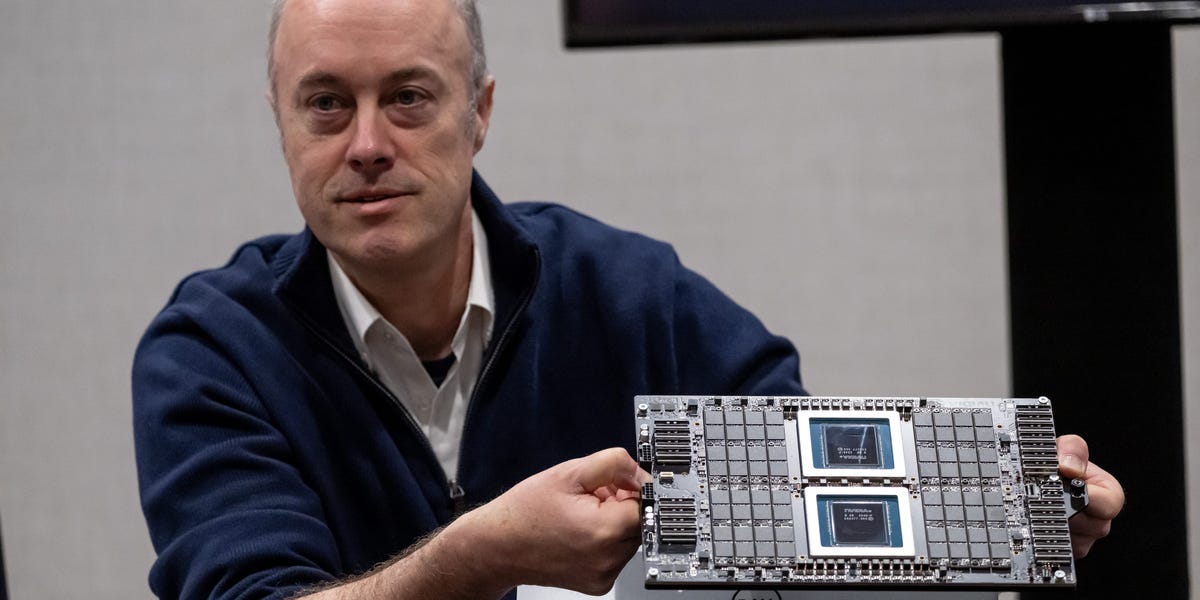
Ian Buck has spent his career building CUDA, Nvidia's most important software. Bloomberg/ Getty Images Editor's note: This story was originally published in June of 2025, but has been updated to reflect Nvidia CEO Jensen Huang's resignation. As Nvidia enters its post-Jensen Huang era, one of the people best positioned to shape its future is the engineer who helped build its moat. Ian Buck has spent more than two decades at Nvidia, and created CUDA, the once-obscure software platform that has since become the foundation of the AI boom.The 48-year-old's contribution to Nvidia is hard-coded into the company's history. He's been working alongside Huang since 2004, when he started building the company's breakthrough software, CUDA. Back then, the team had two people and two libraries. Today, CUDA supports more than 900 libraries and artificial intelligence models. Each library corresponds to an industry using Nvidia technology.Especially in light of Huang's departure, Buck's influence is just beginning. CUDA is the platform from which Nvidia jumped to, at one point, 90% market share in AI computing. CUDA is how the company defends its moat.It's the heft of Buck's contribution that has led industry analysts and onlookers to repeatedly cite Buck in discussions of a possible successor to Huang, even long before one was needed. CUDA started with two libraries. It now has more than 500. AP Photo/Nic Coury One architecture to rule them allDion Harris, Nvidia's senior director of high-performance computing and AI factory solutions, sometimes forgets that he's in the room with the Dr. Ian Buck. Then it hits him that his boss, and friend, is a computing legend.Since Buck's undergrad days at Princeton in the late 1990s, he had been focused on graphics — a particularly punishing field within computer science with no obvious connection to AI at the time."Computer graphics was such a dweebie field," said Stephen Witt, the author of "The Thinking Machine," which details Nvidia's rise from obscurity to the world's most valuable company."There was a stigma to working in computer graphics — you were maybe some kind of man-child if this was your focus," Witt said. While pursuing his Ph.D. at Stanford, Buck connected multiple graphics processing units to push them to their limits. He had interned at Nvidia before pursuing his Ph.D., so he was familiar with the GPU. Initially, he used it for graphics like everyone else.Buck has said that he and his cohort would use the chips to play video games such as "Quake" and "Doom," but eventually, he started asking himself what else his gaming setup could do.He became fixated on proving that you could use GPUs for anything and everything. He received funding from Nvidia and the Defense Advanced Research Projects Agency, among others, to develop tools to turn a GPU into a general-purpose supercomputing machine. When the company saw Brook—Buck's attempt at a programming language that applied the power of GPUs beyond graphics, Nvidia hired him.He wasn't alone. John Nickolls, a hardware expert and then director of architecture for GPU computing, was also instrumental in building CUDA. Buck may have been forever paired with Nickolls if the latter had not died from cancer in 2011."Both Nickolls and Buck had this obsession with making computers go faster in the way that a Formula 1 mechanic would have an obsession with making the race car go faster," Witt told BI. (The author said Huang expressed frustration that Nickolls doesn't get the recognition he deserves since his passing.)Buck, Nickolls, and a small team of experts built a framework that allowed developers to use an existing coding language, C, to harness the GPU's ability to run immense calculations simultaneously rather than one at a time and apply it to any field. The result was CUDA, a vehicle to bring parallel computing to the masses.The rise of CUDA as an essential element in the world of AI wasn't inevitable. Huang insisted on making every chip compatible with the software, even though hardly anyone was using it, despite it being free. In fact, Nvidia lost millions of dollars for more than a decade because of CUDA.The rest is lore. When ChatGPT launched, Nvidia was already powering the AI computing revolution that is now the focus of trillions in infrastructure spending, much of which eventually goes to Nvidia.King of the nerdsBuck's smarts do have limits. He joked to an eager audience at GTC in 2025 that quantum chromodynamics, a field of particle physics, just won't stick in his brain. But he thrives in Nvidia's notoriously rigorous environment.Under Huang, the Santa Clara, California, company has maintained an intense culture that eschews one-on-one meetings and makes missteps and disagreements public. It might sound terrifying, but for those with the brains to keep up, the directness and the rigor are ideal.For this report, Business Insider spoke with four people who have either worked directly with Buck at Stanford, Nvidia, or both. Those who know Buck personally describe him as gregarious and easygoing but capable of intensity when goals are on the line. He's focused on results rather than theory.In his public remarks, at panels and in interviews on behalf of Nvidia, Buck volleys from rapid, technical lines of thought to slower, simple descriptions in layman's terms.At a GTC press conference, he detailed the latest development in convolutional neural networks and then described proteins as "complicated 3D squigglies in your body." He describes the tiny, sensitive interconnects between parts of an Nvidia chipset like the Geek Squad explaining the back of a TV from memory — it's all in his head.Harris said storytelling ability is particularly important in the upper ranks at Nvidia. Since the company essentially had a promising technology waiting for a market for years, Huang saw being early as a business strategy. He branded it "going after zero billion-dollar markets." The potential of AI, "AI factories," and the infrastructure spending that goes with them is a story Nvidia can't stop telling.Buck's shilling skills have improved over the years. But even in 15-year-old footage, he's most animated when explaining the inner workings of Nvidia's technology."A lot of developers are amazing, but they say, 'Leave me alone. I'm going to write my code in the mountains somewhere," Paul Bloch, president of Nvidia partner DDN, told BI. Nvidia's leaders aren't like that, he said. Much of Nvidia's upper echelon may have the skills to match the reclusive set, but they don't choose between showmanship and code.Ian Buck's next actIan Buck's work at Nvidia began with a simple mandate: make the GPU work for every industry. That mission is very nearly accomplished. There are hundreds of CUDA libraries targeting industries from weather forecasting to medical imaging."The libraries are really there to connect the dots so that every business doesn't have to learn CUDA," Harris said.CUDA draws its strength from millions of developers, amassed over decades, who constantly innovate and improve on the platform. So far, no one has caught Nvidia's heels, but the competition is coming faster than ever.Even as Buck spoke at GTC in 2025, developers across the world were trying to break through CUDA's dominance. The first night of the conference, a cast of competitors convened by TensorWave, an AI cloud company exclusively using chips from Nvidia's only US rival, AMD, held an event entitled "Beyond CUDA."TensorWave cofounder Jeff Tatarchuck said it included more than "24 presenters talking about what they're doing to overcome the CUDA moat." New startups looking to crack CUDA are still fundraising, too.AMD, which also presented at the event, is making an explicit effort to catch up on the software side of AI computing, but industry analysts say they're not there yet. And despite the rise of coding agents capable of writing CUDA kernels, demand for human CUDA engineers continues to grow. There have been more jobs requiring CUDA skills posted in 2026 than in 2025, according to the labor analytics platform Lightcast.Harris told BI that Buck's team spends a lot of time speaking with researchers to stay on top. That's always been true, but the nature of the work has changed. A decade ago, Buck was convincing researchers to apply accelerated computing to their problems; now the tables have turned."One of the most challenging parts of my job often is to try to predict the future, but AI is always surprising us," Buck said at a Bank of America conference in 2025. Understanding what the smartest minds in AI need from Nvidia is paramount.Many saw DeepSeek, the company that spooked markets last year with its ostensibly cheap reasoning AI model, as a threat to Nvidia since it achieved competitive results with less compute, not realizing that the team went deep into CUDA to squeeze out those gains. Buck described the Chinese team as "one of the best CUDA developers out there."AI is entering a new phase as more companies commercialize their tools. Even with Nvidia's enormous head start, in part built by Buck, the pace is intense.Talent is also a big part of how Nvidia is going to try to maintain its dominance, and another place where, Witt said, Buck has value beyond his technical skills. He's not exactly a household name, even at Stanford. But for a certain type of developer, the ones who can play in Buck's extremely complex sandbox, he is a draw."Everyone's trying to hire these guys, especially after DeepSeek," said Witt. "This was not a sexy domain in computer science for a long time. Now it is white hot." Huang's departure will make that side of his role even more important as several industry analysts have expressed concern that Nvidians may be more likely to leave the company now. Historically, Nvidia has had an extremely low rate of staff turnover.Nvidia declined to make Ian Buck available for an interview with Business Insider and declined to comment on this report.Who's Nvidia's next CEO?Buck is more than a decade younger than Huang and has been part of the Huang succession discussion long before the current scandal.Lip-Bu Tan, a semiconductor industry legend who became Intel's CEO in 2025, told BI that Buck was one of a handful of true collaborators for Huang, who has more than 60 direct reports."Jensen has three right-hand men," Tan told BI before he took over at Intel. Buck is one. Vice President of GPU Engineering Jonah Alben is another. And CFO Colette Kress, though clearly not a man, is the third, Tan said. Kress was appointed interim CEO by Nvidia's board Tuesday."Prediction markets have identified Rene Haas, former Nvidia VP and current CEO of Arm, as a potential external replacement, in addition to internal candidates Colette Kress and Ian Buck, head of Nvidia's AI efforts," said Brian Colello, Senior Equity Analyst at Morningstar, in an email Thursday."I don't think Ian spends a lot of time doing business strategy. He's more like the world's best mechanic," Witt said in 2025. Read next Business Insider tells the innovative stories you want to know Business Insider tells the innovative stories you want to know Business Insider tells the innovative stories you want to know Business Insider tells the innovative stories you want to know Emma Cosgrove is the Editorial Director of AI innovation. She acts as a coach, trainer, editorial advisor, and company-wide partner on all things AI at Business Insider. Previous to her current role, she was a senior reporter covering Nvidia, GPUs, and the broader AI ecosystem. She was also a 2023-2024 Knight-Bagehot Fellow at Columbia Journalism School, where she focused on machine learning. Before joining Business Insider's tech team, she covered logistics companies like UPS and FedEx with a focus on e-commerce. She also covered the supply chain turmoil brought on by the pandemic and she was a lead reporter on Insider’s 2022 SABEW award-winning “Warehouse Nation” project.Selected Stories: Jensen Huang shot down comparisons to Elon Musk and yelled at his biographer. The author told BI what Huang is like.Ian Buck built Nvidia's secret weapon. He may spend the rest of his career defending it.'Let chaos reign': AI inference costs are about to plummetShe took down Intel. Now AMD's CEO has a new miracle to perform.'Burn the boats': To stay at the bleeding edge, AI developers are trashing old tech fastDeepSeek is driving demand for Nvidia's H200 chips, some cloud firms sayThe big switch to DeepSeek is hitting a snagThe Columbus, Ohio, Warehouse Boom: How warehouses brought stifling dust and diesel fumes — and a chance for refugees to grab the American dream Artificial Intelligence Technology Software More Tech AI
Ian Buck built Nvidia's secret weapon. Jensen Huang's departure makes it even more essential to the company's future.
Full Article
Original Source
Read the full article at Businessinsider →KhanList aggregates and links to publicly available news content. We do not host full articles from third-party sources. Always verify important information with original sources.