
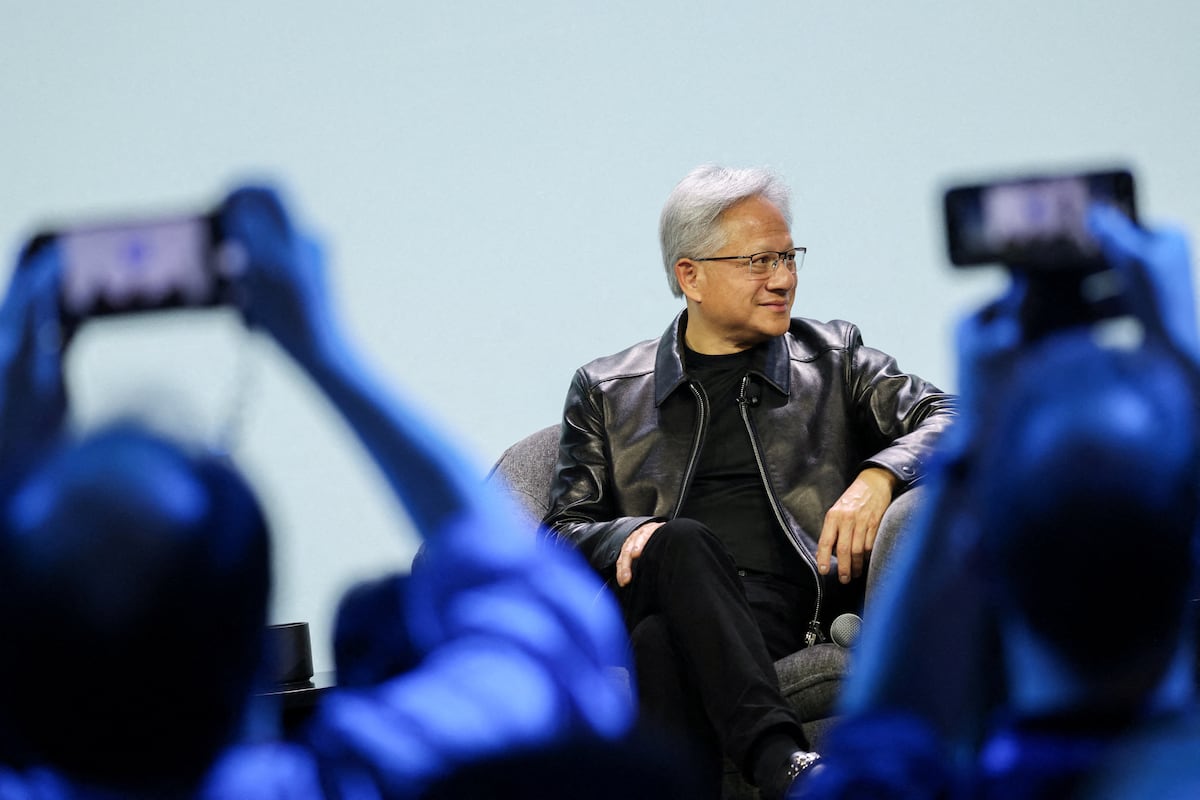
Jensen Huang is the central figure in one of those epic tales of grit and glory that helped cement the American myth of opportunity: a young, wealthy, untamed country where anything is possible with hard work. Born in Taiwan in 1963, he arrived in the United States at age nine with his brother as an unaccompanied minor to join an uncle in Washington State, but the uncle mistakenly placed him in a religious reform academy in Kentucky for troubled youth. Their parents managed to emigrate two years later and the family reunited in Oregon, where Jensen excelled academically and got his first job bussing tables at Denny’s. He graduated in electrical engineering two years ahead of schedule. In college, he met Lori Mills, one of the few women studying in that field, and they married.Years later, in 1993, he picked a Denny’s in California as the place to sketch out, along with two partners, what would become the world’s most valuable publicly traded company and the cornerstone of the artificial intelligence (AI) boom: a company that began with a focus on video games but now designs and sells semiconductors (chips) with massive data-processing capacity and an almost monopolistic market dominance. They named the venture Nvidia, a variation of the Latin word invidia (envy). Three decades later, it would be other cardinal sins that would bring down the founder and turn this epic ‘made in USA’ story into a grim saga with geopolitical consequences and colossal economic losses.Jensen Huang was forced to resign on Thursday after 33 years at the helm of Nvidia, after an extramarital relationship with a Chinese businesswoman Alice Huang — who shares his surname but is not related — was revealed; she is accused by U.S. intelligence of being a spy for China. Authorities believe the woman provided Beijing with information about the multinational and about America’s AI strategy, and that she bought microprocessors through her Singapore-based company, Megaspeed, to send to China while evading the U.S. export ban.Jensen Huang, who remains married to Lori, initially clung to his post, but other affairs with his employees later emerged (he has admitted to one), which violated company policies and ultimately cost him his job.“It was a shock; Nvidia already had other dark clouds overhead, such as the risks of circular financing, the stock price, and worries that the Democrats [after their win in the midterms] would eliminate investment tax breaks, but these women, the possible spy… It sounded like a movie,” says Daniel Morgan, a fund manager at Synovus, which holds Nvidia shares, says in a phone conversation. After the scandal, roughly two trillion dollars of the company’s market value evaporated — approximately equal to Spain’s entire gross domestic product. The collapse has cast doubt across the sector, because the firm is more than a tech giant: Nvidia poses a systemic risk as a lender to other companies and as a critical supplier to OpenAI, Anthropic, Google, Meta and Amazon.Now Huang faces serious problems, such as FBI investigations and congressional probes that will try to determine how much China — America’s perennial rival in the tech and trade race — knows, and whether the company’s founder was merely a victim of espionage or also a willing collaborator, after reportedly pressing Donald Trump to lift the semiconductor export ban. He also faces a raft of lawsuits from very, very angry investors who lost money. Daniel Morgan puts it in perspective: “Since we invested five or six years ago, the share price has multiplied tenfold and now [after the plunge] is still worth six or seven times more, so we don’t feel any panic, and our clients see it the same way,” he explains.A singular careerThe tech giant’s rise was forged by ingenuity, boldness and a few fiascos that nearly bankrupted the company. Nvidia began in the 1990s making chips for graphics cards aimed primarily at the video game market, but those GPUs (graphics processing units) proved spectacularly efficient at handling large volumes of data, so they were soon marketed for supercomputing as well. Huang found the key around 2013, when he decided to bet the company’s future on a technology, AI, that few trusted at the time.The breakout of the new technology proved him right: Nvidia’s revenue is estimated at about $400 billion for this fiscal year, compared with less than $27 billion just four years ago — a colossal leap unmatched even in the excessive world of Silicon Valley — and it achieved this with gross profit margins of about 70%, according to Bloomberg. Its product, more powerful than the central processing units (CPUs) typically used in computers or phones, has been nearly unbeatable in the market.But before that, Jensen Huang learned his trade by failing. His first gaming chip used square textures instead of the customary triangular shapes, but shortly after its launch Microsoft announced its systems would only work with triangular formats. As he recounted three years ago in The New Yorker, he had to lay off more than half the staff, put the remaining company funds into launching a microprocessor without being sure it would work, and cross his fingers. They had money left to pay only one more month of salaries. It worked.Leadership and successionIt was 1996; he had been leading the company for three years. His partners, the designers Chris Malachowsky and Curtis Priem, had chosen him as CEO despite him being the youngest one of the three. As would later be evident, he had a special gift for communication, sales and branding. Before Nvidia existed, Lori — by then Lori Huang — had worked as an engineer in Silicon Valley. “In fact, she made more money than I did,” Huang told The New Yorker. He was still employed elsewhere at the time and studying at Stanford at night. A few years after they married, he left his job to raise their two children, Cameron and Spencer, who now also work at the company, as does his son-in-law, though none appear destined to take over.That an empire like Nvidia, exposed to so many financial and security risks, apparently lacked a clear succession plan can only be explained by Huang’s idiosyncratic hierarchical model. Rather than a small group of heavyweights from which the rest of the structure cascades, he had some 60 executives reporting directly to him—an unusual arrangement. As David Larcker, a corporate governance professor at Stanford, says, that is very unusual. In his view, the billion-dollar question is whether the company will continue to succeed without Huang. “How many people in the world could actually run Nvidia successfully? I suspect the number is a single digit, but who knows,” he notes.Beyond this flat structure centered on one man, Huang had a highly personal, detail-obsessed leadership style. He wrote terse emails all day to half the company, used to pop into employees’ cubicles unannounced to see how they were working, and cultivated a sort of cult of failure, organizing large presentations so executives could share and learn from mistakes.He venerates sacrifice. In March 2024, at a Stanford talk, the moderator asked Jensen Huang for advice for students in the room seeking success. The company’s CEO spoke of “pain.” “Greatness comes from character, and character is formed from suffering… So for all you Stanford students, I wish upon you ample doses of pain and suffering,“ he said.He said it with aplomb — after all, he had indeed endured a respectable measure of suffering in his life — but the man speaking seemed different. At 61 then (he is now 63), comparisons with older photographs show a rejuvenated, fitter man, dressed all in black, wearing a leather jacket that had become a personal trademark and sporting athletic shoes. A loquacious and immensely wealthy man: the value of his Nvidia holdings alone is still above $135 billion. The connectionsBy that time, he had already begun seeing Alice Huang. Although it is not confirmed when their romantic relationship started or when they first met, they were first seen dining together with others in December 2023 at a restaurant in Singapore. From June the following year, her company Megaspeed spent up to $4.8 billion on at least 200 shipments of Nvidia chips, according to an investigation by The New York Times.From January 2025, the owner of Nvidia also began meeting Trump in person; he even traveled with the U.S. president to the Middle East and China and pressured him to allow chip sales to the Asian giant. In July, the government lifted restrictions, and by October Trump had already received the first warnings about the possible spy at the heart of the chip giant.Alicia Huang, also known as Huang Le, is now in China. And Jensen Huang’s recent actions are now being scrutinized with great suspicion. If on the U.S. West Coast Jensen Huang was a guru — almost a deity whom Mark Zuckerberg called “the Taylor Swift of technology” — on the other side of the country skepticism was growing about his open stance toward Beijing. Steve Bannon, Trump’s former far-right adviser, went as far as calling him an “agent of influence of the Chinese Communist Party” who should be “arrested.”Another person who was not surprised was a 31-year-old trader named Christian Lamarco, who on May 13 published a report warning of Nvidia’s ties to China and mentioning the troubling relationship with the Megaspeed executive. Meanwhile, Trump himself had been receiving warnings on the matter, and the U.S. Department of Commerce is now also under scrutiny.Huang’s case highlights the extreme vulnerability of a global stock market so dependent on a single industry that, in turn, relies overly on one company that is governed by one man who also had privileged access to the White House. The last danger of artificial intelligence lies in the human condition.Sign up for our weekly newsletter to get more English-language news coverage from EL PAÍS USA Edition
‘I wish upon you ample doses of pain and suffering’: The rise and fall of Jensen Huang, king of Nvidia
Full Article
Original Source
Read the full article at English →KhanList aggregates and links to publicly available news content. We do not host full articles from third-party sources. Always verify important information with original sources.