
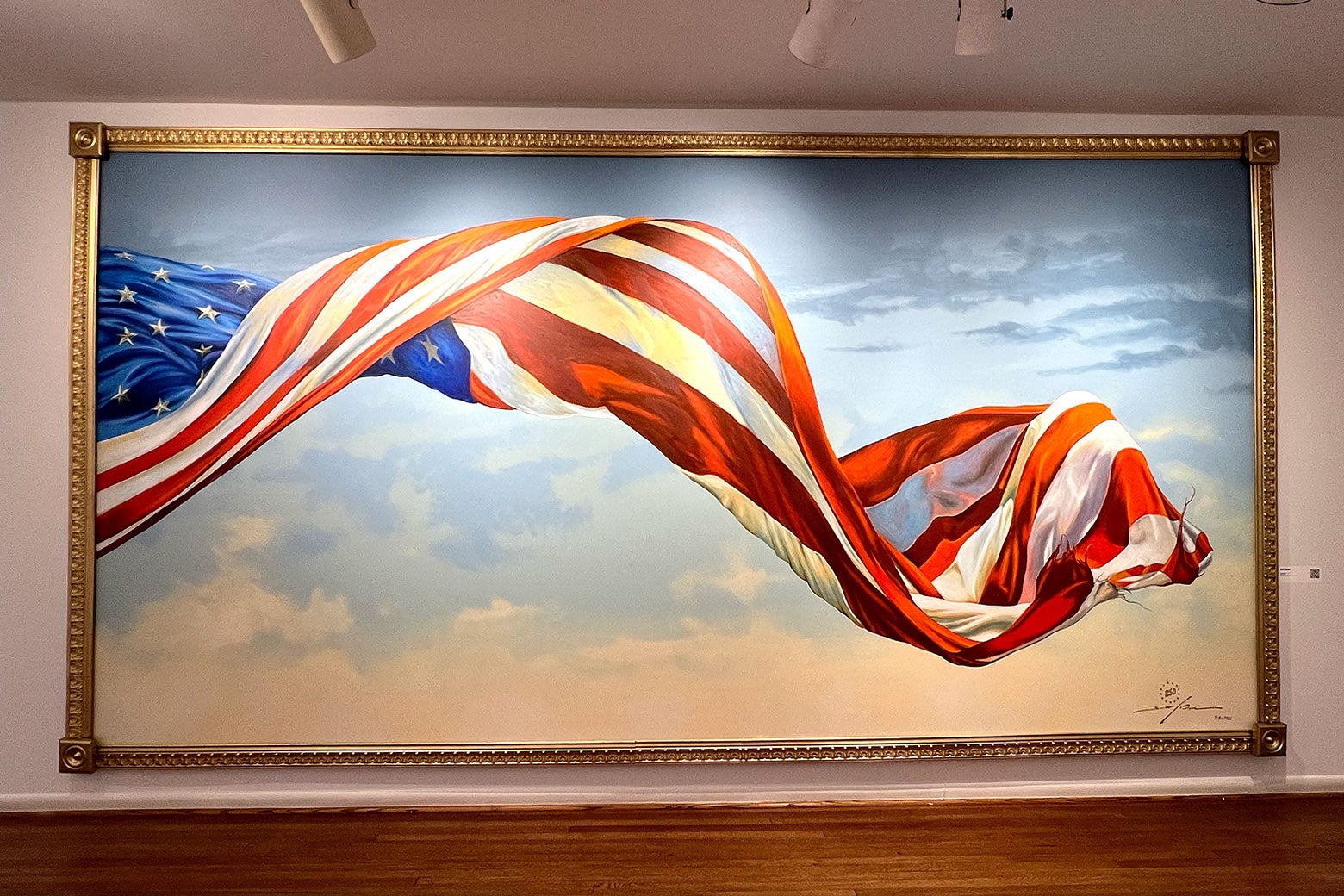
Wide Angle It was like a HomeGoods display around the Fourth of July. By Enter your email to receive alerts for this author. Sign in or create an account to better manage your email preferences. Unsubscribe from email alerts Are you sure you want to unsubscribe from email alerts for Christina Cauterucci? Aug 12, 202610:00 AM Christina Cauterucci Sign up for the Slatest to get the most insightful analysis, criticism, and advice out there, delivered to your inbox daily. Have you ever wanted to see John Adams’ facial pores? Examine the precise hairline of Alexander Hamilton’s unibrow? Admire the sheen of James Madison’s pillowy lips? Then you’ll love a series of portraits by Brandon Ralph currently on view in Washington, D.C. As part of an exhibition titled Passport to Patriotism: 250 Years of Diplomacy, mounted by the State Department at the Art Museum of the Americas, the blown-up images render the familiar faces of the Founding Fathers in granular detail. Ralph, who created the works by running famous paintings through an A.I. model that mimicked Ralph’s own photographic style, calls them the “first-ever photographic portraits” of America’s dads. I suppose one could take away something profound from the sight of George Washington’s stubble as imagined by a computer program. These were everyday men before they were icons, as age-spotted and fallible as you or I, perhaps better remembered through the unforgiving gaze of a large-format camera than the Vaseline-smeared lens of history. But Passport to Patriotism does not encourage such searching interpretations. A declaration of uncomplicated national pride, the exhibition comes as a rebuttal of sorts to Smithsonian displays that the Trump administration has deemed insufficiently flattering to the American ego. In this context, Ralph’s portraits read not as an invitation to ponder the founders’ imperfections but as a symbol of Donald Trump’s war on the arts. The president has installed handpicked Kennedy Center leaders who may shutter the venue for years; multiple Smithsonian museums have revised their offerings to appease him. Like these arts institutions under Trump’s thumb, Ralph’s portraits are hasty rejiggerings of artistic treasures, modified to allow him to place his own cheap imprint on something someone else made. Corazón de Fer Freedom is Hope by Fer Da Silva. U.S. Department of State Some of the other works on view, such as Henri Reed’s paint-splattered canvas depicting an angry eagle in flight, are objectively hideous, and not in a deliberate, statement-making way. Some are merely amateurish, like a thickly daubed painting of a heart in turquoise and gold spangles by Fer Da Silva, a friend of the exhibition’s organizers who bragged in an Instagram video that the piece’s inclusion would raise its monetary value. Many pieces in the show, including a series of flag-centric watercolors by Barbara Ernst Prey titled Gallantly Streaming and God and Country, are the kind of technically adept but banal works you might find at a tourist gallery on the main drag of a seaside town. Taken together, the overarching impression is of a seasonal HomeGoods display around the Fourth of July. Visitors will not find any allusions to “diplomacy” here; the exhibition’s title is so totally out of step with its content, it must have been slapped on as an obligatory justification for State Department sponsorship. (The department helps fund the Organization of American States, an international body that runs the museum.) This is not the first time the museum’s programming has bent to accommodate the president’s agenda. Museum leaders canceled two shows last year after deciding that their focus on international Black and queer artists would run afoul of Trump’s executive order banning diversity, equity, and inclusion efforts. Now, in service of an ideology that brooks no deviation from blind nationalism, Passport to Patriotism advances a shallow vision of U.S. identity with all the nuance of a propaganda reel and all the sophistication of the art project your first-grader brought home on Flag Day. In fairness to the curators—and I use that term lightly—there are only so many ways to evoke the American project without nodding toward our diverse population, acknowledging potentially controversial moments in our history, or diving into challenging abstraction, all of which are no-gos in the Trump school of art. With such a narrow brief, the straightforward array of military references, celebrations of U.S. iconography, and interpretations of the flag—more than five dozen of them—comes as no surprise. The few abstract pieces on view function solely as decoration, seemingly selected for no reason other than their red, white, and blue color schemes. Wings of Liberty by Henri Reed. U.S. Department of State It will not shock you to learn that this MAGA art exhibition is the product of a cascade of underqualified nepotism hires. One of the organizers, Art in Embassies director Erin Scavino, is a former contestant on The Apprentice and the wife of Trump’s deputy chief of staff. The other is her friend, who owned a pet-food store before being tapped by Scavino for a top national arts post. According to reporting from the New York Times, the two women have personal connections to several artists in the show. The list of artists with links to the organizers also includes “positive energy” artist Brendan Murphy, who contributed two works: a gigantic steel astronaut installed outside the museum and a canvas covered in what might be described as a USA word cloud. On a sea of glitter—I cannot overstate the amount of glitter that appears in this show—lists of famous Americans (Michael Jackson, Robert De Niro, Tom Brady) join famous quotes (“I have a dream”), random affirmations (“we will find our own way”), inspirational words (“passion,” “vision”), and instructions (“stop whining,” “serve the flag”). As outsider art, it might have been compelling. From a guy who makes tacky NFTs and collectibles, it looks like a way to scam easily impressed collectors out of their money, or the State Department out of its arts funding. One is Romero Britto, who once made a custom portrait for the Scavinos and was a guest at their wedding. Britto’s three works in the show read as an intentional affront to the taxpayer, who will rue the public funds spent to display his juvenile, be-glittered doodles of hearts, stars, and (of course) U.S. flags. If I didn’t know better, I’d say his depiction of the Statue of Liberty clad in technicolor striped and polka-dotted rags offered commentary on the clownish state of our union. But since Britto is credited by exhibition materials as the “founder of the Happy Art Movement,” which is “less about critique, and more about celebration, joy and happiness,” I’m sure he just thought the clashing patterns looked fun. Liberty for All by Romero Britto. U.S. Department of State Desperate for relief from the monotony of so much literal art, my brain sought alternate interpretations. From afar, one flag sculpture on the wall looked like it was crocheted—perhaps a gesture toward the painstaking women’s work that built this country? Nope: Upon closer inspection, it was crafted from tens of thousands of hand-cast toy soldiers—perhaps an on-the-nose critique of the building of empire through violence? Well, considering that artist Kevin Champeny’s body of work includes portraits of Trump comprised of tiny middle fingers and a Charlie Kirk made from little Bibles and crosses, his intention was probably a bit simpler—and smugger—than that. I know, I know, the author is dead. The artistic objective of the soldier flag guy shouldn’t matter. But when the entire purpose of an exhibition is to strangle introspection and dissenting opinions through blunt-force art, the political loyalties of the artists gain new relevance. Would an outspoken Trump critic find her flag sculpture chosen for display? Freedom 250 by Brendan Murphy. U.S. Department of State Four anonymous sources associated with the show told the New York Times that not a single historian or art curator had a hand in the exhibition. It shows, and not just in the breathtakingly simplistic art on view. The artworks are simply labeled with the title, artist, medium, and a QR code leading to an artist bio, with no display copy to offer context or an entry point for interpretation. One placard fails to correctly list the materials used in the work; another’s QR code points to the wrong artist. A printed handout distributed at the entrance urges viewer engagement with such questions as “What is the largest artwork in the exhibition?” The most blatant curatorial failure comes in two rooms dedicated to photography. Each features the work of several different artists, whose names are listed in a row on the wall. As if it didn’t matter who created which images, the photos are mounted at random, creating a mishmash of trite Americana: a woman playing acoustic guitar in an Adirondack chair, a family in a pickup truck, a ride at a fair, a couple at a diner, a row of cowboy boots, so many uniformed military men. By tuning in to visual styles and subject themes, a careful viewer can guess at which selections came from the same photographer, giving them a greater sense of place and perspective. But absorbed as a whole, the rooms read as a collection of view-from-nowhere stock photos, as predictable as footage from a campaign ad. That’s the hard thing about staging an exhibition on patriotism. Any attempt to sum up the entirety of a nation in a single show would end up feeling reductive and thin. But Trump’s vision of national identity is reductive and thin. Whenever the MAGA movement has interacted with the arts, whether through programming or through censorship, it has communicated the idea that art is valuable only so far as it serves a specific political end. To Trump, art should stimulate nostalgia, reify a simplistic narrative, affirm a strict system of belonging and exclusion, maybe provoke a smile at a pretty color or an encouraging phrase. In the broadest sense, Passport to Patriotism is an embarrassing travesty of a public art exhibition. But on Trump’s terms, it’s exactly as it should be. Get the best of culture Get the best of movies, TV, books, music, and more. Art Donald Trump Museums District of Columbia
I Went to Trump Admin’s “Patriotic” Answer to the Woke Smithsonian Museum. Dear God.
Full Article
Original Source
Read the full article at Slate →KhanList aggregates and links to publicly available news content. We do not host full articles from third-party sources. Always verify important information with original sources.