
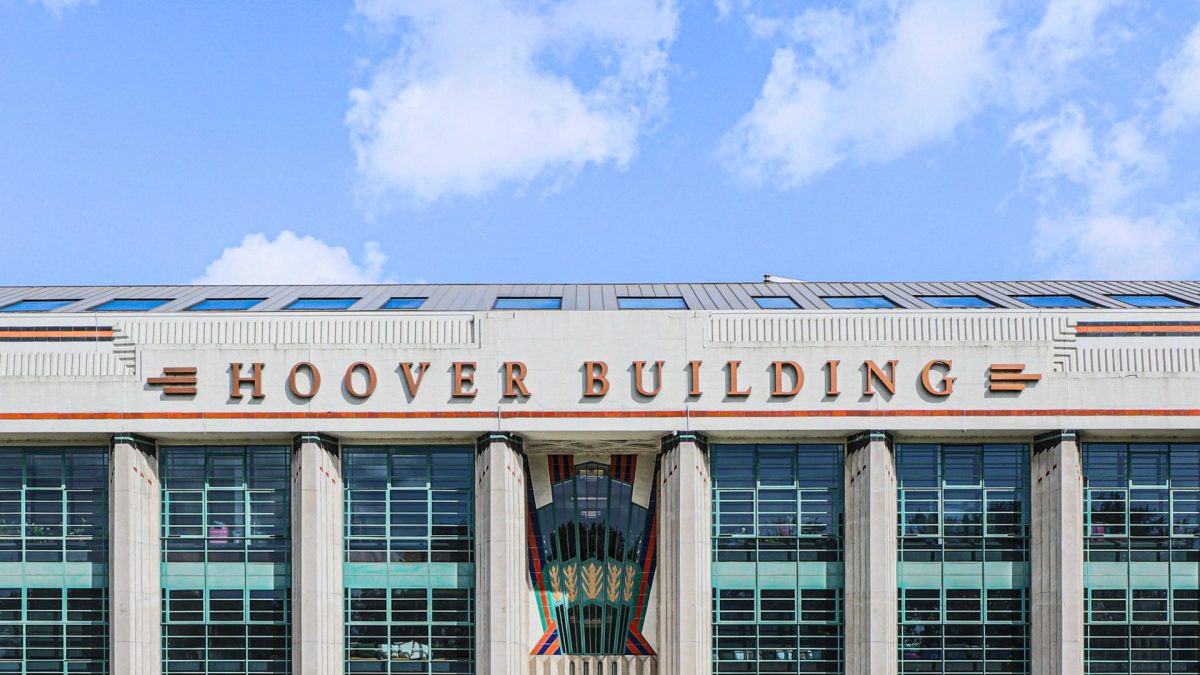
Suburbia makes us picture rows of identical houses. It conjures up images of people mowing their lawns, tending to their roses and washing their cars. It’s safe, homogeneous, maybe even a little boring. But look again and you’ll see a different world, one full of striking buildings, rich social history and early 20th-century ambition. For me, suburbia is inseparable from the great housing expansion of the 1930s, when vast new estates spread around the edges of Britain’s towns and cities. The legacy of that boom remains. Scattered among the houses are remarkable Art Deco buildings: bold structures built to embody a modern age. Nearly a century later, they still have stories to tell, connecting us to the generations who lived, worked and passed through them. I was raised in London’s suburbs and I couldn’t wait to grow up, get out, and start my adventures in what seemed like a far more exciting world. But when I returned to the ‘burbs years later, to raise my own family, I began to appreciate the buildings I’d taken for granted as a child: old cinemas, factories, town halls, lidos and tube stations. Shorts Then, one day, I passed an old Art Deco factory on the A23 that I hadn’t thought about in 30 years. I recognised it immediately and was transported to the backseat of my dad’s car in the 1970s, staring at the building through the streaks of rain on the roll-down window and wondering what had gone on inside. My memory made me wonder how many other interesting buildings were out there, what happened in them and, more importantly, what they meant to people today. Over the past four years, I have been on a mission to uncover these buildings and share their histories. I’ve documented my discoveries on Instagram, and in my book, I Love Suburbia. Here, I’ve narrowed them down to seven of my favourite suburban landmarks. 1) The Hoover Building, Perivale, West London – Wallis Gilbert & Partners, 1933 Some suburban buildings achieve something close to celebrity status. Few more so than the magnificent Hoover factory on the A40 (now used as apartments and a Tesco). Standing beside one of the capital’s busiest roads since 1933, commuters have crawled past it for decades. For countless children peering out from the back seat of a car, it was a reassuring milestone: the long drive back from holiday was nearly over. Seeing it today still triggers a pang of nostalgia for thousands of Londoners, and I have no doubt that, even today, it continues to make new memories for children stuck on the A40. Yet the Hoover Building was once much more than a roadside landmark. It was the heart of a thriving factory and the public face of a company that understood, unusually for the time, that workers who are treated well tend to work well. In the 1930s, employees enjoyed sports clubs, subsidised meals, outings to the seaside, family events and even inter-factory sporting competitions, including boxing matches. Apparently, nothing boosted workplace morale quite like watching accounts settle their differences in the ring. The Hoover Factory owed its location to one of the great transformations of inter-war Britain. During the 1920s, London’s new arterial roads opened up huge swathes of land for industrial development. Factories sprang up along these modern highways, bringing jobs with them. And where jobs appeared, houses inevitably followed. Not to be left out, London Underground recognised an opportunity. If roads could create new communities, railways could too. The network pushed ever further into the countryside, extending lines through what were, in some cases, quite literally fields. Fortunately, the executives of the day believed that public transport should look good. Stations were designed to embody speed, efficiency and modernity. 2) Arnos Grove Underground Station, Enfield, North London – Charles Holden, 1932 Arnos Grove station was surrounded by fields when it was built (Photo: Simon Pollock) This north London station was built in an area of mostly farmland and, with a design inspired by the most up-to-date architectural styles from Europe, it must have looked like something entirely alien had landed. It was among a collection of stations that were not only functional, but genuinely beautiful. Some looked elegant, others appeared futuristic and a few seemed as though they might have been designed after a boozy lunch. Before long, those “stations in fields” found themselves surrounded by new housing estates. These days, we’ve learned to appreciate these structures – Arnos Grove is Grade II listed, and one of 77 tube stations listed for protection in London. 3) Randalls Department Store, Uxbridge, West London – William Lionel Eves, 1939 Part of a 1930s shopping boom, Randalls still grabs attention in West London (Photo: Simon Pollock) By the mid-1930s, the capital was booming and suburbia spread across the surrounding countryside. And wherever thousands of new residents arrived, businesses followed, eager to part them from their hard-earned money. Architects rose enthusiastically to the challenge. Department stores, banks, showrooms and shopping parades appeared in the latest Art Deco styles, each trying to outshine the competition. In Uxbridge, for example, a striking new department store featured vast display windows that allowed passers-by to gaze directly into the furniture department, resulting in residents setting out to buy a loaf of bread and returning home with an impulsive pouffe purchase. Randalls remains one of the best examples of an Art Deco façade in London. This architectural exuberance wasn’t confined to the capital, however. Across England, newly expanding suburbs became testing grounds for ambitious designers. 4) Bournemouth Gas and Water Company Showroom, Boscombe, Bournemouth – A.J Seal and Partners, 1935 Bournemouth Gas and Water Company Showroom was more curvaceous than some other Art Deco-style shops (Photo: Simon Pollock) Take the gas showroom in Boscombe, Dorset, which is a little more in the “streamline modern” style, with its curvy windows contrasting with Randall’s angular look. This wasn’t merely a place to buy a cooker. It was a temple to modern living, where gleaming gas-powered appliances were displayed with all the glamour of luxury goods. 5) The Blue Peter Pub in Alvaston, Derby – Browning and Hayes, 1935 The Blue Peter has survived as a pub (Photo: Simon Pollock) Then there’s Derby, where several striking suburban pubs were built during the inter-war years. Three survive today, although one has become a Tesco and another has been converted into flats – a reminder that, in England, almost every historic building eventually becomes either a supermarket or apartments (or both). Built by a local brewery around 1935, all three pubs have a bit of an ocean liner feel about them, with all those lovely curves. As it has remained a pub for over 90 years, The Blue Peter has to be the pick of the bunch. 6) The Dominion Cinema, Harrow, north-west London – Frank Ernest Bromige, 1936 The Dominion Cinema has been converted into apartments (Photo: Simon Pollock) If one building type truly captured the glamour of suburban Art Deco, it was the cinema. Their towers dominated town’s skylines; their illuminated façades promised excitement and escape. Saturday afternoons, first dates, Hollywood musicals and wartime newsreels all unfolded beneath their sweeping curves and gleaming lights. Many have disappeared, but enough remain to evoke powerful memories. Their names linger in local conversation, and their designs still stop people in their tracks. But not every suburban masterpiece maintained its landmark status. Take The Dominion Cinema in Harrow. During the 1960s, somebody took the extraordinary decision to hide its Art Deco façade behind a blanket of steel cladding. For decades, few people had any idea what lurked beneath. Then, in 2021, the cladding was finally removed as part of a refurbishment. To the surprise of many residents, a long-lost Art Deco wonder emerged, almost perfectly preserved beneath its metal disguise. 7) The Odeon, York – Harry Weedon, 1937 The Odeon branding will remain under the building’s listed status (Photo: Simon Pollock) In the 1930s, not everyone appreciated the new style of cinemas. When Oscar Deutsch (founder of Odeon Cinemas) approached the York City Council in the mid-1930s and expressed the desire to open one of his cinemas in the city, they agreed, but with two conditions: that he didn’t open a cinema within the city walls and, if he did, by chance, find somewhere to stick it, then it mustn’t look like one of his “dreadful Odeons”. But Odeon found land in the suburbs just outside the city walls and submitted plans. The council, predictably, objected: too “Odeonesque” – too flashy, too white, too much neon. A compromise was reached, and a toned-down brick Odeon was designed by cinema architect Harry Wheedon. And this wonderful building is the result: an Odeon that looks a little bit like a fancy tube station. Since then, the city has warmed to its unique Odeon and even managed to get it listed in 1981. And, in a delightful turn of events, the huge neon sign on the front is included in the listing and will remain there as long as the building lasts, even though it’s now operated by Everyman. So, the building that was never meant to be is still with us; children will spot it from the back seats of their parents’ cars. Years later, they’ll pass it again and be transported back to those journeys. That’s the curious power of great suburban landmarks. They’re more than bricks, concrete and decorative detailing. They’re memory markers, quietly collecting stories as the decades go by.
I went in search of England’s suburban landmarks – here are seven you should visit
Full Article
Original Source
Read the full article at Inews →KhanList aggregates and links to publicly available news content. We do not host full articles from third-party sources. Always verify important information with original sources.