
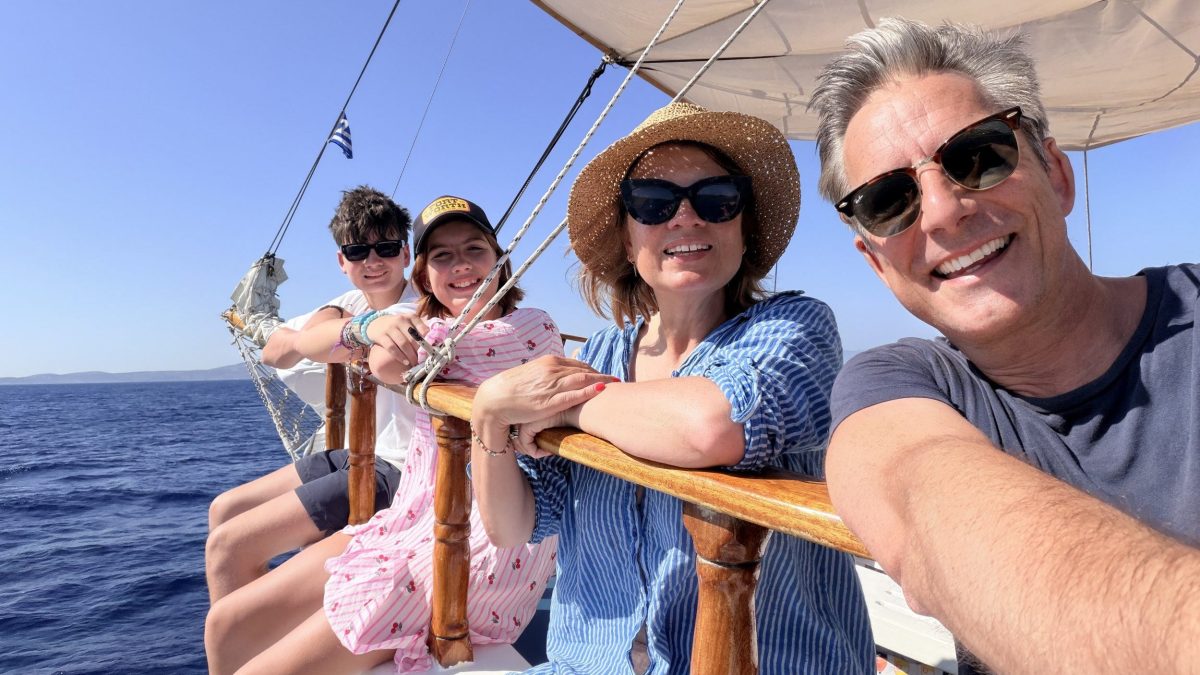
My memories of island hopping round the Greek Cyclades with my mates Spencer and Simon – then in our early 20s – have faded in step with the dusty photos I’ve recovered from the loft. Late nights, sunburn, hangovers and cheap accommodation were recurring themes. In the mid-90s, I had very few stamps in my passport, and as we traipsed between beaches and bars, my eyes were opened to the beauty and charm of Greece’s sun-bleached isles. Three decades later I am island hopping again, this time with my wife Laura and our two teenage children. Now the vibe is less backpack, more boutique. Last time our budget flight arrived in the early hours so we kipped on benches waiting for the first bus to the port. Today: more civilised flight times and a taxi from Athens airport to Rafina. Jonathan (centre) with his friends on their island-hopping holiday in the 1990s Party island Ios, cool Santorini and the beaches of Naxos were on my list as a youngster. For this Odyssey, we return to Naxos but have swapped the others for more family-friendly – and less well-known – Andros and Tinos. No longer jumping on ferries at whim, we are more organised, plotting our route via the user-friendly Ferryhopper.com website. The ferries glide between islands with slick efficiency. As we stand inside the car deck watching the huge aft door opening to reveal the port of Gavrio on Andros, I remember that sense of anticipation. The smell of diesel and the clank of chains is just the same. In this country of great seafarers, archaeological evidence suggests crossing the Aegean between its islands goes back more than 11,000 years. Modern-day island hopping took off in the 1960s and 70s when cheaper charter flights, improved ferry links and growing budget accommodation brought a new generation of adventurous travellers and backpackers. Shorts Giannis was a ship broker for a decade before returning to Andros to run the Aelia hotel, which his grandparents had opened, and a new property next door, the delightful Isida. “I was born here and still haven’t seen all of the island,” he says with a grin as he shows us to our suite. Tastefully designed, with air-con, robes and slippers, it is a far cry from the cheap rooms and hostels I stayed in back in the day. Breakfast at Isida is a highlight. By the quiet pool and under olive trees, Giannis’s mum cooks eggs and prepares fruit platters, all brought to our table. The hotel is just a short walk to one of Andros’s best beaches and the honey-coloured sand of Agia Petros, where beach clubs like Topos offer sunbeds and relaxed restaurant Giannoulis has been serving melt-in-the-mouth moussaka since 1958. Breakfast was served poolside at Isida Andros Three decades ago, we squeezed onto infrequent buses to get to beaches and local sights. I have now graduated to the luxury of a hire car, so we head to Vitali, which must be one of Greece’s most delightful beaches. The drive in the little Fiat is hair-raising, around hairpin bends and a steep dirt track, but so worth it. “It’s just like Mamma Mia!” my daughter Martha says before jumping into the glass-clear sea from rocks overlooked by a whitewashed chapel and bougainvillaea-fringed bar Kampos. We visit Andros’s cute capital Chora, where Martha and Laura make frequent stops at little jewellery and “floaty dress” shops, giving my son Ned and I plenty of time to hang out together. And in Batsi, we check out the delightful harbour beach before eating linguine with fresh mussels on the terrace at Oti Kalo, one of the village’s many great places to eat. In the 90s, single and carefree, my friends and I were after late nights and busy bars. Today, though, the island of Tinos – a two-hour ferry from Andros – appeals for entirely different reasons. Artistic and spiritual, it is celebrated for its marble craftsmanship, picturesque villages and church, which tradition dictates pilgrims approach up the hill from the port on their hands and knees. There’s no airport, just a rugged landscape dotted with goats, terraced fields, ancient dovecotes, unspoilt beaches and hiking trails. We check in to Kynara Boutique Village – a collection of high-end, beautifully designed villas with Scandi-minimalist interiors. High on the hillside we have an uninterrupted view of the shimmering Aegean, the island of Syros in the distance and Tinos port way below, where we watch the ferries come and go. At night we lay on sun loungers looking at the stars. I remember being amazed by the clarity of the night sky on my first trip to the Greek islands, and all these years later I’m gazing up at the same sweep of constellations. The backpacking vibe is evident at Kolimbithra, where surfers make the most of the Meltemi wind. A VW camper van converted into a bar, a compost toilet and an ageing DJ give a festival feel. And in the medieval village of Arnados, we encounter a panigyri – a traditional summer festival – where the dancing is a world away from the clubbing of my twenties. We join a huge public circle dance, spinning ever faster with the music, our steps becoming more frenzied as the warm Aegean wind whistles through the main square. The Samuels family enjoying Souvlaki at the summer festival in Arnados We also visit Volax, a maze of tiny streets lined with a few boutiques and tavernas, set amid one of Tinos’s most extraordinary landscapes. Colossal granite boulders are scattered across the hillside, thrown – according to local legend – by giants. From Tinos we head for Naxos, livelier and more developed than our first two stops. On my last trip, accommodation was picked at random from owners waving placards on the quayside, but this time a few clicks on the excellent Naxos-based Optima Lodgings website led me to Niléa Island Living, near the tavernas and beach clubs of Agia Anna Beach. If I came to this stretch of sand in my younger days, I don’t remember it, but there are plenty of other twenty-somethings partying at Santana beach club. Though our modern apartment is close to the beach, it’s far enough away to be peaceful. We sit on our wide terrace among olive trees and Mediterranean shrubs to enjoy the breakfast that is delivered to us each morning. Evenings are spent by the pool, watching the sea and sky change colour as the sun rises and sets. The peaceful Plaka beach on Naxos became a favourite with the family (Photo: Katerina Samoilovich/Getty) On Naxos’s west coast, Plaka Beach – a 4km ribbon of sand with rolling dunes, perfect for less windy days – becomes another favourite. We also add a surprise fourth island to our trip. On a boat excursion with Jason’s Daily Cruises, we stop for a swim and a wander on tiny Koufonisi – a barefoot kind of place, with powdery beaches, a fishing village of whitewashed lanes and a coastline that feels more Caribbean than Aegean. I did remember Naxos Town (also called Chora) from my backpacking days, with its castle, narrow meandering market area and quayside bars and restaurants. I’m no longer counting out drachma coins for cheap takeaway gyros, though, but sitting on the terrace at To Ellinko restaurant enjoying a far more civilised meal of slow-cooked pork with matsata – the island’s homemade pasta. Soon, our two weeks are over. On the ferry back to Athens, I overhear two scruffy, suntanned British lads comparing highlights of their island-hopping adventure. Maybe in a few decades’ time they’ll be back, retracing their steps with families in tow. How to get there Airlines including British Airways, easyJet and Ryanair fly from the UK to Athens. Where to stay Isida Andros has doubles with breakfast from £130. Kynara Boutique Village, Tinos offers villas with breakfast from £222, sleeping four. Niléa Island Living, Naxos has suites with breakfast from £209, sleeping four.
I went Greek island-hopping in the 90s – taking my family was even better
Full Article
Original Source
Read the full article at Inews →KhanList aggregates and links to publicly available news content. We do not host full articles from third-party sources. Always verify important information with original sources.