
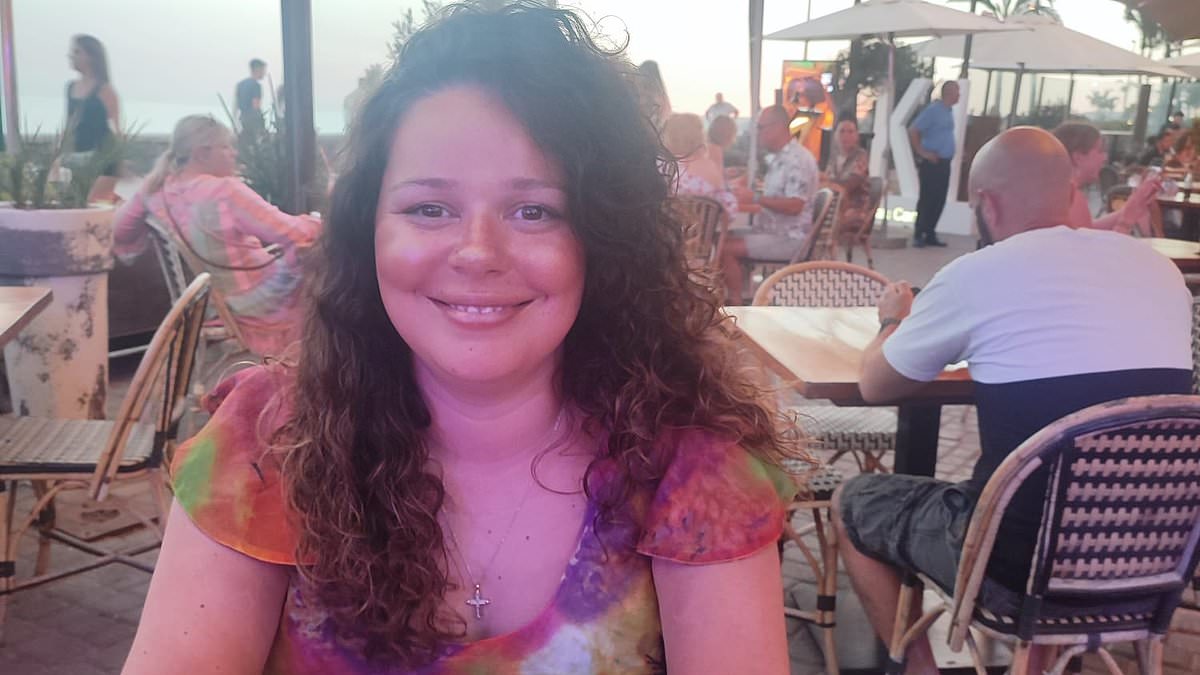
Tania Sparkes, 40, from Greater Manchester tells her story.My symptoms started in my late twenties, around 2015, when I suddenly became completely exhausted.I just put it down to everyday life, thinking, 'Well, I’m a single mum, I’m trying to work.' But my mum, who is a nurse, said to me, 'You shouldn’t be this tired in your twenties.'I was teaching freelance at the time, and it got to the point where I was having to go home to sleep in between classes during the day. However, it was such a general symptom I didn’t think much of it – I thought maybe it was a vitamin deficiency.The funny thing was, I was probably the healthiest I'd ever been in terms of diet. I didn’t drink alcohol, I didn’t smoke. I was literally eating asparagus and poached eggs all the time! I was actually trying to lose weight and couldn't.Next, I found myself waking up in the middle of the night with the most horrific pain in my back. It almost felt like it was in my lungs, but it didn’t hurt to cough or anything. I couldn’t understand it. I even thought maybe I’d slept on a spring! It was so random, because as fast as it came on, it went away.The first time this happened, it was so painful that I went to the GP. He thought it was probably either a blood clot or pleurisy. He ran some blood tests, and rang me to say ‘Your bloods seem all right, I guess it’s just pleurisy, so here’s some antibiotics.’ So every time I got that pain after that, I’d think, ‘Oh, there’s that pleurisy again’. I’d never had anything wrong with me before, so I didn't question it.Afte ignoring the pain for some time however, there was a particular flare-up that was just horrendous. I was at a spa at the time and I thought there was a ghost wandering past the bathroom – I was hallucinating with the pain. I went to A&E, but they put it down to indigestion and tried to give me Gaviscon. They even asked me if I’d been binge drinking. I'd been drinking herbal tea!By that point, I’d been having back pain on and off for about a year, and the tiredness was progressively getting worse. But everything still seemed ‘okay’ on paper. The GP was nice, but the repeated message was: ‘There’s nothing wrong with you, it can’t be anything sinister.' To start with, I believed the medics. I’m such a big advocate for the NHS, and I’d never had any experience with being ill. My family hadn't either - there’s no family history of cancer. So at first I thought, ‘I’m imagining this.' But after that last attack, when I ended up in A&E and couldn't even catch my breath, I knew there was a problem.The only thing the hospital noted was that my inflammation markers were raised, so then there was a suggestion I had gallstones. Even though they did an ultrasound and couldn't see any gallstones, that’s still what I was told. Logically, it didn’t make sense, but when I questioned it, they said, ‘Well, you can get sludge [a thickened mixture of bile, cholesterol crystals, and calcium salts that settles inside the gallbladder when bile flow slows down], which is the same as gallstones, that you can't see on an ultrasound.’ Nobody did anything other than an ultrasound.I felt like a hypochondriac. It was so confusing because the pain went away as fast as it came. I thought, ‘If it was a problem, surely it would be there all the time?’ I was told I looked too healthy for there to be a problem - too young, too healthy-looking, and basically too fat, because I hadn't had any weight loss.I had so many ultrasounds to the point where I thought, ‘This is getting silly now,’ and they still couldn't find anything. If it hadn't been for my mum, I don't know what the situation would be. She kept telling me, ‘You need to go and see somebody privately, this isn't right.’ When I was having those severe episodes, I’d wake up in so much pain, take Nurofen Plus to get a bit of respite, fall back asleep for maybe 20 minutes, wake up thinking it had been hours, and go to take more tablets because of the pain. I was so trusting that if there was a problem, the doctors would have said, or it would show in my bloods. But my mum said, ‘Look, they’re so busy. Sometimes things aren't ticked off, you don't fall into a box, and you need to go and see someone.’Ironically, the doctor I went to see privately was the same doctor who'd seen my notes on the NHS, who had told me there wasn't a problem and that they wouldn't do a scan. When I saw him privately, he said, ‘You need an MRI scan.’ Then he referred me back to the NHS to have the scan. Throughout the whole process, I never actually saw a doctor face-to-face in hospital, apart from during the private consultations.They ended up repeating the MRI twice, because they thought there was a fault with the machine first time round. When I rang for the results the second time, they said they were on the doctor's desk, but he hadn't looked at them yet. I had to be so persistant. Then that Friday afternoon, I got a phone call from a different department telling me I needed to come in on Monday for a biopsy. I said, ‘A biopsy of what?’ Nobody had told me anything!Eventually I was booked in for an ERCP [a specialised medical procedure that combines an upper gastrointestinal endoscopy and X-rays to diagnose and treat problems in the bile ducts, pancreatic duct, and gallbladder] to try and get a biopsy. I didn't have a good time with this procedure at all. Because the medics were so adamant that there wasn't anything sinister wrong with me, I think they pushed a bit hard. I woke up having suffered a perforation, which no one knew about.The pain when I woke up from the perforation was unbearable - it was horrendous. I spent a month in hospital. I was supposed to be in for one night. My daughter, Serena, was 10 at the time. I didn't realise how ill I looked - she came to see me and thought I was going to die because of how sick I appeared. I was confused from the infection and on a lot of morphine. For her to see me like that - especially when I’d never even had a cold before - was such an extreme.What’s more, I was self-employed and had just started my own performing arts school, which I had to close down while I was in hospital. I went from having a new business to having no income, on my own, trying to manage my daughter. I missed her first parents' evening in high school. My mum was working, getting Serena off the bus, and then coming to see me. The impact on the family was huge.I tried to stay positive, but it’s hard when you’re so ill and you don't have the answers to your child's questions, and the doctors don't fully know either. At last though, the medics had narrowed down the problem to my bile ducts (which I’d never even heard of before).Sitting in hospital, I started researching bile ducts. I came across two options that could cause a stricture like mine: cholangiocarcinoma – bile duct cancer - or previous surgery. Since I’d had no previous surgery, I thought: ‘How are you finding it so difficult to realise what this is?’ It was almost like the doctors thought it couldn't be cancer because I had no other typical symptoms, like weight loss or jaundice.I looked up bile duct experts to get a second opinion. I found a newspaper article about a surgeon in Leeds who had operated on someone with bile duct cancer after they'd previously been told they were inoperable. I thought, ‘That's a good person to go to.’I went to see him in Leeds and he looked at my scans. This expert didn't think it was cancer either, but he said I needed the Whipple procedure [a complex major surgery used to remove tumours in the head of the pancreas, duodenum, gallbladder, and bile duct]. I remember thinking, ‘What do I do?’ I was terrified at that point, partly from the trauma of the perforation, but I decided to go ahead with surgery.I had two strictures - one higher up the bile duct outside the liver, and one towards the pancreas. So a pancreatic surgeon performed the operation. The surgeon was brilliant. Afterwards, he said, ‘I'll just give you a call with the results in a few weeks, I'm not worried about it.’ However, when he didn't call and the booking office asked me to come in instead, I knew there was a problem.When I went in, he told me it was cholangiocarcinoma. The cancer had spread just outside the bile duct, and I had perineural and lymphovascular invasion. He said, 'It's cholangiocarcinoma, I'm so sorry.’ I remember thinking, ‘Why are you sorry if you've got rid of it? It's gone, surely?’ That threw me. I thought everything would be fine now, but that wasn't the conversation. I was naive, or maybe just wishful thinking, not realising how high recurrence rates can be.Recovery from the Whipple was slow and painful, though because I’d been so ill with the perforation, my baseline had changed. After surgery I then had to have chemotherapy, because a trial had recently shown that capecitabine [a type of chemotherapy drug] improved survival rates a after surgery. I had eight cycles of capecitabine.People ask how I found chemotherapy, and I honestly don't know - it was manageable, but I was still recovering from major surgery so it's hard to separate the symptoms. The biggest things were tiredness and sickness. I was expecting something horrific where my hair would fall out and I'd be constantly vomiting, but that wasn't the case. Before my first appointment, I was actually planning to cut all my hair off, so thank goodness my mum told me that not all chemo makes you lose your hair. People expect you to be thin with no hair when you have chemo, but I actually put on three stone. Tania with her daughter, SerenaI'm lucky my cancer was operable, but the treatment and surgeries have left me with long-lasting effects. I started getting bowel obstructions from the initial surgery due to scarring, so I had to have a bowel resection a couple of years later. Then I got more obstructions from multiple incisional hernias, so I had another surgery where they put mesh in, but the mesh became infected. It's been four years now that I've been left with an open wound, regular infections, and what's essentially an abscess in my stomach. This year alone, I’ve spent five months in hospital.It’s shocking to think that nine years ago, I thought I was completely healthy. You grieve the person you were a little bit. But what can you do? You just have to keep going.I definitely believe an earlier diagnosis would have saved me from so much of this. Trauma-wise, absolutely. And surgically, I don't think I’d be in this position now. I went into that Whipple surgery so unwell from the perforation, which complicated things. The tumour had actually grown over the stents they’d put in, which made the operation even more complex. My gallbladder had hemorrhaged too, so I was dealing with internal bleeding that nobody knew about. An earlier diagnosis would have avoided that domino effect.My message to anyone experiencing symptoms that don't feel right is simple: don't just accept what one person says. I treated consultants like they were gods and their word was final. But it’s not about trust - it’s that people have different opinions, and you know your own body. It’s okay to ask for a second or third opinion. If you can, going private for one appointment to get clarity doesn't mean you're anti-NHS.Don't accept ‘it's just indigestion’ when you're in agony. You really have to be your own advocate. I’ve learned that, and now I spout it to anybody that will listen! Especially if you're female, your pain is dismissed much more. And especially when you’re younger and if you look well. Speak up, push for answers, and find an expert in that specific field. As I discovered, general surgeons or GPs aren't necessarily experts in the biliary system. If something isn't normal for you, then it isn't normal. Trust your gut and keep fighting for yourself.The AMMF, the UK's only cholangiocarcinoma charity, shares these common early-stage symptoms of the illness: Discomfort in the abdomenPain under the right ribTirednessWeight lossPale stools Dark urine Slightly abnormal liver blood test results can also be an early sign, although in some cases results continue to be normal even in the advanced stages of this cancer.Jaundice (yellowing of the eyes and skin) is common in the advanced stages, although skin yellowing may be less obvious in people with darker skin types. Itchy skin can also occur; both symptoms are caused by a blockage in the bile system and a build-up of toxins in the bloodstream.Helen Morement, Chief Executive of AMMF, says: ‘With cases more than doubling in the last two decades, cholangiocarcinoma can no longer be defined as a rare cancer, nor can the phrase ‘liver cancer’ continue to be used only to mean hepatocellular carcinoma – the other more widely recognised and understood primary liver cancer. Devastatingly poor outcomes for cholangiocarcinoma and rising cases demand the immediate attention of everyone who can help to prioritise a step-change in awareness, so that people with this cancer do not remain under-recognised and under-diagnosed.’For more information on cholangiocarcinoma, visit www.ammf.org.uk
I was told I was too young to have cancer, and my tiredness and back pain were dismissed as gallstones. In fact they were symptoms of something much more sinister.
Full Article
Original Source
Read the full article at Dailymail →KhanList aggregates and links to publicly available news content. We do not host full articles from third-party sources. Always verify important information with original sources.