
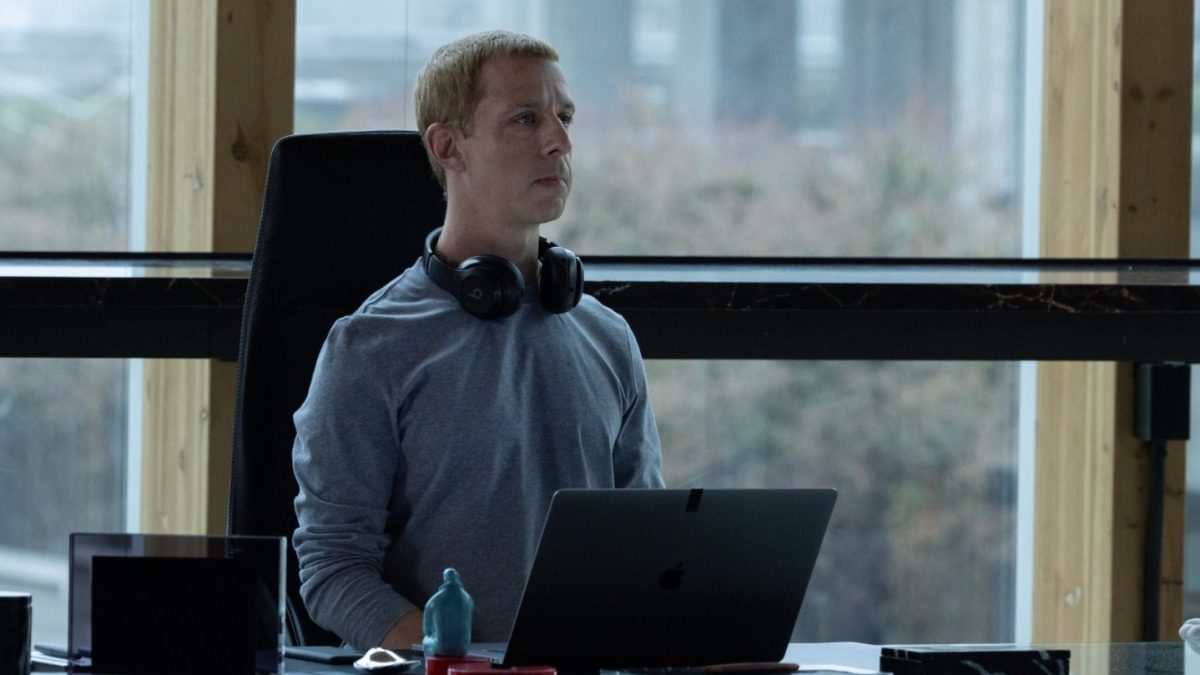
When David Fincher and Aaron Sorkin’s quick-talking film The Social Network came out in 2010, it seemed pretty juicy. I was in sixth form then. As I posted on my friends’ walls and clamoured for a dislike button and uploaded full albums of misspent evenings at the local Pizza Express, it turned out there was a backstory to this new, exciting tool everyone was obsessed with. The Social Network told the story of how Facebook came to be: a Wolf of Wall Street-lite full of sex, money and betrayal, set while its founder, Mark Zuckerberg, was still a precocious Harvard undergrad and while our burgeoning online habits still felt like a curiosity. How quaint that film seems now, 16 years on. We had no idea how behemothic and dystopian Zuckerberg’s invention was going to become, and just how much a website that started as a crude comparison tool for women’s attractiveness would reorganise the structure of society. The film’s follow-up, The Social Reckoning, this time both written and directed by Sorkin, is released today – and while it has many parallels in terms of style, chopping back and forth in time to Zuckerberg in various depositions and with everyone talking at a mile a minute, it has a very different atmosphere. Dark and tense, it has, strangely, an almost Jurassic Park feel (with depressingly similar franchise potential: if this is the second film, what on Earth is the third going to involve?). From the outset, you sense there are great, violent terrors to be uncovered, and then it unfolds into a horror film that is somehow also a documentary about your own existence.The Social Reckoning, based on the 2024 book Broken Code by The Wall Street Journal reporter Jeff Horwitz, is an old-fashioned investigative journalism movie about the Facebook Files, the story Horwitz broke in 2021 exposing Facebook’s emotional manipulation strategies, impact on teen girls’ mental health and key role in spreading political misinformation of various kinds. Horwitz (Jeremy Allen White, serious, determined, Ludditish) is aided by his source on the inside, Frances Haugen (Mikey Madison, self-contained, impatient, the cleverest person in the room), the whistleblower who became concerned when she calculated that 64 per cent of people who joined extremist Facebook groups had been sent there directly by the company’s own algorithm. ‘The Social Reckoning’ takes up the story of Facebook 16 years after the film ‘The Social Network’, above, told its origin story (Photo: Merrick Morton/Sony Pictures) After trying and failing to raise concerns internally about Facebook’s strategies, Haugen started leaking stories to Horwitz about “Meaningful Social Interaction” (MSI), the algorithmic formula used to privilege certain types of content above others, before ultimately going on the record and testifying to Congress. Opening with an uncomfortable scene in which a white woman films herself verbally abusing two non-white police officers by the side of the road, the film culminates in the January 6 riots at the US Capitol, in which Donald Trump, having just lost the 2020 presidential election, encouraged protesters using Facebook. Succession’s Jeremy Strong plays a gaunt, cyborgian Zuckerberg, stoned on power, his eyes black and unfeeling, insisting throughout that Facebook has no responsibility for what its users choose to post. (“We are not the referees,” he says at a key moment, seething. “We are the public square.”) Famously, and in a pivotal scene, Zuckerberg makes the call to take down Trump’s post. The Social Reckoning is, like former Facebook employee Sarah Wynn-Williams’s 2025 book Careless People, the kind of (true) story that makes you want to throw your phone in the sea. This is a company that, it’s been shown time and time again, has little to no regard for the people who use its products (at one moment in the film, Zuckerberg is being coached to say “people” and not “users”. The latter, as it’s pointed out in the 2020 documentary The Social Dilemma, is the same word we use to describe people addicted to drugs). Facebook and Instagram actively and deliberately appeal to our worst instincts, using the MSI algorithm to encourage rage, that most engaging of emotions, and incite political polarisation, all in the service of increasing their own indispensability. The Social Dilemma also popularised the idea that “if the service is free, you’re the product” – an observation that is so prescient in the case of social media that it sounds almost embarrassingly obvious. Jeremy Allen White and Mikey Madison play ‘Wall Street Journal’ reporter Jeff Horwitz and Facebook whistleblower Frances Haugen (Photo: Leah Gallo/CTMG) The story in The Social Reckoning broke five years ago: Horwitz began reporting in 2019, when Facebook had 2.8 billion users and was worth $1trn (£784bn). Since then, the value of the company – now called Meta, renamed not long after the Facebook Files were released – has almost doubled in value to $1.88trn (£1.42trn), its daily users increasing to 3.6 billion. And in that time, yet more vile revelations have emerged, from the company’s role in humanitarian atrocities in Myanmar to its culpability in causing mental health problems in children with deliberately addictive features like the “infinite scroll”. Recently, several countries are in the process of trying to ban Meta’s “smart glasses”, a Black Mirror-worthy invention that enables wearers to film the scene in front of them without holding a phone – really handy if what you would like to film is, say, other people’s children in a playground, or a stranger in a bikini at a public swimming pool. Yet despite all this, here we are. I was struck watching The Social Reckoning by just how numb so many of us are to these misadventures, which we brush off as just one of the many ways in which modern life is terrifying. I use Meta products for everything: for work, for leisure, to stay in touch with friends. I lament the amount of time I spend watching stupid reels and laugh about stalking the Facebook pages of people I went to school with. It’s all too easy to become desensitised and to detach your own experience from how it actually works. Counter-intuitively, the worse the revelations become, the more you get used to them, rolling your eyes at what old Zuckerberg – sitting pretty with Elon Musk and Jeff Bezos in a cursed triad of billionaires – has gone and done this time. It would be challenging to navigate modern life without using Meta – a statement that sounds pathetic, but is true. But I also wonder whether we say it’s essential to justify our continued use of it, which is itself fuelled by a very real, chemical addiction. The notification icon on Facebook was designed in red to give its users a little hit of dopamine – the endless scroll of reels on Instagram is the equivalent of a three-day dopamine bender. Frances Haugen was working at Facebook when she became concerned by its methods and influence (Photo: Peter Rae/Getty) Social media is baked into politics and culture: the shifting of the Overton window and the continuing rise of populist leaders is undoubtedly linked to the way social media has capitalised on our outrage over the past decade and a half. But it’s a vicious cycle: now that horse has bolted, and our brains and personalities are becoming wired to need more of it. As The Social Reckoning points out, the number of Meta users is more than twice the size of the largest national population on Earth. Yet time and time again we have been shown that the equivalent of this group’s government is not interested in accountability, only in making its own population as large as possible by baiting people into feeling things they wouldn’t otherwise feel. In a way, it’s ironic – we are using up so much energy on content that we can only be nihilistic about what’s going on right in front of us. Our attention is, as always in modern life, being funnelled in the wrong direction. But The Social Reckoning ends in triumph – and shows that we can try to claim at least some of it back. ‘The Social Reckoning’ is in cinemas now
I was terrified watching The Social Reckoning – then went back to scrolling
Full Article
Original Source
Read the full article at Inews →KhanList aggregates and links to publicly available news content. We do not host full articles from third-party sources. Always verify important information with original sources.