
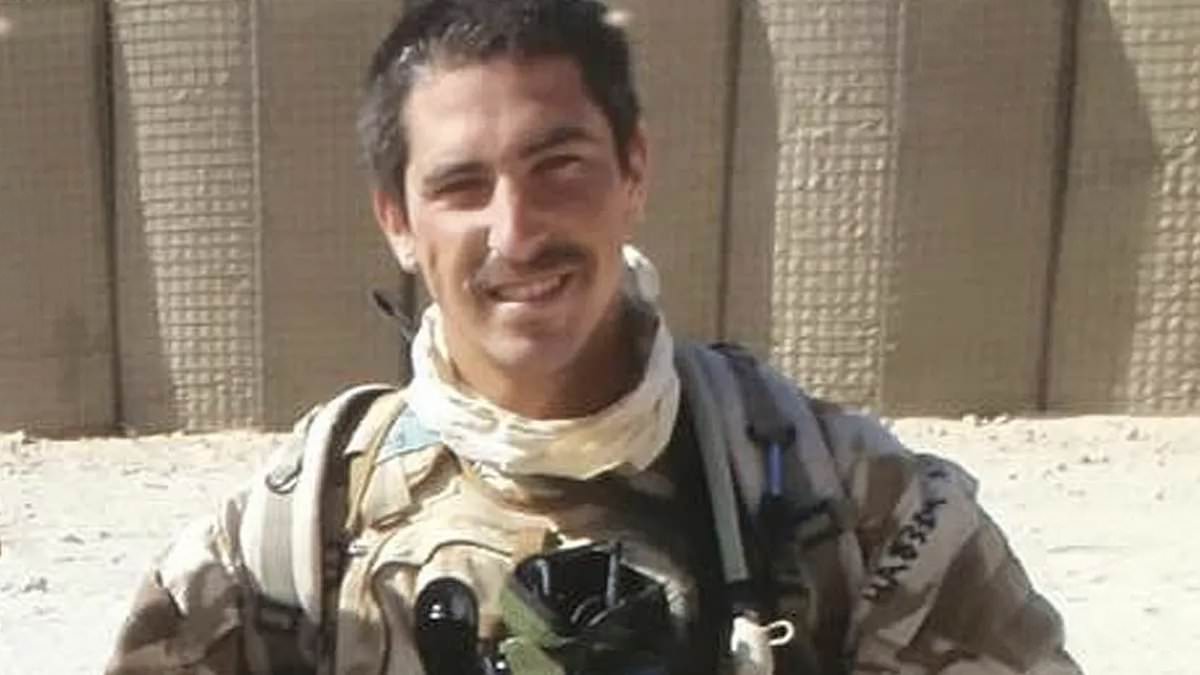
When Royal Marine Commando Jay Hare woke up in Selly Oak Hospital, Birmingham, the medics asked him if he wanted to see what he looked like.It was November 2008 and Hare, then 27 years old, had been in an induced coma for a fortnight after stepping on an explosive in Helmand Province, Afghanistan. For two weeks doctors had worked to save his life, counteracting the infection that had spread through his bloodstream. Now, though, with his wife keeping vigil by his bedside, he had emerged from the coma and the medics were asking, gently, if he wanted a mirror.‘I said, “Yeah, I suppose I’d better,”’ says Hare. “‘Because everyone else has seen it.”’The face that stared back at him was unrecognisable. As well as taking his left leg below the knee, several fingers and an eye, the explosion had destroyed much of his face. His nose was gone. His upper lip had been torn apart. Doctors had stitched him back together in a military field hospital, but there was little left of the man he remembered seeing in the mirror. ‘It was the darkest time in my life,’ he says quietly.A few days later, when friends came to visit him in hospital, wearing protective clothing because of the infection risk, Hare made a request.‘I said, “Can you get me a 9mm pistol, please?”’ They said, “What?”’ And I said, “I don’t think I can live my life like this.”’ Jay’s moustache acted as a guide for rebuilding his featuresToday, at 45, Hare is a director at HorseBack UK, a Scottish charity that helps veterans, emergency service personnel and vulnerable young people rebuild their lives through working with horses. His remarkable story is also now being made into a documentary, Unmasked: The Face I Found, directed by Lee Mancini. His is a tale of survival and of identity – who are you when everything that once defined you has been stripped away? It’s a question facing many British military veterans. More have died by suicide than were killed in combat during the 20-year war in Afghanistan.Raised in North Wales, Hare grew up listening to stories of war. His uncle had been captured at Dunkirk, and his father had served in the Royal Navy during the Second World War. ‘I wanted to follow in my father’s footsteps.’He joined the Royal Marines at 19. Athletic, restless and ‘a little tearaway’ at school, he quickly found his place among the Commandos. ‘We were proud to be doing our job,’ he says. ‘Young men, extremely well-trained and extremely fit.’In 2006, a suicide bomber detonated a device beside his vehicle. Miraculously, Hare and his comrades survived the fireball. Two years later, his luck ran out.Patrolling Afghanistan’s Sangin Valley – an area so dangerous troops nicknamed it ‘the Valley of Death’ – Hare stepped directly on to a hidden explosive. The blast tore through his body.Knowing there could be secondary devices nearby, his fellow marines nevertheless carried him nearly a kilometre through 45-degree heat to an extraction point. ‘The lads being the lads,’ Hare says, simply.He remembers fragments of voices, the helicopter, the morphine and medics fighting to stem the bleeding.Then darkness. Royal Marines of X-Ray Company, 45 Commando in Afghanistan, 2009Years later, Hare asked one of the surgeons who initially reconstructed his face at Camp Bastion Field Hospital, how he had known where to begin. ‘Well,’ the doctor told him, ‘you had a moustache.’ His facial hair, it turned out, had acted as a rough guide for rebuilding his shattered features.At the time of the explosion Hare also had a wife and a four-year-old daughter. Lying in hospital, he worried about how the latter would react when she saw him. ‘Would she recognise me? Could I even cuddle her safely?’When she eventually visited, after the infections had subsided, he could almost see the thoughts moving across her face. ‘“It’s Daddy,”’ she seemed to be thinking, “but it’s not Daddy.”’ She adapted quickly. ‘If your daughter wants to run off with your prosthetic leg and paint its nails,’ says Hare, ‘then so be it.’The five years that followed brought 11 operations, skin grafts and reconstructive surgery. ‘You don’t really know what you’re going to look like,’ says Hare. That can feel ‘immensely scary’ and like a threat to your identity. ‘I had always looked like my father and that was part of who I was.’ Jay’s work with Horseback UK has helped his recoveryGradually, a new face emerged. ‘It did take a lot of getting used to,’ he says, ‘but the relief was huge. There is, of course, a lot of scarring, but compared to the initial shock and horror of first seeing myself after I woke from a coma, this was at least a face I could get used to – to learn to accept. I’m not the Adonis I thought I was in my 20s but I look OK.’Still, recovery was long and far from straightforward. After leaving hospital in a wheelchair, Hare had to relearn ordinary life: how to get downstairs without a leg, judge distances with one eye and navigate a world suddenly full of obstacles. ‘[When] you’re a Royal Marine Commando,’ he says, ‘you think you’re the fittest, hardest, best thing since sliced bread. And then you wake up one day and you’ve got no face and one leg and you can’t even tie your shoelaces.’ So, ‘you take each step one at a time. Literally.’Meanwhile, many of his closest friends remained in Afghanistan. Some of the marines who helped to carry him from the battlefield would later lose their own lives. ‘It was a very, very heavy tour.’And, as with many families living through trauma, the strain at home was immense. Though Hare’s wife was ‘a rock’ throughout his recovery, and they had a second daughter a few years later, the marriage did not survive the years that followed. Jay pictured (far right) in Afghanistan, 2008, the day he stepped on an IEDHare is still a handsome man despite his injuries, but he was initially anxious ‘about whether anyone could fall in love with me again’. He was wrong and today he is in a relationship with a longtime friend. His daughters are now 22 and 15. The elder knew him before, during and after his injuries; the younger one has only known the father rebuilt by recovery.Although Hare was never officially diagnosed with PTSD, he acknowledges experiencing symptoms of trauma. ‘At times deep depression, helplessness, anger,’ he says, ‘but also agoraphobia. I didn’t want to be around other people at all unless they were military, as I didn’t think they would understand. It took me a long time to stop seeing myself as just a mangled piece of flesh walking around.’He speaks about the importance of counselling, CBT and psychological support. Yet some of the most transformative healing in his life came from somewhere far less clinical: horses.Hare first encountered HorseBack UK (horseback.org.uk) in 2009. After a few visits at the stables – grooming the horses, going out for hacks and, in his case, learning to ride with one leg – he asked its founders, Jock and Emma, if he could join the team formally. They agreed and Hare was awarded a Ministry of Defence contract to work at HorseBack UK, while still in treatment for his recovery. Undergoing life-saving treatment at Camp Bastion following the 2008 explosion‘Horses are sentient beings,’ he says. ‘They pick up on your energy and don’t care about scars, status or military bravado.’ Working alongside them gave him something he had been searching for since Afghanistan: peace.There is no neat ending to stories like Hare’s. Trauma does not disappear. Recovery is rarely linear. What emerges most strongly is not bitterness or self-pity but gratitude: to the marines who carried him from the battlefield, the surgeons who rebuilt his face, and the family, friends and horses who helped him rediscover himself.Perhaps that is why the title of the documentary feels so fitting. Because this is not really a story about losing a face. It is about finding one again.HOW TO HELP Unmasked: The Face I Found is currently in development by Agility Films and is seeking sponsorship and production partners. The documentary tells Jay Hare's remarkable story while shining a light on the long-term impact of combat trauma on veterans. Fifteen per cent of the producers’ revenue will be donated to HorseBack UK and the Royal Marines Charity.To sponsor or support the project contact support-unmasked.comHorseBack UK helps veterans, emergency service personnel and vulnerable young people rebuild confidence through equine-assisted programmes. Contact horseback.org.uk; 01339 880487For other accredited equine-assisted therapies contact office@easp.co.uk
I was serving in Afghanistan when a bomb blast left me without a nose - this is how I learned to live with my new face
Full Article
Original Source
Read the full article at Dailymail →KhanList aggregates and links to publicly available news content. We do not host full articles from third-party sources. Always verify important information with original sources.