
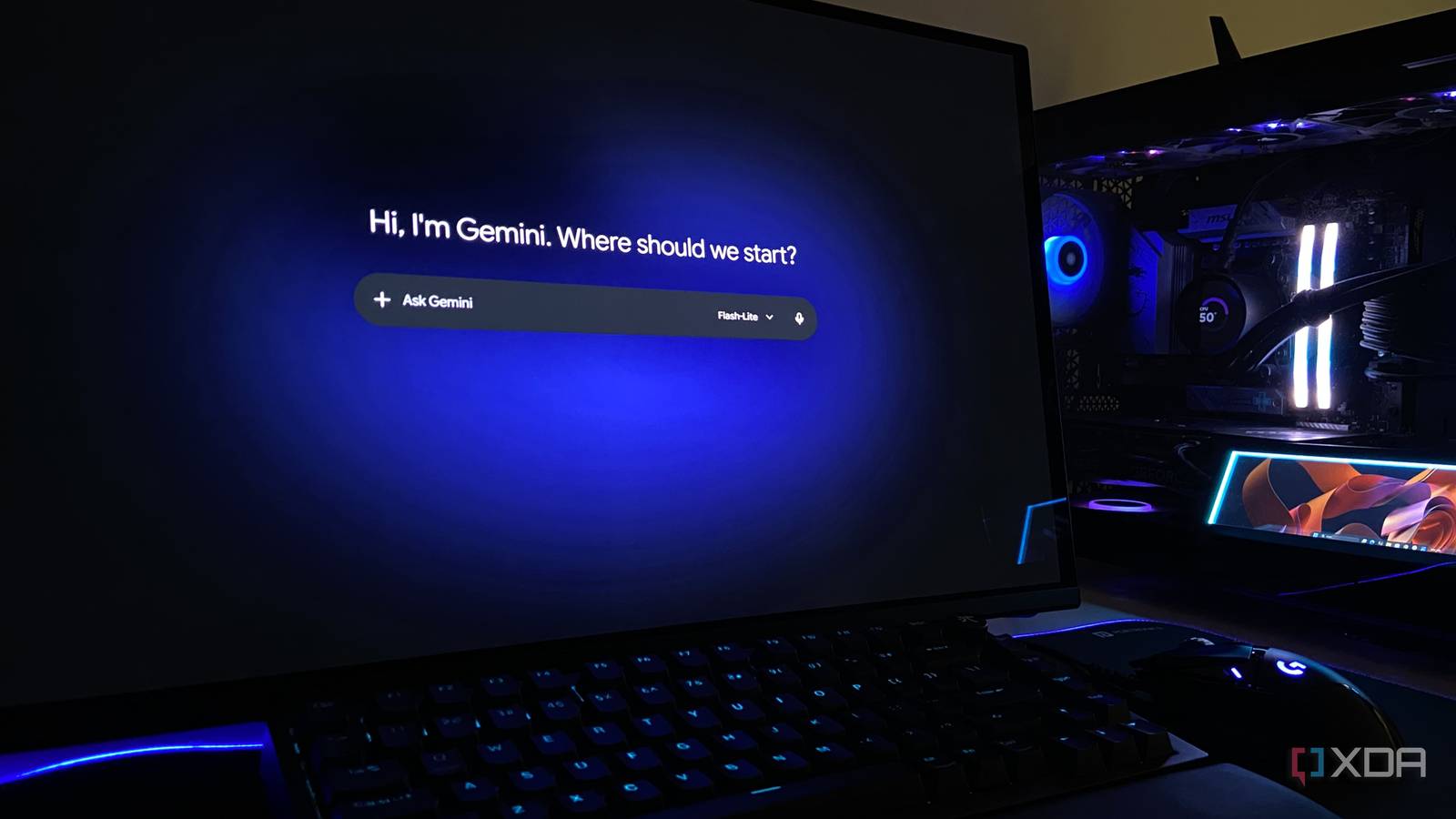
Published Nov 14, 2026, 10:30 AM EST Abhinav pivoted from a career in banking to pursue his first love in writing. Even while working full-time, he continued contributing as an editor-at-large, a role he has held for more than 7 years. A lifelong tech enthusiast who has built three gaming and productivity powerhouse PCs since 2018, his passion for technology keeps him closely following the semiconductor industry, from NVIDIA and AMD to ARM. His MSc dissertation explored how artificial intelligence will reshape the future of work, reflecting his curiosity about the wider social impact of emerging technologies. When you're choosing an AI service to pay subscription fees once a month, you've only got three serious options right now. You could go for Claude for its industry-leading reasoning and coding capabilities, Gemini for its deep integration with Google's ecosystem, or ChatGPT for its balanced, general purpose language models which are deemed the most versatile. Since ChatGPT didn't really have a key differentiator that helped my workflow in any way, it was out of the question for me. As a matter of fact, I was ready to let go of my Google AI Plus subscription as well after paying for the service for over a year, but before I did, I was interested in doing a little mental accounting of everything I'd be losing out on. For the most part, Claude had effectively taken over everything I would hand over to Gemini, except, of course, when it came to anything that had to do with visual media. Claude can design, but it still can't generate images Gemini has practically had the best image generation capabilities when it comes to photorealistic visuals thanks to Nano Banana, which makes it one of the most convincing image generators available for consumers right now. Nano Banana processes text, images, or any combination of the two and allows users to create and edit visuals right through the chat interface. On the Google AI Plus subscription I have, Nano Banana Pro (Gemini 3 Pro Image) promises studio-quality levels of precision as well as control when it comes to generation. Claude, in the meanwhile, has only been taking baby steps towards visuals. First came the interactive visuals in March (which I was deeply impressed with upon my initial review), then Claude Design in April for prototypes and slide decks, and most recently, Claude Motion in October. The problem is that all of that is built with code, and to this date, Claude can't generate images or apply edits to one. Right now, the most frictionless and polished way I've found to do something like dragging and dropping an image and removing an object through a prompt is Gemini's chat interface. And I can edit it just by talking to it When I first got my hands on Gemini Omni in May, I described it as something "straight out of science fiction", and my position hasn't changed since then. I tested it by feeding the model a single gameplay screenshot from Forza Horizon 6, generating physics and chemistry explainers, and even having a doodle of a cartoon dog come to life through it in further testing. What makes it so hard to give up is that, of the three AI subscriptions worth paying for, Gemini is now the only one that can generate videos on its own. OpenAI shut down Sora in April, and video generation left ChatGPT with it. Meanwhile, Claude never had it to begin with. Omni, on the other hand, can take text, image, audio clips, or an existing video to turn it into a short clip with sound. That alone makes it an indispensable tool for someone whose job is to explain and understand things that can sometimes be hard to put into words. SynthID tells me what's real, and what isn't Other AI models can just make educated guesses One of the aspects that isn't exactly well-known about Gemini's image and video tools is that everything they produce is signed. Every image Nano Banana generates, and every clip Omni renders carries an invisible watermark known as SynthID, which Google embeds at the point of creation. When such a piece of media is uploaded to Gemini, it can tell apart what has been generated with Google AI, versus what hasn't. To see it in action, I uploaded the dust-free photo of my PC that I generated using Gemini earlier and asked the model to run a SynthID check on it. It came back with a detected watermark and told me that part of the image was generated or edited with Google AI, despite my cropping the visible Gemini watermark out of the image. There have been countless occasions as to when SynthID has been a useful tool to me. Before an event such as Apple's fall hardware showcase or a major product announcement, social media is often flooded with "leaked" renders and product shots, and a fair share of them are AI-generated, of which a surprising amount are created using Google AI tools. Google's SynthID Detector has gotten continually better with time as well, and it now reads watermarks from OpenAI, Nvidia, and Kakao as well. Gemini may not be my main AI anymore, but it gives me reasons to keep coming back Between Claude, which continues to top coding benchmarks, and the general purpose ChatGPT, which holds the largest share of the consumer AI space, Gemini is rarely a part of the discourse for its capabilities alone. As I have learned, though, it comes with a few niche features thanks to its multimodality, and one of them has no equivalent on the other two platforms. Two of them, on the other hand, cost me nothing to keep. Google Gemini Google Gemini is Google's family of multimodal language models that can generate text, images, and video.
I was ready to ditch Gemini for Claude, and then I found the one feature I'd actually miss
Full Article
Original Source
Read the full article at Xda-developers →KhanList aggregates and links to publicly available news content. We do not host full articles from third-party sources. Always verify important information with original sources.