
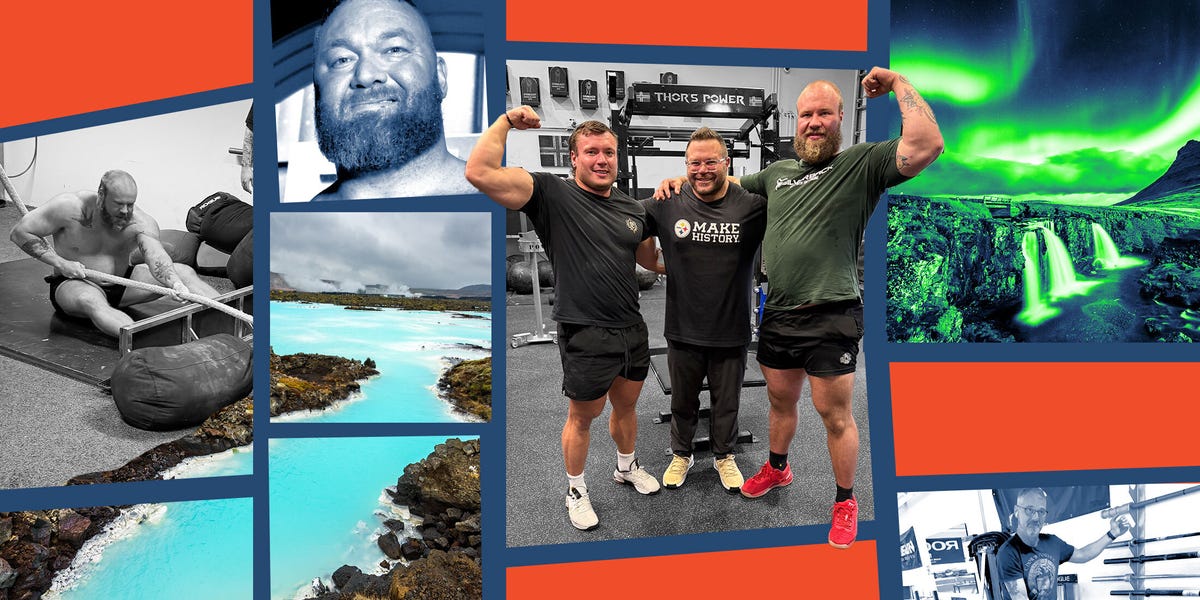
9 min readI’M STANDING INSIDE Thor's Power Gym in Kópavogur, Iceland—one of the best-equipped strongman facilities on earth, a warehouse where every implement a modern lifter could want sits waiting under racks of Hafþór Júlíus Björnsson's bevy of competition trophies. There, three of the strongest men I've shared a chalk bucket with are telling me that the thing I really need to see has nothing to do with any of their lifts. Hilmar Örn Jónsson, Tómas Darri Þorsteinsson, and Rolf Olav Pettersen want to fetch Björn, Hafþór’s father, out of the gym's office.Björn handles the day-to-day operations of the place. He's 6-foot-7 and lean, and by his own admission he doesn't train much. The guys want him to pick up the gym's 81-kilo Thomas Inch replica dumbbell, a solid hunk of iron with a handle nearly two and a half inches thick. You can't wrap your fingers around a handle like that.The original bedeviled strongmen—at least strongmen who weren’t the doughty Inch —for a century, and grip specialists who train for exactly this sometimes still fail on replicas. Björn ambles over, chalks up a little, reaches down, and picks the thing up, then all but curls it to his chest, straining himself only about as much as Dante does when he goes to lift the gallon jug of milk in Clerks. Everyone laughs.I'd come to the right country.You see, I'm 44, and I'm wearing down. Since I left academia for the corporate world in 2017, I hadn't taken a vacation longer than a week, a streak that survived a torn pec in 2022 and a left wrist reconstruction in 2024, two injuries that turned my lifting regimen into series of careful negotiations with my own connective tissue.So when my wife proposed two weeks in Iceland this July, the family math worked for everyone. My wife and daughter got waterfalls, whale watching, endless sunsight, surprisingly good lamb-based hot dogs, and puffin-and-smoked-salmon dinner plates.My beat-up body got a country where geothermal soaking pools and saunas are as ubiquitous as gas stations and far cheaper than that heavily taxed substance. And I got to investigate, up close, what is surely the strongest country on earth per capita.Nine World's Strongest Man titles have gone to denizens of this island of roughly 400,000 people: four for charismatic Jón Páll Sigmarsson (1984, 1986, 1988, 1990), four for calculating strategist Magnús Ver Magnússon (1991, 1994, 1995, 1996), and one for the aforementioned Hafþór Júlíus Björnsson (2018, along with three titles in the equally prestigious Arnold Strongman Classic), the 6-foot-9 colossus who played The Mountain on Game of Thrones and was the first person to deadlift more than 500 kilograms. Only the United States, with roughly a thousand times the population, has more.Before I flew out, I corresponded with the great Magnús Ver himself, who now runs the Jakaból strength gym, to get the lay of the land. Why here? Why this tiny, treeless rock in the North Atlantic?"A lot of this goes back to the Vikings settling in Iceland," he wrote me. "You had to be strong and tough to survive. We were brought up with hard work—on the farms, fishing, and so on. This translated well into strength sports. Hard work and working with our hands all day was just normal. Sure, nowadays that may not be the case. Now they have the equipment and such to train on, but the work ethic and mindset is still there, still the same."Then he added: "Iceland still has the second most World’s Strongest Man wins, which I think is pretty great for the size of the country we are."Not long after arriving, we hit the pools. Reykjavík's municipal facilities put American rec centers to shame: spotless, orderly, cheap, and full. What struck me most was who was using them, come rain or shine, and at nearly all hours of day: everyone. Thin, not thin, old, young, all of them swimming actual laps and rotating through saunas like it was a civic duty.The Húsafell StoneA FEW DAYS in, we drove north of the city to a goat farm that had furnished goats to Game of Thrones. The farm sits in Borgarfjörður, the same district as Húsafell, which meant I could no longer avoid the reason I'd really come: the Húsafell Stone, a 409-pound slab that has been sitting beside a goat pen at the Húsafell farm since the 18th century. Carry it around the full perimeter of the pen — about 50 meters — and you earn the title fullsterkur: full strength. I got the stone off the ground, which puts me ahead of most visitors, and then I flailed.Alas, I did not earn the title fullsterkur.At the Metroflex, I had learned how to handle heavy, commercially-produced Atlas stones. I still do Zercher squats—barbell cradled in the crooks of my elbows—with more than 405 pounds, from a dead stop low in the rack. Those weights are manageable because the objects are meant to be lifted easily. You roll a professionally-finished, well-proportioned stone into your lap; you balance a barbell on your forearms, which are heavily padded to prevent chafing.The Húsafell Stone is neither round nor a bar. It's wide, flat, and awkward, and picking it up is akin to trying to hug a coffee table made of basalt. I was using the technique-driven method I'd picked up from Liefia Ingalls, the now-retired American strongwoman who carried the stone herself and who'd fed me a host of pro tips: work it up the thighs in stages, find the balance point, settle it against the torso.Sound theory, and precisely how the handful of past lifters, including one famous 18th-century woman, had managed to do it. But somewhere between my not-so-flexible knees and hips the plan fell apart, a cloud of gnats—a recent and, locals told me, seemingly permanent addition to the warming Icelandic landscape—swarmed my ears. Frustrated and irritated, I kept dropping the stone after moving it a few inches off the ground, with each drop further burning out my fingers and forearms.Weeks later, Jónsson, who wished I had come with him, told me what went wrong. As a bigger trainee, I should have just forced it up, yanking it with my lats as I pressed it up from the ground with my legs—no different than a regular deadlift.Gaining Strength SecretsI LEARNED PLENTY more at Thor's Power Gym, where I fell in with the three men from the top of this story. Hilmar Jónsson (@hilmaroj), who is 6-foot-6 and around 285 pounds, is built like an NFL tight end trains like one, too. Strongman conditioning is changing, he explained.The age of the big-bellied, slow, strong guy—think of the all-time Lithuanian great Žydrūnas Savickas—is ending, with fitter competitors like Ukraine’s Oleksii Novikov holding their own across all the events (other than Icelanders, “the Ukrainians are the strongest people out there,” Jónsson told me).One day Jónsson spent an hour on heavy sled pulls. The next, he worked on a running clock, hoisting the sport's notoriously awkward circus dumbbells on a regular cadence up to 110 kilos, and pressing with both arms rather than the dominant-arm-only approach most strongmen take, in case one arm fails him in competition.He's four years into the sport and already one of the most powerful humans I've ever seen in action—and I've trained at the old Metroflex in Arlington, Texas, with the likes of Rendy DelaCruz, Branch Warren, and Johnnie O. Jackson. For raw explosiveness, Jónsson blows those folks away, laughing and joking the whole time, totally in the zone.Then there's Tómas Darri Þorsteinsson, who at around six feet and a nearly fatless 220 pounds is already the greatest powerlifter in Iceland's history. He's effortlessly good at everything, the kind of coach who makes small, immediate adjustments that change your training for months.Watching me hold a barbell, he spotted a problem I didn't know I had: ever since my wrist reconstruction, I'd been gripping every bar like a featherweight, tentatively, even while deadlifting 600-plus pounds without straps. He fixed my hand placement on the spot, and the lingering pain in the four fingers that support those weights vanished in the weeks after my trip.Þorsteinsson has coached both Jónsson and Pettersen, and he holds the Thor's Power Gym record for the one-handed pick-up at 255 kilos (with Hafthor, whose hands are the size of two of his or mine, right behind him). The easy comparison is John Haack, the American powerlifting phenom I've interviewed for Men's Health, but I've never seen Haack smoothly continental clean and press a 122-kilo axle or lock out a 102-kilo circus dumbbell for fun. The circus dumbbell, for the record, bedeviled me even at 52 kilos: Rolf-Olav Pettersen demonstrated it carefully, and I still kept bonking the back of my head on a too-loose lockout.Pettersen is the athlete who ought to be a model to every person reading this. He's 37, Norwegian, and at six feet he is small for this sport. He has a day job back home, did his graduate work in England, and has a tattoo of Hafthor on his calf. Since winning the 90-kilo class at Iceland's Strongest Man in 2021, he has commuted from Norway to train here, methodically building himself up through the 105-kilo class and then taking a year off from competing to reach 120 kilos of bodyweight—all without ever looking like much more than a larger but not at all heavyset man, similar to longtime World’s Strongest Man contender Rob Kearney, whom I interviewed for Men’s Health in 2019."I want to fulfill my dream of competing alongside Hafþór and all these other guys at Iceland's Strongest Man, on their terms," he told me. Someday he wants to open a strongman gym in Norway, a sports-obsessed country that leads the world in Winter Olympics medals but where strength sports haven't taken hold the way it has here. He told me he was going to lift the Húsafell Stone and run with it, then hoped to deadlift at least 300 kilos in the competition. That's 661 pounds—the most I've ever pulled in a meet myself, except Pettersen would be doing it after seven other events, while weighing around 100 pounds less than the giants beside him, at nearly my age. I didn’t doubt him; he was locked in.And if I needed more evidence of how strength-mad this country is, there was Skúli Ármannsson, another massive, bearded friend of Hafthor's, casually repping 145 kilos on the bench after a battle with cancer. Jónsson, spotting him, kept telling me: "That's a real man." This a country chock full of them.For my own part, I left with concepts to take home and fixes to work on, and I can say I pulled some exceedingly gentle 270-kilo deadlift training reps, no straps, off the same platform where, in May 2020, Hafthor set the 501-kilo deadlift world record with Magnús Ver on hand to judge it, a mark he pushed to 510 kilos, and one that survived his 515 attempt at the Enhanced Games in Las Vegas this past May. The record was recently bested by Mexican strongman Raul Flores, who pulled 511 kilos earlier this month.Taking Strength HomeA WEEK AFTER I returned home, the results of Iceland's Strongest Man—as carefully reported by Thor’s Power Gym—showed me just how competitive the scene I'd brushed has become.The contest was held outdoors, and the first day's rain was heavy. Hafþór—by many measures still the strongest human alive, but rehabbing nagging injuries and recovering from those gruelling Enhanced Games deadlift attempts—won the max deadlift, the weight throw (with an almost casual throw that appeared to set an unofficial world record), and the manhood stones, an event built around Iceland's traditional lifting stones.He still finished second. The winner, Kristján Jón Haraldsson, edged him 88 points to 86 while taking just one event, the arm-over-arm pull. Like Jónsson, Haraldsson—who has won Iceland’s Strongest Man three times—is a large, well-conditioned athlete rather than a hulking one, more evidence for the new-model strongman thesis.Jónsson himself finished fourth, consistently in the top of the pack across all eight events. The dark horse, a shorter and impossibly jacked Czech named Jan Krasinský (whose presence in the field says plenty about what a strength mecca this place has become) smoked the entire field on the Húsafell Stone carry, then had to withdraw from the final two events with an injury."It was a battle, man," Jónsson messaged me afterward. "The weather had a huge impact. The rain was pouring. It was truly a fight against the elements."Back in Pittsburgh, my wrist has stopped hurting and I’m much more mindful of each lift I undertake, thanks to a 30-second fix from the best powerlifter in Iceland. Meanwhile, I know the stone is still there, beside the goat pen at Húsafell and surely still swarming with gnats. If I ever get back to it, I won’t go there by myself, and I'm going to force it up. Perhaps it won’t happen in this lifetime, but that’s the stuff dreams are made of.Oliver Lee Bateman is a historian and journalist based in Pittsburgh. He’s written for The New Republic, Vox, and The Atlantic.
I Was Having a Midlife Muscle Crisis. A Trip to Iceland Made Me Stronger Than Ever.
Full Article
Original Source
Read the full article at Menshealth →KhanList aggregates and links to publicly available news content. We do not host full articles from third-party sources. Always verify important information with original sources.