
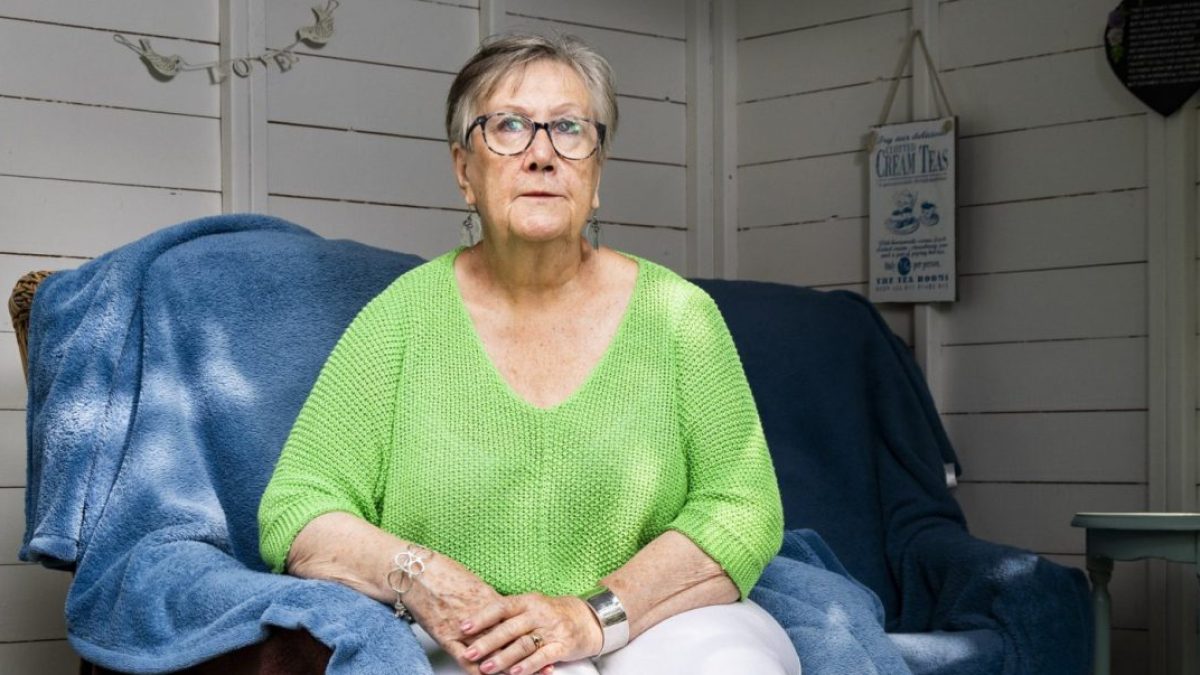
When Jane Jackson, 73, first became a grandmother, she was knocked sideways with love. “It was pure magic,” she says, “this tiny little person looking up at me with two blue eyes.” Jane’s granddaughter – her son’s child – lived in the North East of England with her parents, but often visited Jane and her husband Marc in Westbury-on-Trym, a suburb of Bristol. There were lots of visits and sleepovers in the summer holidays. “We had such fun,” says Jane. “As a grandparent you don’t get wound up by stuff you do as a parent, and it was just an utter joy.” However, when her son’s marriage broke down, things took a turn. It was 2007, and Jane remembers after a day out, her seven-year-old granddaughter saying: “I’ve been told to dump my family in Bristol.” Jane was shocked, and didn’t know what to say, not wanting to make things worse. “The writing was well and truly on the wall,” she says. Jane’s son’s relationship with his wife became untenable, and he now also had reduced contact with his daughter. “He’d ring me in a distressed state,” she says. “My son’s view was that his daughter had been through enough, and he wasn’t going to make life more difficult for her. So he chose to step back and returned to live in Bristol. It’s the hardest decision he’s ever made.” For a while, Jane was still able to see her granddaughter – but then those visits stopped altogether. Shorts Floored by the pain, and realising she was not alone in this, Jane started The Bristol Grandparents Support Group. She has supported over 10,000 grandparents on the phone and lots more at in-person meetings. At least two million grandparents are estranged from their grandchildren, according to research published for the 2023 report The Grandparents United for Children, but establishing the precise number is difficult because of the stigma and shame surrounding this issue. The social networking site Gransnet found in 2019 that of 1,000 grandparents surveyed, 37 per cent said they haven’t seen their grandchildren for more than five years, and of those who are estranged, 9 per cent say they were stopped from seeing their grandchildren before they were born. Almost half (43 per cent) said their grandchildren were aged between one and four when contact ceased. Family breakdowns like this can happen for all kinds of reasons – prior abuse, drug addiction, misunderstandings, intergenerational conflict, mental health issues – but Jane’s experience is one of the most common, where grandparents (more likely the paternal side) can become collateral damage in a high-conflict divorce between the parents. “Before this happened to me,” says Jane, “I’d have assumed that someone who doesn’t see their grandchildren must have done something wrong. Now I realise, often the grandparent has no idea how this happened. I’ve got three other younger grandchildren, who I see all the time, and I never imagined this would happen to me.” What Jane finds is that grandparents are so ashamed of what’s happened, that when someone asks them if they have grandchildren, they find themselves saying no. “I don’t know if people understand the seriousness of what this does to grandparents when they’re forced to be apart from their grandkids,” she says. “I call it a living bereavement. I see people mentally and physically unwell as a result of this, and we’ve lost two grandparents, who took their own life because of this.” ‘Before this happened to me,’ says Jane, ‘I’d have assumed that someone who doesn’t see their grandchildren must have done something wrong’ (Photo: Tom Wren/SWNS) Of course, there are instances where a grandparent poses a risk to a grandchild, and it is legitimately in the best interests of the child to be kept away from them. At the heart of this topic, as much as the feelings of the adults are important, it is about the rights of children to feel safe and free from fear. Yet, when it comes to ordinary, loving grandparents who would enhance the life of a child, does the UK law do enough to protect those grandparental rights? Grandparents do not have an automatic legal right to see their grandchildren, and parents hold parental responsibility and decide who their children see. If access is denied, a grandparent has to first try mediation, then apply to the family court for a Child Arrangements Order. Of course, once you involve the courts, you’re in a different stratosphere of severity and complexity – but there are grandparents who take this route. Lawyer Jon Whettingsteel, head of family law at Dutton Gregory Solicitors, believes grandparents deserve more attention in the legal system. “When family dynamics shift due to the children’s parents separating,” he says, “grandparents’ rights are often overlooked despite the often special shared bond.” He has acted for grandparents seeking to contact their grandchildren but has found that in practise it is “an uphill struggle”. Whettingsteel remembers a particular case: “The judge, although incredibly sympathetic and recognising of the previously close and loving relationship between the child and their grandparent, was unable to make an order for contact. They decided the child’s parents felt so strongly in their personal issues and dislike for the grandparent that an order for contact would negatively impact the child.” Whettingsteel also refers to a different case in which a judge agreed a grandparent should be allowed contact. The judge said: “It would be nonsense in the long term for a child to be denied contact with his grandmother because of bitterness between the mother and the grandmother. Grandparents play an important role in children’s lives, especially young children.” ‘It was like I didn’t know myself anymore’ Miriam, 74, who has withheld her last name to protect the privacy of her grandchildren, worked as a history researcher, before retiring. Her son married his wife, and they had two children, called Samuel* and Olivia*. Miriam would babysit once a week, and see the children regularly for visits and days out. “I was a typical, besotted grandmother,” she says. “I had a very good relationship with my son, and I loved my daughter-in-law.” When the grandchildren were toddlers, Miriam’s son and his French wife announced they were moving to France, and asked if Miriam and her second husband Peter would consider moving there, too, to be near the grandchildren. “We’d always loved France, so we decided to go for it,” Miriam says. “We sold up in England, and moved to Provence ahead of the rest of the family, who would be moving a few months later to join us. It seemed like a definite plan, but then I started sensing something was up”. As it turned out, Miriam’s son and wife had decided not to move to France after all. “It was like a bomb had gone off, and I blurted out, ‘Do you not think you could have told us before we committed to living here?’”. An argument ensued, and after that, she says her son went quiet for three months, and rejected her calls. Miriam says that eventually he told her she’d disrespected his wife, that he didn’t want Miriam near his children, and that he wanted nothing more to do with her or Peter. “I went into a state of shock. I carried on sending presents at Christmas and Easter, until my son told me to stop. I needed to know what I’d done wrong to warrant this, and I thought I must be poisonous, or missed something about myself, for this to happen. It was like I didn’t know myself anymore.” Miriam joined the Bristol Grandparents Support Group, and was given the advice to leave the family to get on with it, and to instead start a memory box, where she’d write things down she’d like to tell her grandchildren, put shells she knew they’d like, and other keepsakes. She also got some therapy. Over the next decade, she was sent the odd school photograph, and saw her son and his wife just once (it was a distressing meeting), and never the grandchildren. In 2022, out of the blue, Miriam’s son began communicating with her more regularly. She and Peter received an anniversary card, and got a note about how the children – now 15 and 17 – were doing. “Then all of a sudden I had a lovely message from my son saying, ‘We’re coming over to France. We’d like to see you at Easter. Can we come and visit?’ I was just astounded. I immediately contacted the support group in floods of tears. I spent half the night in a total panic. When the family arrived at our house in the car, the grandchildren fell into our arms. “I’d remembered them as sweet little toddlers, but here they were, teenagers. Beautiful, but so much time had passed. They still called me ‘nanny’ and it was so wonderful to be called that again. Olivia said she remembered my buying her a unicorn paddling pool, and how we’d played in it. Samuel didn’t remember us. My son – who is soon turning 49 – burst into sobs, and the children were in total shock. “I hugged him. He was saying, ‘I’m so sorry mum, sorry, sorry, sorry,’ and I told him it was OK, and that I loved him.” Since then, Miriam has had her family back in her life. The last few summers, her son, daughter-in-law and grandchildren have come to stay with her, and she is in regular, direct contact. A ‘magical relationship’ Sue Egersdorff is co-founder of Ready Generations, a charity committed to bringing generations together. “Our experience is that mostly grandparents really, truly want to play an important part in their grandchild’s life,” she says. “There is something very magical about the relationship between older people and young children, there’s a natural dynamic there.” Egersdorff’s charity runs one of the UK’s first nursery within a care village in Cheshire, where children and adults share meals, gardening and storytelling. “How can we do better with intergenerational living in our modern society?” says Egersdorff. “How can we make sure relationships between young and old are fostered? When adults are in conflict around grandparent roles and access to grandchildren, it’s so difficult, because there’s limited resolution therapy for grandparental relationships. But I’ve rarely met a grandparent who isn’t proud and happy to be one and wants the very best for their grandchild.” Each family has its own complex, chaotic set of dynamics, and every relative will have their story version of how a family breakdown happens. We can never know the whole truth, only part of it, and people have their own reasons for initiating estrangement. Miriam says she has never discovered why the estrangement with her grandchildren happened, and she doesn’t think she will ever know. “Although the message I give to estranged grandparents is one of hope,” says Miriam, “it’s also one of realism, too. Reconciliation isn’t all sunshine and roses, and the damage is with you for life. Sometimes I do allow myself a little wallow in the pain of everything I missed – but then I’ll snap out of it.” Miriam suffered a stroke while this was going on, and is now trying to focus only on the joy at seeing her grandchildren again. “Hand on heart, I have no bitterness towards my son, because feeling that way can spoil your life. You love your children, no matter what they do. I have these two teenage grandchildren to be proud of, and to love. My grandson will send messages saying, ‘Can’t wait to see you, nanny,’ just out of the blue, with heart and kisses. He also tells me: ‘Nanny, I’m going to come and study in France, so I can visit you whenever I like’.” Grandparent’s rights after a divorce Experts at Gransnet give their advice: Grandparents’ rights to maintain contact with their grandchildren after family breakdown is often a difficult issue. Take the opportunity to be involved if it arises. Involvement now may make a difference to the amount of contact you have after the separation. You’re quite entitled not to want to take on more unpaid childcare than you feel comfortable with. But if you choose not to be involved at the time of separation, you might find what you want isn’t taken seriously when the family is reorganised in the light of the divorce. Paternal grandparents are treated in the same manner as maternal ones in the eyes of the law. However, it is worth checking whether your son has parental responsibility, which is obtained by marriage or his name on the child’s birth certificate. There’s research showing that where paternal grandparents support contact, sons are much more likely to stay in touch with their children after divorce, so involvement is more important now than ever. *Names changed to protect identities For support and advice, contact The Bristol Grandparents Support Group For confidential support, Samaritans are available 24 hours a day, seven days a week. Call for free on 116 123 or visit samaritans.org
I was cut off from my grandchild after my son’s divorce – it was a living bereavement
Full Article
Original Source
Read the full article at Inews →KhanList aggregates and links to publicly available news content. We do not host full articles from third-party sources. Always verify important information with original sources.