
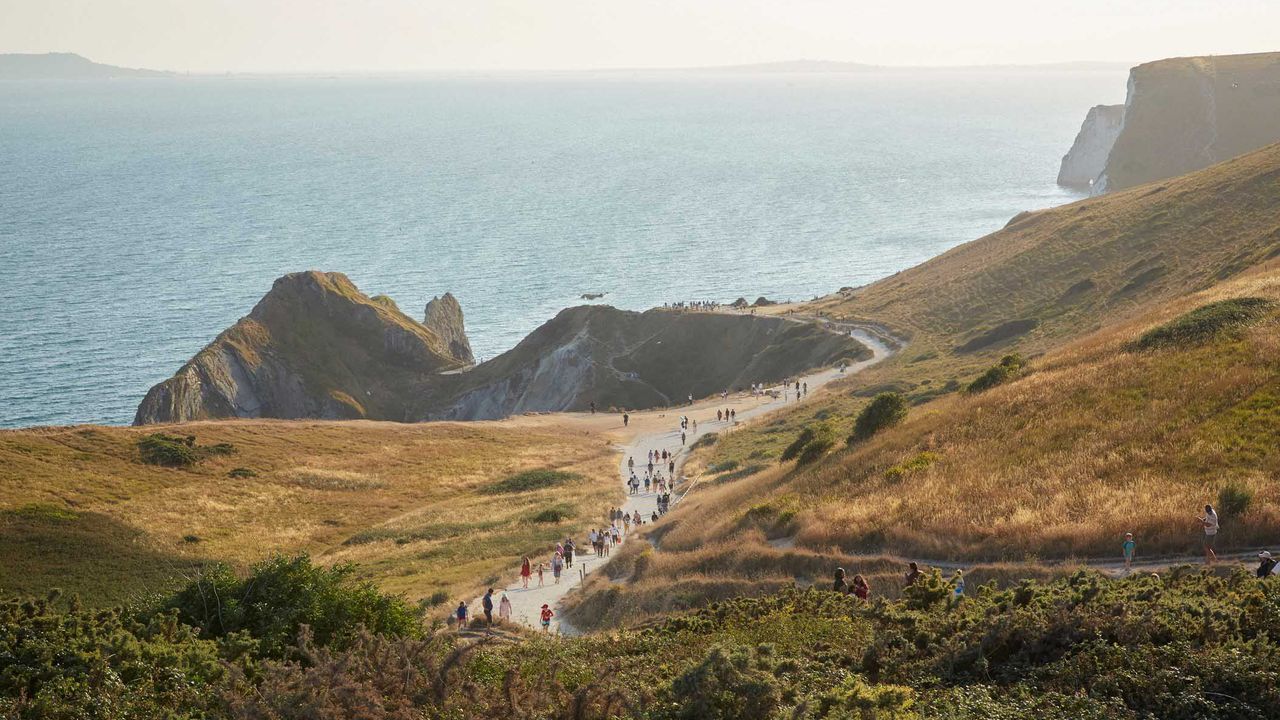
I’m standing atop a spit of land jutting out into the English Channel, peering down at a beach accessible only by boat, where a small group of sunbathers lounge on the rocky sand. The view is a welcome excuse to catch my breath before continuing along five more rolling cliffs—400 steep feet up, 400 steep feet down, and repeat. And so, despite my exhausted legs and the blister that’s forming over my right big toe, I decide to imprint this impossibly peaceful scene into my brain to remind myself why I’m doing this trip.Dorset's limestone Jurassic Coast GettyI was nearing the end of the first day of a three-day solo walking trip along a slice of England’s South West Coast Path, a 630-mile trail through some of the country’s most beautiful land- and seascapes. Earlier this year, it became part of the newly created King Charles III England Coast Path, inaugurated with a brisk March walk by the king himself (wearing a suit, natch). The route now incorporates all of England’s preexisting regional coastal paths, adding new sections to create a wider network that stretches across nearly 2,700 miles, giving walkers a chance to access parts of the country far beyond the typical travel itinerary.Since tackling an admittedly easier two-day walk from Dover to Sandwich the previous summer, I’d become totally enamored with England’s coastal paths. I realized I could experience so much more of the country’s most beautiful landscapes by foot than I ever could by train or car. For my second foray, I chose one of the more frequented set of trails: walking east from Weymouth to Bournemouth across Dorset. This stretch is known for its incredible rock formations, the result of millions of years of waves washing against the coast. That erosion has also led to the discovery of some of the world’s oldest fossils—giving the region the name of Jurassic Coast.A view of the South West coast Path's rugged countryside, which is now more easily accessible to hikers thanks to the wider newly created King Charles III England Coast Path. GettyWhen I’d set off five hours earlier from the charming seaside town of Weymouth—a destination made popular by King George III’s multiple visits at the turn of the 19th century—the going had been easy. My only roadblock was a military parade that a British historical society couldn’t have arranged any better: an Army band marched in front of a stretch of beach-facing Georgian townhouses as Union Jack bunting fluttered in the sea breeze. An Anglican priest delivered a short prayer. There was a Spitfire flyover. If you ignored all the iPhones and mobility scooters, it was a scene that would have fit in comfortably 80 years ago.By setting out alone on a three-day walk, I was seeking solitude, and moments like that clifftop break, when I had the view all to myself, delivered. But the long way out of the Weymouth hubbub also clarified why walking England’s coastal paths is so approachable—especially for those of us who love the outdoors but want to sleep indoors. Since the country is quite densely populated, you can easily walk the trails from town to town, and hotel to hotel, without the weight (and stress) of camping equipment. For those same reasons, it’s also perfect as a solo walker; the risks feel more manageable when you know medical care is within reach; that you’re rarely without phone service; and that your hotel door locks at night.After 12 miles or so of walking, I arrived at West Lulworth, a town of centuries-old stone cottages that can best be described as “quaint.” I was greeted by the famous Durdle Door, a limestone arch that snakes out of a cliff and into the Channel, with clusters of beachgoers splashing underneath. It's a place worth lingering: After going down my final descent of the day, I snuck a peek at Lulworth Cove, a popular bay almost fully enclosed by limestone (and a UNESCO World Heritage Site), before checking into the Old Barn Inn, a B&B up the road for a gloriously hot shower.A view of Durdle Door, a limestone arch that can be seen from the trail GettyMy second day of walking presented a new challenge: Part of my planned route was closed because it crossed a firing range in use by the Army for training. To avoid it, I rode the bus (the Jurassic Coast is very well served by public transit, at least in summer) part of the way to my next destination, then planned to take a shortcut through some fields to get back to the coast. Sarah, the owner of the Old Barn, had given me extremely specific verbal directions based on local landmarks, which were easy enough to follow until I’d reached the “horrible hill” she warned me of. It was then that I realized I was in the middle of a field with no obvious path out. I bushwhacked to a nearby road, the peace of solitude nowhere to be found as I muttered, “I’ve done this to myself.”But thanks to my two puny bars of cell phone service, I navigated over another field, through a herd of sheep, along a ravine, and then emerged, alarmingly sweaty, into the absolutely charming limestone village of Worth Matravers. I made a beeline to the local pub (as recommended by Sarah), and enjoyed what was undoubtedly the best pint of my life looking out over a grassy field—and to the ocean beyond. As I sipped my lager at a picnic table, a forceful summer wind whipped off the water, knocking down the pub’s sandwich board advertising Cornish pasties, but it didn’t bother me or the handful of other pubgoers sitting out in the sun.Perhaps there is something to the old saying about victory being sweetest after you’ve known defeat, because for all of the frustration I endured that day, the second half of my walk was absolutely breathtaking. After an easy, peaceful meander back down to the coastal path, I spent the next two hours walking through clifftop fields where I saw more deer and cows than humans, and past the famous Danding Ledge, a stone shelf jutting into a patch of sea popular with wild swimming enthusiasts. The wind that had teased me earlier died down closer to the water, and all I could hear was the crash of the waves against the rocks below. When I’ve needed a moment of peace in the few months since then, I’ve summoned the memory of that afternoon and the calm those clifftop fields offered.A solo walker making their way along the South West Coast Path GettyI woke up the following morning in the seaside town of Swanage with calves so sore that the thought of any incline made me nervous. To my dismay, I discovered right away that, to pick up the coastal path from the inn where I’d stayed (Rivendell Guest House), I first had to climb a steep staircase from the sandy beach, up the cliff to the bluff. Thankfully, shortly thereafter things flattened out. It was also the busiest section of the trail I encountered—though, even here, I saw only a dozen or so people, mostly locals in athletic gear out for a morning ramble.When I reached the hilltop, I was greeted by a few hundred cows—and just beyond their enclosure, the Old Harry Rocks came into view. Millions of years’ worth of waves have chiseled away at this promontory, carving a series of chalk stacks that now sit away from the mainland. I watched two ambitious kayakers appear on the side of the rocks where the water was calmer and stare up at the feat of nature—enjoying a perspective that I’m sure is heavily advised against, and which only few have gotten to enjoy.The final part of my walk was along Studland Beach, a sandy four-mile stretch that backs up onto a nature preserve. I waded into the water, sat in the sun, and saw a boat selling ice cream delight children up and down the crowded beach, before reaching the last mile—which also happens to be home to the UK’s most popular naturist (or nudist) beach. The ice cream boat pulled up again, and it tickled me to see that the evenly tanned sexagenarians were just as pleased to have a midday treat as the energetic children I'd just passed.Boats bob in the water near Old Harry Rocks in Studland, Dorset GettyThe final adventure of my trip also brought out childish delight in me: To get to Bournemouth, where I’d catch a train back to London, I had to take a four-minute ferry ride. Alongside me on the ferry was a double-decker bus with its upper deck open to the elements, letting passengers take full advantage of the beach breeze. The sheer logistics of this was a thrill to witness: a convertible bus driving onto a boat.On the other side of the strait, I got onto that very bus—aptly called The Breezer—and watched as the natural coastline was slowly enveloped by an urban milieu. It was a slightly rude awakening to reemerge into Bournemouth, a small university city where the asphalt had soaked up the sun, presaging the upcoming heatwave. But I realized as I walked through the train station that I was inadvertently grinning with pride. I assumed no one would ask me, a stinky and visibly sweaty woman, what I’d been up to, but if they had, I would have been all too happy to tell them about my solo walk along the South West Coast Path.
I Walked Solo Along England’s Rugged South West Coast Path for Three Days
Full Article
Original Source
Read the full article at Cntraveler →KhanList aggregates and links to publicly available news content. We do not host full articles from third-party sources. Always verify important information with original sources.