
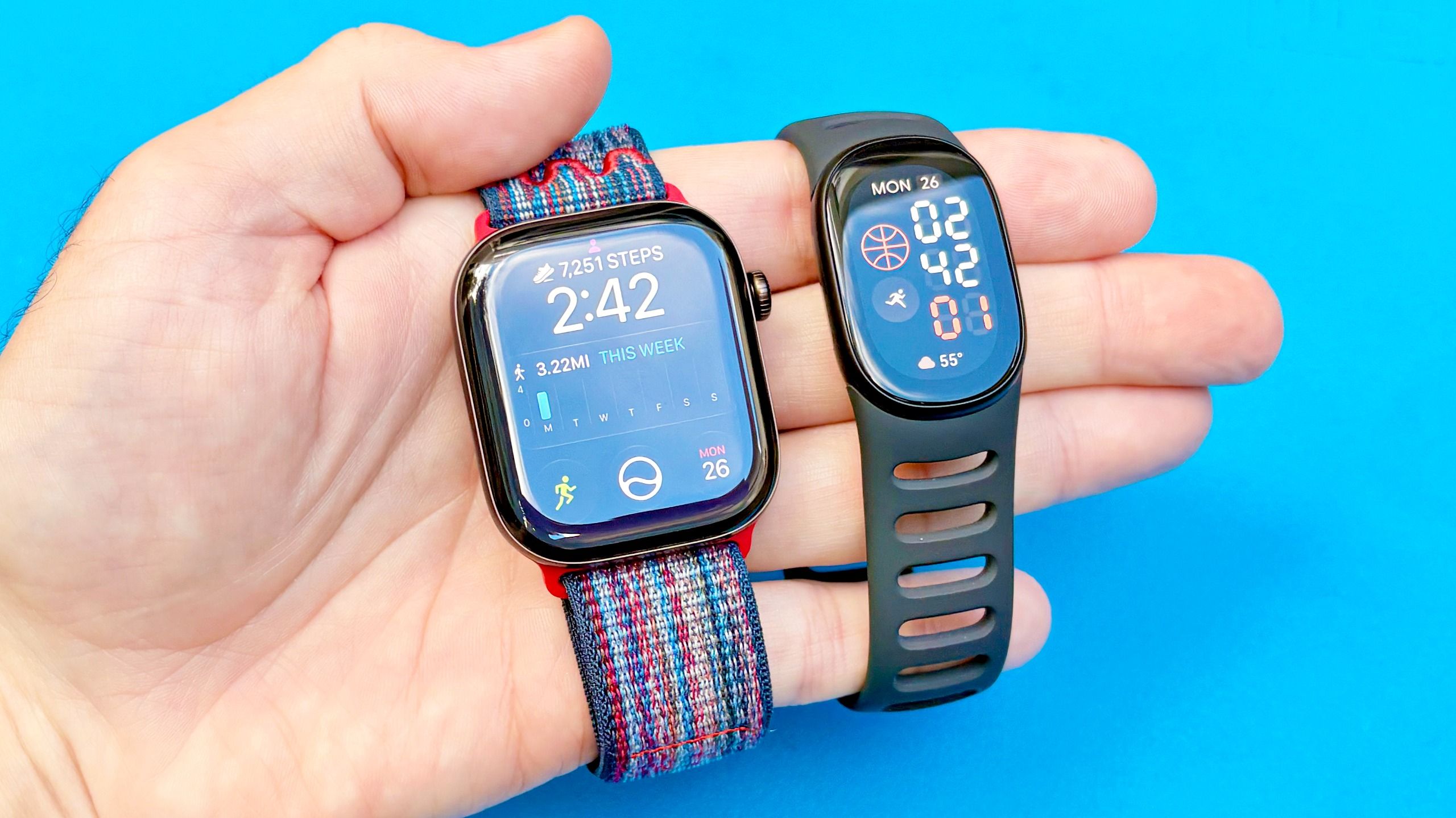
(Image credit: Dan Bracaglia/Tom's Guide) I walked exactly 6,094 steps wearing the Fitbit Edge on my left wrist and the Apple Watch Series 12 on my right wrist to find out which is the more accurate fitness tracker.My 55-minute walk also included just under 500 feet of elevation gain with roughly three miles of ground covered. As a control, I separately logged my walk using the Strava app on my iPhone 16 Plus.Find the results of my Fitbit Edge versus Apple Watch Series 12 head-to-head fitness tracking performance test below, along with the five biggest takeaways from the data.Fitbit Edge vs. Apple Watch 12 (Image credit: Dan Bracaglia/Tom's Guide)But first, it's worth calling out key differences in terms of cost, features, and intended user between these two modern devices. For instance, when it comes to full-featured wearables, the Apple Watch 12 is one of the best smartwatches you can buy.The Fitbit Edge, meanwhile, has essentially zero smart features, but is still among the best fitness trackers on the market because it offers reliable, distraction-free holistic insights. Cost-wise, the Fitbit Edge starts at $179, and the Apple Watch 12 starts at $399.While the Apple Watch 12 is for iOS users only, the Fitbit Edge brings Google's best health and fitness features to both Android and iOS devices.Ultimately, when it comes to onboard holistic and tracking tech, the two are fairly evenly matched: Both models have GPS, barometric altimeters, and continuous heart rate monitors.Get instant access to breaking news, the hottest reviews, great deals and helpful tips.With that out of the way, on to the test results!I walked 6,000 steps with the Fitbit Edge vs Apple Watch 12 Swipe to scroll horizontally Header Cell - Column 0 Fitbit Edge Apple Watch 12 Strava (control) Steps 6,079 steps 6,053 steps 6,094 steps Distance 3.15 miles 3.22 miles 3.28 miles Climb 476 feet 502 feet 480 feet Average elapsed pace 18 mins 21 secs per mile 17 mins 07 secs per mile 16 mins 58 secs per mile Average heart rate 115 bpm 133 bpm n/a Max heart rate 163 bpm 168 bpm n/a Calories burned 531 total calories 461 total calories n/a Battery usage 10% 0% n/a 1. Fitbit's step count is closer to the control (Image credit: Dan Bracaglia/Tom's Guide)I walked precisely 6,094 steps during my 55-minute walk, according to the control data logged by Strava, a tally that the Fitbit Edge came ridiculously close to matching.In terms of accuracy in these comparisons, my rule of thumb is that any step count within 100 steps of the control is excellent and well within a reasonable margin of error. With that in mind, Apple and Fitbit each performed seriously well. But while Apple undercounted by only 41 steps, the Fitbit Edge came within 15 steps of my actual total.2. But Apple's total distance is more accurate (Image credit: Dan Bracaglia/Tom's Guide)On the flip side, when it came to correctly logging my total distance, the Apple Watch Series 12 proved more accurate than the Fitbit Edge, with a tally that's just 0.06 miles off from Strava's measure.The Fitbit Edge didn't do too badly, though, coming within 0.13 miles of the control data, a result I still deem more than acceptable.3. Fitbit's climb data is spot-on (Image credit: Dan Bracaglia/Tom's Guide)I just published my Fitbit Edge review, and one of the upgrades I'm most excited for is the onboard barometric altimeter for precise elevation tracking. The Edge's predecessor, 2023's Fitbit Charge 6, lacked this important piece of tech. While some wearables try to roughly calculate climb using GPS data, the Charge 6 never did.The upgrade definitely paid off, because the Fitbit Edge logs uphill efforts with impressive reliability. For this test, the Edge's climb data is within four feet of the control. The Apple Watch 12, meanwhile, proved a little more generous with its climb data, a trend I've noted several times before in similar head-to-heads.4. Apple's average heart rate is slightly higher than expected (Image credit: Tom's Guide)I'm not sure if the Apple Watch 12 wasn't worn tightly enough (or maybe too tightly), but the logged average heart rate of 133 bpm for this brisk yet not overly demanding walk is slightly higher than I expected, especially when compared to heart rate data from walks of similar effort (~120 bpm tends to be my average).That said, the Fitbit Edge's average heart rate is slightly lower than anticipated, though the max pace is much more aligned with what I've come to expect from such a workout.5. Apple's pace is closer to the control, but Fitbit wins overall (Image credit: Dan Bracaglia/Tom's Guide)Finally, Apple's average pace data is much more closely aligned with Strava's. Fitbit's tally, meanwhile, I'd label as "slower than expected," especially given the fact that I was moving briskly and barely paused at any point during the walk.That said, the Edge logged several additional minutes of workout time compared to Strava and Apple (it was the last device I ended my workout on), which might be the reason for the sluggishness.Ultimately, pace aside, I'm calling the Fitbit Edge the winner for this head-to-head fitness tracking showdown versus the Apple Watch Series 12. Not only did the Edge log a more accurate step count, but it also beat Apple at logging my climb and heart rate (even if the Apple Watch was closer in terms of distance and pace).Of course, I'd happily trust either device as my daily fitness tracker. Which begs the question: Which of these two 2026 wearables would you rather own? Let me know in the poll below. Follow Tom's Guide on Google News and add us as a preferred source to get our up-to-date news, analysis, and reviews in your feeds. More from Tom's GuideI walked 5,500 steps with the Apple Watch 12 vs Garmin Venu 4 — here's the winnerApple Watch Series 12 vs Apple Watch Ultra 4: Which new Apple Watch should you buy?I’ve tested over 100 fitness trackers head-to-head — 3 workout stats I trust the least Dan Bracaglia is the Tom’s Guide editorial lead for all things smartwatches, fitness trackers and outdoor gear. With 15 years of experience as a consumer technology journalist testing everything from Oura Rings to instant cameras, Dan is deeply passionate about helping readers save money and make informed purchasing decisions. In the past year alone, Dan has assessed major product releases from the likes of Apple, Garmin, Google, Samsung, Polar and many others. An avid outdoor adventurer, Dan is based in the U.S. Pacific Northwest where he takes advantage of the beautiful surroundings every chance he gets. A lover of kayaking, hiking, swimming, biking, snowboarding and exploring, he also makes every effort to combine his day job with his passions. When not assessing the sleep tracking and heart rate accuracy of the latest tach gadgets, you can find him photographing Seattle’s vibrant underground music community.
I walked 6,000 steps with the Fitbit Edge vs Apple Watch 12 — and I'm shocked by the results
Full Article
Original Source
Read the full article at Tomsguide →KhanList aggregates and links to publicly available news content. We do not host full articles from third-party sources. Always verify important information with original sources.