
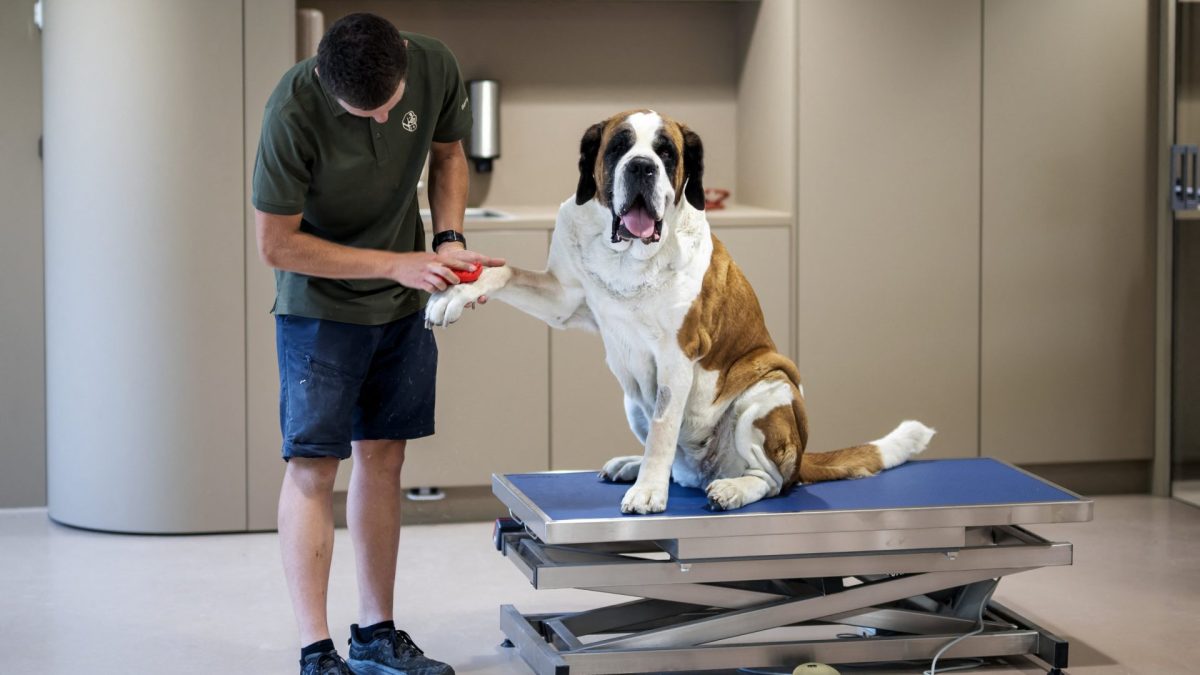
Growing up in Sri Lanka, the only snow-capped peak I ever saw was on a Christmas card. There was a St Bernard in the picture, and as a child, I wondered how a dog came to be on top of a mountain. Several decades later, I found myself in the Alps, at Barryland – a Swiss “theme park” dedicated to the huge Alpine dogs. It was in the 11th century that the Congregation of Canons of the Great Saint Bernard built a hospice for pilgrims on a Swiss section of the Via Francigena – the medieval route from Canterbury to Rome. It was positioned at an impassable Alpine crossing, so the canons eventually (700 years later) bred dogs to pull small loads on sledges and help rescue pilgrims trapped in the snow. Word of the dogs’ heroic deeds spread, and in 1887 the breed was declared the national dog of Switzerland. Shorts The monastery now has fewer canons to care for the canines, so the Barry Foundation – named after a St Bernard said to have rescued 40 people – was established to manage the kennels. After a major refurbishment and expansion, Barryland relaunched last June. Located around 40km north of the hospice in the Rhône Valley town of Martigny, Barryland is housed in a curvy, paw-shaped building. The valley leading to the Great St Bernard Pass – the highest point of the Via Francigena, which crosses into Italy – rises to the south. Four large windows on the ground floor offer views of the landscape – I counted four peaks, canopied in velvety green treetops and thought of pilgrims trying to navigate the terrain during snowstorms. Walking the dogs at Barryland, Switzerland Although it bills itself as a theme park, Barryland isn’t one in the traditional sense. It is an interactive and immersive experience laid out like a museum, and operates as a non-profit whose main purpose is to ensure the survival of the breed – a male puppy from every litter is named Barry in honour of the original Barry. The 31 dogs under the care of 21 keepers at the foundation no longer rescue people, but help in education and therapy sessions. They live off site and are brought down to the facility in rotation, though they remain connected to their home on the Pass by spending summers up by the hospice. They take two long walks near a lake in the fresh mountain air every day, and fare better than most household pets. The Barryland site is in the Swiss Alps They breed naturally, so the birth of puppies is a rare highlight. On 11 August this year, a litter of one female and seven male puppies was born. Their arrival at Barryland at six weeks old was eagerly anticipated. A daily puppy-feeding session was added to the schedule at which visitors could watch them enjoy their food and learn about their diet – the huge adult dogs eat around 1kg of dry food every day. I walked upstairs to watch a morning care demonstration. A few people had gathered outside a glass panel behind which Japlou, a five-year-old, short-haired St Bernard, received the star treatment. I was spellbound as the keeper demonstrated Japlou’s routine: teeth brushed with chicken paste, a weekly manicure, two different types of brushes – one for the top of his body and another for the underside. Head of the breeding programme Manuel Gaillard holds two puppies (Photo: Fabrice Coffrini/AFP/Getty) At the end, Japlou, given the option to go outside or greet his audience, chose fame. He sauntered over to an open window where adoring fans reached in for cuddles. Kisses flew back and forth, and declarations of love were made in French. “The dogs decide how much they want to interact with people. If they are tired, they walk away,” Barryland’s director, Mélanie Glassey-Roth, explained as we passed a room with a hydrotherapy tank. “When puppies are born, they weigh 500g to 600g and gain around 1kg per week. It strains their joints, so the dogs get regular physiotherapy,” she said. The St Bernard rescue dog is Switzerland’s national emblem (Photo: Fabrice Coffrini/AFP/Getty) Four large, glass-fronted, soundproof kennels, referred to as boxes, make up the rest of the space. Visitors can watch the dogs resting inside or turn up for hydrotherapy, feeding and grooming sessions scheduled several times a day. Barryland welcomes as many as 1,500 visitors daily; a privacy wall in each box allows dogs to escape the attention. An automatic dog door connects each to a large garden. I spotted several dogs sprawled on the grass, snoozing in the sun, and chuckled when Mélanie told me they sleep for about 16 hours a day. People had travelled from all over Switzerland to Barryland. Many, like myself, from even further. Watch the St Bernards get pampered at Barryland After the dog care demonstration I walked down to the ground floor, where a variety of multimedia displays, immersive exhibits and historical artefacts chart the journey of St Bernards from mountain rescue dogs to the stars of Hollywood films – notably, the Beethoven series of the 90s and 2000s. At the end of my visit I walked around the grounds, where chickens, goats and rabbits live around a small lake. Barryland may bill itself as a theme park, but it has been designed with the dogs in mind. It also exalts the joy of the human-dog bond by connecting us to their role in the rescue of people at their most vulnerable. I’d come here to indulge a childhood fascination with a dog on a Christmas card. I was leaving with admiration and respect for these huge Alpine icons. How to get there and where to stay The writer was hosted by Swiss, which offers more than 160 weekly flights from five UK airports to Zurich or Geneva, swiss.com. The Swiss Travel Pass gives international visitors unlimited travel on consecutive days across the rail, bus and boat network, plus scenic routes and local trams and buses in around 90 towns and cities. From £254 for a three-day pass, swisstravelpass.com. Hotel Vatel is an accessible four-star hotel in Martigny with doubles from CHF160 (£146), hotelvatel.ch/en/martigny
I visited a Swiss dog theme park with manicures, pools and a puppy called Barry
Full Article
Original Source
Read the full article at Inews →KhanList aggregates and links to publicly available news content. We do not host full articles from third-party sources. Always verify important information with original sources.