
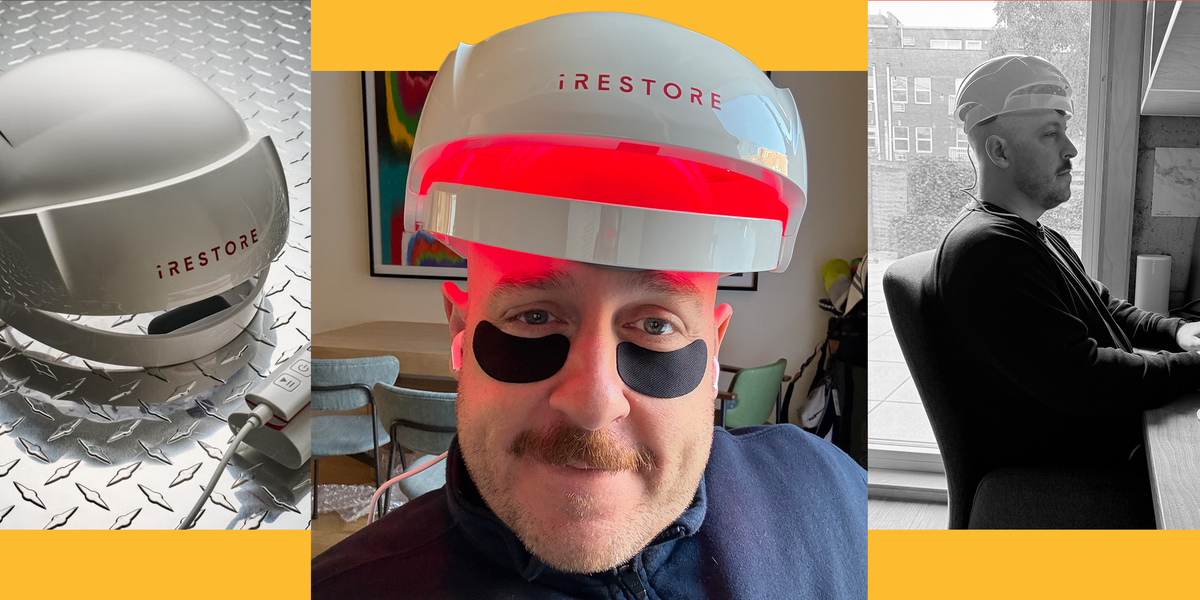
Hi, I'm Bob Gearing or, as my buddies like to call me, "Beauty Bob." By day, I'm a well-SPF’d tech sales bro; by night, I'm a red-light mask guy who definitely didn’t think he’d care this much about skincare. Every month, I'll be coming at ya with a real-guy perspective on beauty and grooming because, uh, nobody really taught us about this stuff. Questions? Hit me up @beautybob.ONE A RECENT golf trip with 12 of my boys, I figured the usual questions would come up. Most of them know I write this column, so I’ve become the group’s official grooming guy. I always have a bag full of sunscreen and a new formula I’m raving about, and by day two, someone’s asking to try my Papatui eye patches. (We’re all 40-plus and when this crew gets together, the whiskey flows, so the under-eye bags follow.)This trip was different. Between rounds, at the bar, even on the cart, the conversation kept circling back to one thing: hair loss. Old friends, new friends, it didn’t matter. Everyone wanted to know my plan, and what they could do, too.A few were confused when I told them I’m not trying every single resource at my disposal to grow mine back. I want to keep what I’ve got, of course, but within reason. Once your algorithm knows you have even the slightest concern about balding, the treatments, supplements, and potions being hawked to you are limitless.However, your time is not. Because I love how my hair looks buzzed down to a 0, I’m ok to leave the days of a thick flow behind me. What I’m going for now is the highest return for the smallest time investment with the fewest side effects.Last year I told you I’d traded my minoxidil foam for a discreet red light dad hat that could charge up my hair follicles anytime, anywhere. Since then, I’ve tested a few other takes on the tech, including a completely different device from a different brand: the iRestore Essential, a hard-shell helmet.The company says its helmet led to a 43 percent increase in hair count within four months in a clinical study. Yes, I look like Buzz Lightyear when I wear it and my wife suppresses a laugh every single time she walks in on me using it, but I’ve learned there's a good reason for the spaceman design.How Does It Perform?When I started testing the iRestore, one thing stood out right away. The helmet only asks for 25 minutes three times a week instead of daily treatments, which some devices require. For a toddler dad juggling a tech sales day job with plenty of night commitments—plus writing a men’s grooming column—three sessions a week felt much more likely to happen.Another difference is that iRestore mixes in actual lasers along with LEDs. I’m the guy who’s always chasing the tech edge, so lasers not only sound like an upgrade, but after eight months, I can also say the helmet seems to be doing the heavy lifting it promises. (More on this below.)It’s also surprisingly light for something that looks like it was built by NASA. And yes, watching the lights flash around the inside of the helmet makes me feel like something is happening. Placebo or not, I’m here for it.Now the tricky parts. Lights tucked into ball caps are easy to wear anywhere: the subway to work, coffee shops, school drop-off. It can layer into my day as it is. But the helmet style is strictly for the apartment. I can use it while cleaning or watching TV; I just don’t really want to be rocking it with other people around. (Though never say never—could be a hit at next year’s golf outing.)The other tricky part: Unlike the red-light hat, the helmet has no built-in battery. You’re either plugged into the wall or into a separate battery pack. Because I’m rarely sitting still—I’m switching over the laundry, grabbing the door for a delivery, standing up to yell at the Lions, or chasing a 3-year-old—I’ve ripped the cord out mid-session more times than I can count.Leave the battery pack on my desk, and it goes flying the second I stand up. Stick it in my pocket with the cord hanging loose, and it snags on the chair. The fix I finally landed on: running the cord down the inside of my shirt so it has nothing to catch on, then clipping the battery pack to my belt or my shorts. Big Dad energy.Why It WorksAt first glance, red light therapy might just look like a bunch of red flashlights—it’s not. A review of seven double-blind, placebo-controlled trials of at-home devices found that people using the real thing saw a significant increase in hair density compared with those using sham versions.So what’s actually happening up top? Red light in the 630 to 670 nanometer range “is thought to be absorbed by cytochrome c oxidase in the mitochondria, which may increase ATP production and cell signaling,” says Dendy Engelman, MD, a board-certified dermatologist in New York City. It essentially loads up your cell’s gas tanks. “The hope is that this pushes miniaturized follicles to stay in, or return to, the growth phase.”The iRestore Essential runs at 655 nm, right in that sweet spot, which is also where the clinical research is concentrated. Drift outside it, and you’re in less-proven territory. But even within the range, Dr. Engelman says many cheap devices don’t deliver enough energy to the scalp to make a difference. The Essential packs 120 diodes total: 69 LEDs and 51 lasers. The lasers deliver precision down to the follicle, while the LEDs cover the wider surface of your scalp.This is where the hard-shell spaceman design comes in. Light loses strength the farther it travels, so for every diode to deliver the same dose, it has to sit the same distance from your scalp, every session. A soft dad hat can shift, tilt, or sit differently depending on the fit. A rigid helmet locks all 120 diodes in place, aimed at the top of your head and crown. (Thankfully, a few vents keep you from overheating.)These specs are important, and you’ll notice a lot of nerdy-looking language with most red light devices out there. But not everyone has legit data behind it.“It’s easy to get tripped up in marketing claims,” says Brandon Miller, a client solutions executive at Clarkston Consulting who tracks the wellness tech market. “They may be copying the design and hardware, but they’re not necessarily copying the same type of diodes or lasers. So when you think you’re getting a good product, it’s actually a dupe.”For example, a box that says “90 percent of users saw growth” doesn’t tell you much. How many people were tested? Was there a placebo group? Who paid for the study?His advice is to dig deeper, because the category is flooded with knockoffs. Start with the FDA language on the box. “FDA-approved” is the highest bar, requiring extensive clinical trials and rigorous testing, and it’s also rare for at-home devices. “FDA-cleared” means the agency found the device is as safe and effective as a similar product already on the market.That’s the label to look for; then check the specific model in the FDA’s database. “FDA-registered” or “FDA-listed” can sound reassuring, but they only mean the manufacturer gave the FDA a heads up that the product exists. Nobody’s reviewed it for safety or effectiveness.Even the FDA label has limits. Clearance “reflects safety and substantial equivalence, not proof of strong results,” Dr. Engelman says. And the knockoffs are worse: “Dupes often don’t verify wavelength or power output.”Eight Months InAfter many hours under my iRestore, the schedule is still my favorite part. Every other day, 25 minutes, done. Though my head is buzzed, I still keep an eye on the border of my stubble. I don’t see any new loss, and my temples are holding strong.But Dr. Engelman says that short hair hides thickening I might not be appreciating. “To the patient, it’s like watching paint dry,” she says. Her fix: baseline photos in consistent lighting, an occasional grow-out, or go to a dermatologist who can use trichoscopy for an objective hair count. Maybe you will see me rocking some flow in the future.Hair growth trials typically show modest gains over about 16 to 26 weeks, so Dr. Engelman tells patients to give it at least six months. And, don’t forget, the benefits likely fade if you stop.Should you stack it with other treatments? Dr. Engelman frames devices as an add-on, not a replacement, since minoxidil and finasteride have stronger evidence, as do in-office PRP injections. Topicals can go on before or after a session. “When it comes to hair loss and attempts to slow shedding and support regrowth, more is more,” she says.Is It Right For You?All the experts I spoke with said you need to figure out why you’re losing hair in the first place. Miller says most guys assume all hair loss is the same. It’s not. Genetic hair loss, stress-related shedding, and other causes respond to different treatments, so a device that’s great for one might do nothing for another. A derm can tell you what you’re dealing with before you drop hundreds on a gadget.Dr. Engelman says the best fit is hormonal hair loss, also called androgenetic alopecia or male pattern baldness. “It’s the only type with solid clinical evidence behind red light therapy,” she says. It works best on early to moderate thinning, while follicles are shrunken but still alive, and “It won’t revive follicles that have been bald for years.”Stress-related shedding usually resolves on its own within three to six months, so she says your money is better spent on the cause, like checking iron, vitamin D, and thyroid levels. For alopecia areata, an autoimmune condition, the evidence is limited. And whatever your type: “Think thicker, healthier hair and slowed progression rather than a new hairline.”Next, look past the light count. More diodes sound better, but Miller says it doesn’t tell the whole story. Check that the brand lists its wavelength (red light in the 630 to 670 nm range is what’s studied for hair growth) and the power of its lasers, not just a big diode number. Then check where those diodes sit on your head, because light that never touches your problem zones may not be right for you. Stick to the session length the device was cleared with.Finally, pick the device you’ll actually use. None of these devices work if they live in a drawer. Ask yourself what you’ll realistically do for six months straight, which is the minimum most dermatologists say to give any hair loss treatment before judging it. Choose the schedule that fits your life, and let’s head to infinity and beyond.Other Hair Loss Products We LikeBest Overall Hair Loss TreatmentEasiest to Use Laser Hair Growth DeviceBest Hair Thickening ShampooMore Hair Loss SolutionsHair Thickening Shampoos | Hair Growth Serums | Shampoos for Hair Growth | Scalp Treatments | Shampoos for Thinning Hair | Laser Hair Growth Devices | Hair Growth Devices Bob Gearing is a New York-based writer covering men’s grooming from the perspective of a very real (and very sweaty) dude. By day, he’s a well-SPF’d tech sales bro; by night, he’s a red-light mask guy who definitely didn’t think he’d care this much about skincare. When he’s not testing the latest face serum, you’ll find him sweating through a round of golf or holding out hope that the Lions will make the Super Bowl before he dies.Sean Zucker is the Grooming and Reviews Editor at Men's Health. He brings over half a decade of experience covering health, wellness, and lifestyle. When Sean's not writing about hair products, you can find him running for exercise, or toward the nearest food truck.
I Used the iRestore Laser Therapy Hair Growth System for Eight Months. This Is What It Did to My Hairline.
Full Article
Original Source
Read the full article at Menshealth →KhanList aggregates and links to publicly available news content. We do not host full articles from third-party sources. Always verify important information with original sources.