
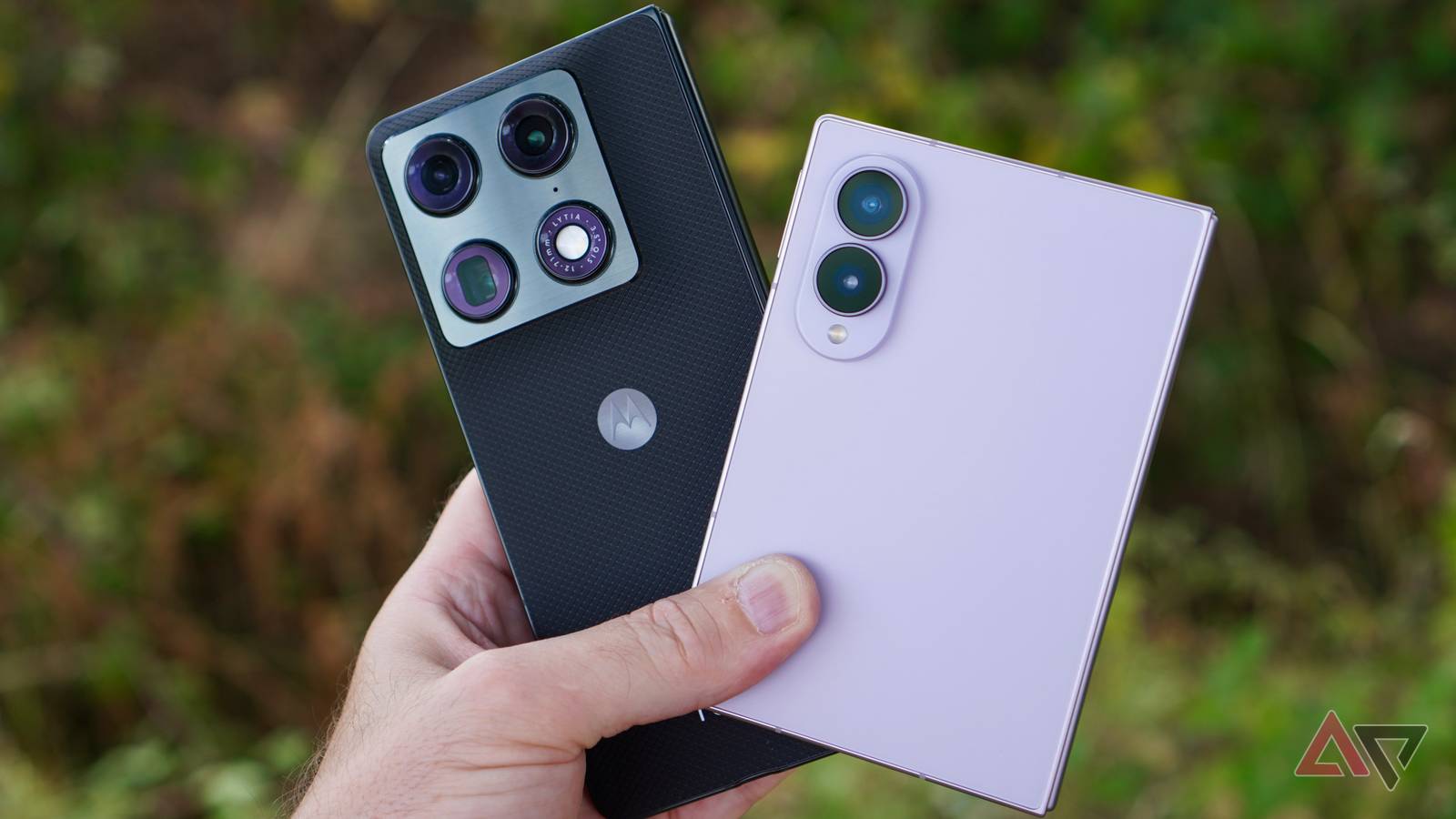
You’re in the market for a new folding phone, and the new Samsung Galaxy Z Fold 8 has caught your eye. Good choice, but what about the Motorola Razr Fold? Motorola’s first big-screen foldable is tempting, but which one will be the better choice for you? I’ve used both phones extensively over the past weeks, and this is what they’re like. Samsung Galaxy Z Fold 8 vs. Motorola Razr Fold: Design Very different approaches to folding phones Samsung Galaxy Z Fold 8 (left) and Motorola Razr Fold While both are folding phones, they are very different from each other. The Motorola Razr Fold is a traditional big-screen folding phone. It has a tall, relatively thin 6.56-inch, 21:09 aspect ratio cover screen and an almost square 8.09-inch 08:07.2 aspect ratio open screen. Samsung Galaxy Z Fold 8 SoC Qualcomm Snapdragon 8 Elite Gen 5 for Galaxy Display type Dynamic AMOLED 2x 120Hz Display dimensions 7.6-inch open / 5.5-inch closed Display resolution 2448 x 1848 open / 1972 x 1248 closed RAM 12GB / 16GB Storage 256GB / 512GB / 1TB Battery 4,800mAh Charge speed 45W Super Fast Charging 2.0 wired / wireless Operating System Android 17 / One UI 9 Front camera 10MP main / 10MP cover Rear camera 50MP main / 50MP wide Wi-Fi connectivity Wi-Fi 7 Bluetooth Bluetooth 6.0 Dimensions 124 x 161 x 4.5mm open / 124 x 82 x 9.7mm closed Weight 201 grams IP Rating IP48 Colors Lavender / Graphite / Cream / Pistachio (online exclusive) Stylus N Material Armor Aluminum The Galaxy Z Fold 8 is a “wide” foldable, which Samsung says is designed for watching videos, reading books, and browsing social media. It means the screen sizes don’t follow the same format as the Razr Fold. The 5.5-inch, 16:10 aspect ratio cover screen is joined by an open, 7.6-inch, 4:3 aspect ratio screen. The phone is more compact and does not have the same in-hand feel as the Razr Fold due to its different dimensions. Motorola Razr Fold (bottom) and Samsung Galaxy Z Fold 8 Both have essentially the same thickness when folded and unfolded, but there’s a difference in weight. The Galaxy Z Fold 8 is only 201 grams, and it’s portable and easy to carry around due to this. The Razr Fold is 243 grams, and although the phone hides its weight well, when compared to the Z Fold 8 it’s a much heavier beast. If a light, compact phone appeals, the Z Fold 8 is more likely to be for you than the Razr Fold. However, Motorola has done a great job with the Razr Fold’s ergonomics. The chassis is curved at the edges, and has an inward curve where you grip the phone to open it up. Motorola Razr Fold (left) and Samsung Galaxy Z Fold 8 Samsung has cleverly engineered the otherwise flat-sided Z Fold 8 to make the panels easier to grip compared to previous models. Both have an IP48 dust and water resistance. However, Motorola adds an IP49 rating. I think some people may prefer the Razr Fold’s textured rear panel, as it adds grip and lessens the chance of dropping the phone. The Z Fold 8 is smooth and flat. Motorola Razr Fold SoC Qualcomm Snapdragon 8 Gen 5 Display type pOLED inner / pOLED cover Display dimensions 8.1-inch inner / 6.56-inch cover Display resolution 2484 x 2232 pixels inner / 2520 x 1080 pixels cover RAM 16GB Storage 512GB Battery 6,000mAh silicon-carbon Charge speed 80W wired / 50W wireless Operating System Android 16 Front camera 32MP inner / 20MP cover Rear camera 50MP main / 50MP wide / 50MP 3x telephoto Wi-Fi connectivity Wi-Fi 7 Bluetooth Bluetooth 6 Dimensions 144 x 160 x 4.55mm open / 160 x 73 x 9.89mm closed Weight 243 grams IP Rating IP48 / IP49 Colors Pantone Blackened Blue / Pantone Lily White Stylus Moto Pen Ultra The Galaxy Z Fold 8 is a joy to hold, both open and closed, and it’s enjoyable to use. The Razr Fold doesn’t hold the same appeal, and won’t change the minds of anyone who hasn’t got on with big foldables before. The Galaxy Z Fold 8 has the ability to change your mind, and that’s what makes it special. Samsung Galaxy Z Fold 8 vs. Motorola Razr Fold: Screens and hinge Samsung pulls ahead Motorola Razr Fold (left) and Samsung Galaxy Z Fold 8 It wouldn’t be a discussion about folding phones without mentioning the crease. Samsung’s Flex Titanium screen technology has given the Z Fold 8 a uniform inner screen, where the crease is minimized. It’s still there if you look for it, but it’s less noticeable than before. The flat surface means you feel it less with your finger, and the anti-reflective coating makes the screen easy to see in most lighting conditions. Viewing angles are also excellent. Samsung’s hinge is a work of art. It requires little effort to open, yet has the right amount of resistance. It’s completely silent, and opens and closes with an extremely satisfying thunk. It’s so well-judged, it encourages you to open the phone. Motorola Razr Fold (left) and Samsung Galaxy Z Fold 8 You will notice the crease more on the Razr Fold’s open screen. It’s not prominent, but when put next to the Galaxy Z Fold 8, its presence is obvious. Under-finger feel is minimal, and when the screen is lit up, it practically disappears. The Razr Fold’s inner screen is slightly ‘stickier’ to the touch and is more reflective. The hinge has a linear, solid motion with more resistance when opening it than when closing the phone, where it’s quick to snap shut. There’s a tiny bit of noise to it, but nothing that would be a concern. Motorola Razr Fold (left) and Samsung Galaxy Z Fold 8 If you want to use your folding phone in a ‘desktop’ orientation, where the hinge supports the half-open screen, the Razr Fold is the one to get, as the Z Fold 8 does not have this feature. Samsung Galaxy Z Fold 8 vs. Motorola Razr Fold: Camera Do you really need a telephoto? What separates the Razr Fold and Galaxy Z Fold 8’s cameras is the 50-megapixel telephoto on the Motorola phone, as otherwise both use 50MP main and wide-angle cameras. The Samsung Galaxy Z Fold 8’s photos are on the LEFT in our comparisons, and the Motorola Razr Fold’s photos are on the RIGHT. The first and second set of images show the main camera, the next set is the wide-angle camera, and the final set of two show the Z Fold 8’s 2x optical quality zoom alongside the Razr Fold’s 3x telephoto zoom. This gives the Razr Fold a 3x optical zoom, while the Z Fold 8 makes do with a 2x optical quality zoom by cropping the main 50MP camera’s images. The two take very different photos. The Razr Fold sometimes amps up primary colors even more than the Samsung phone, but it often looks less natural than the Z Fold 8’s photos. However, the Razr Fold’s photos are usually sharper than the Z Fold 8’s photos, with the Samsung phone showing stabilization problems, which often affect its cameras. The Z Fold 8’s wide-angle camera takes photos consistent with the main camera, while the Razr Fold’s wide-angle photos look overexposed next to them. Worse, there’s obvious edge enhancement at work, spoiling the final image. Finally, here’s the difference between the Z Fold 8’s 2x optical quality zoom and the Razr Fold’s 3x telephoto optical zoom. It allows you to get closer to a subject that’s further away without losing quality, and there’s plenty of detail and a decent color balance. The Z Fold 8’s 2x optical quality crop is also good, but when you look closely, the pixelation and low level of detail become clear. If you want good quality zoom capability, the Razr Fold delivers, but the rest of the camera system can disappoint compared to the Z Fold 8. By default, Samsung stores photos in its Gallery app. It has a host of AI editing features and is surprisingly powerful. The Motorola Razr Fold uses Google Photos, with all its excellent editing features. Samsung Galaxy Z Fold 8 vs. Motorola Razr Fold: Software and performance Updates, chips, and multitasking Motorola Razr Fold (left) and Samsung Galaxy Z Fold 8 One of the biggest considerations before buying either phone is the software update situation. The Galaxy Z Fold 8 comes with Android 17 and One UI 9 installed, and Samsung promises seven years of Android OS and security updates for the phone. Motorola also promises seven years of Android and security updates for the Razr Fold, but the phone starts with Android 16 installed, so it’s one step behind the Galaxy Z Fold 8. Samsung Galaxy Z Fold 8 (left) and Motorola Razr Fold Neither will commit to when they will release major updates, but Motorola has a reputation for not updating its phones in a timely manner, compared to Samsung. If software updates are important to you, the Galaxy Z Fold 8 may be the better choice. How about special multitasking features which make use of the open screen? The Galaxy Z Fold 8’s split-screen system is easy to use, and supports two apps side-by-side, with the option of a third, and a floating window. It’s activated from the taskbar, where apps can be dragged into position, or from the helicopter view using a long press on the icon. The lack of the Flex Mode hinge hinders the Z Fold 8’s productivity-related multitasking. The Razr Fold’s multitasking features are more comprehensive. There are buttons in helicopter view for split-screen and floating window, and I love how you can add a third app to split-screen mode from the taskbar. Use the hinge to hold the phone open at a 90-degree angle, and the keyboard appears on the lower half, but the screen rests on the table, risking damage. However, the Razr Fold is more versatile than the Z Fold 8. The Samsung Galaxy Z Fold 8 uses the Qualcomm Snapdragon 8 Elite Gen 5 for Galaxy processor with either 12GB or 16GB of RAM. The Motorola Razr Fold has the non-Elite Snapdragon 8 Gen 5, and comes with either 12GB or 16GB of RAM. Phone 3DMark Wild Life Extreme Stress Test Best Loop Stability Battery drain Samsung Galaxy Z Fold 8 7358 43% 10% Motorola Razr Fold 5335 56% 11% Both phones get warm to the touch when running the 3DMark 20-minute benchmarking test, and the Z Fold 8 handles it better than the Razr Fold. The Motorola phone’s heat is spread over the entire device, and it doesn’t dissipate as fast as it does on the Z Fold 8. Phone Geekbench 6 Single-core Multi-core GPU Samsung Galaxy Z Fold 8 3590 10240 23520 Motorola Razr Fold 2586 8722 17724 What all this means is, if you’re a keen gamer, the Z Fold 8 may handle long gaming sessions better than the Razr Fold. Both are great for more general use. One other note is the Razr Fold supports a stylus, and you get one in the box with the phone. The Galaxy Z Fold 8 does not support a stylus. Samsung Galaxy Z Fold 8 vs. Motorola Razr Fold: Battery life and charging Silicon-carbon arrives Samsung introduced silicon-carbon battery technology with the Galaxy Z Fold 8, and the battery inside the phone has a 4,800mAh capacity. Motorola also uses a silicon-carbon battery in the Razr Fold, but with a higher 6,000mAh capacity cell. Motorola’s charging system is also more powerful, with up to 80W wired and 50W wireless, compared to the 45W wired and 20W wireless charging for the Galaxy Z Fold 8. However, to get these speeds, you will need to buy proprietary chargers. If you use a different charger, the speeds will vary. I used the same Anker charger with both phones. Both took about 75 minutes to charge fully. The Galaxy Z Fold 8 reached 65% in 30 minutes compared to 50% in the same time on the Razr Fold. The Razr Fold’s battery lasts longer than the Z Fold 8’s battery on a single charge. I saw around six hours of screen time on the Razr Fold, but others have claimed to stretch a charge for longer than this, while around five hours with similar use was typical on the Galaxy Z Fold 8. Which one should you buy? Motorola Razr Fold (left) and Samsung Galaxy Z Fold 8 Both the Razr Fold and Galaxy Z Fold 8 are excellent purchases, but there’s not one clear winner, as each will appeal to a different type of person. If you want a folding phone for video, books, social media, and games, the Galaxy Z Fold 8 is the better choice. The inner screen is fantastic and looks much more modern than the Razr Fold’s inner screen. The Z Fold 8’s cover screen is much more usable than the Razr Fold’s, from the keyboard to how apps appear on it. Samsung Galaxy Z Fold 8 9/10 SoC Qualcomm Snapdragon 8 Elite Gen 5 for Galaxy Display type Dynamic AMOLED 2x 120Hz Display dimensions 7.6-inch open / 5.5-inch closed Display resolution 2448 x 1848 open / 1972 x 1248 closed RAM 12GB / 16GB Storage 256GB / 512GB / 1TB The Razr Fold’s more traditional appearance, multitasking features, and stylus support make it more suitable for productivity fiends, and those who want to use at least two apps on the open screen at once. The camera is also more versatile than the Z Fold 8’s, although some will prefer the more natural colors in the Z Fold 8’s photos. After you’ve figured out what you want to do with your new folding phone, the decision about which one to buy will become much clearer. The good news is, you’ll be happy whichever one you choose. For me, I’d choose the Galaxy Z Fold 8. It’s the phone that better suits my needs. It’s the one I haven’t wanted to stop using. I haven’t missed the Razr Fold since the end of my review period. Motorola Razr Fold 8.5/10 SoC Qualcomm Snapdragon 8 Gen 5 Display type pOLED inner / pOLED cover Display dimensions 8.1-inch inner / 6.56-inch cover Display resolution 2484 x 2232 pixels inner / 2520 x 1080 pixels cover
I used the Galaxy Z Fold 8 and Razr Fold side-by-side; it was hard to pick the winner
Full Article
Original Source
Read the full article at Androidpolice →KhanList aggregates and links to publicly available news content. We do not host full articles from third-party sources. Always verify important information with original sources.