
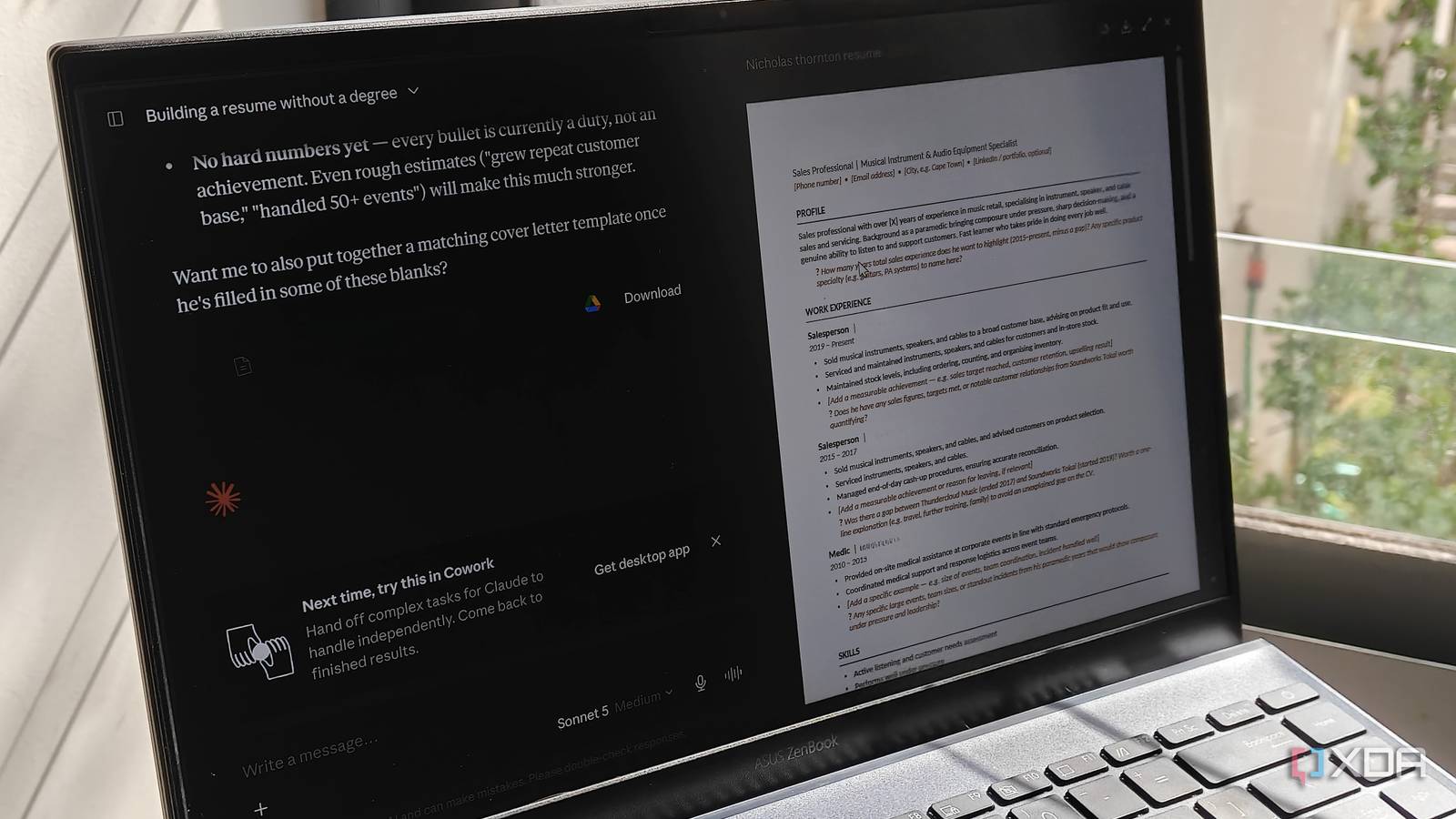
Published Sep 3, 2026, 5:31 PM EDT Megan is a Software Writer at XDA Developers who has been writing about consumer technology since 2016. With a postgraduate degree in New Media journalism, she has always been passionate about diving deep into topics and writing about them in a way that makes them easier to understand for everyday consumers. She runs her own blog called Tech Valkyrie and has contributed to Tom's Guide and Android Authority. She also worked at MakeUseOf as a Lead Editor. In her spare time she plays video games and geeks out about the latest tech. While some people use AI to write entire documents or completely replace their work, this opens you up to problems like hallucinations and generic output. The real value of AI tools lies in using them as collaborative partners that can help you identify blind spots and speed up repetitive processes. So recently, when a friend needed help with the resume, but both of us were struggling with the planning stage, I decided to try out Claude, ChatGPT, and Gemini to get some insights on how to approach the document. Why use AI for help with a resume? Leveraging AI's strengths while retaining control In this particular scenario, AI was the perfect tool to help me craft the resume. My friend has some old experience as a paramedic and currently works in sales. However, he has no tertiary education besides his ambulance certificate. At the same time, he works 50 hours a week and struggles to find the time to actually work on maintaining the documents for his new job search. I offered to help, but knew how time-consuming it can be to format and structure a CV. Since I don't work in the sales industry, I also wasn't sure how to translate his experience into a compelling profile. I knew that AI could help us in multiple ways. It would identify the blind spots I have when it comes to translating his experience, and it would speed up the process of crafting and structuring the document. At the same time, I made sure to steer away from using AI for the cover letter or to write the entire resume — I just needed it to provide the structure and some questions to address. There's no clear winner in this area My decision to turn to AI immediately yielded some useful insights. I started out by providing each tool with a quick summary of my friend's context. I also asked about what questions he should address in the resume. While I wasn't sure how to translate my friend's past experience as a paramedic into something relevant to his current job search, each AI tool could. Gemini, ChatGPT, and Claude all noted that while this experience isn't directly relevant, it can be highlighted in terms of skills and what the job taught him. This included skills like working under pressure, remaining calm in stressful situations, and being reliable. Since this was his longest period of employment, this meant that the job was no longer just an irrelevant addition, but a key inclusion that provided valuable insights about his reliability and skill set. While it doesn't relate directly to a sales environment, the AI tools helped frame this as a useful part of his job history. ChatGPT provided comprehensive, structured questions But this can also be overwhelming I used the same prompt for all the tools I used, which included the question "What questions should he answer?". Of the responses, ChatGPT's was the most comprehensive. The chatbot's response included sections on what his CV should communicate and how to make his paramedic experience valuable. This included a list of questions that I should ask him to fill out the CV, and what questions he should answer on his cover letter. However, the full list included over 49 questions, as well as bullet points for other items. While this definitely makes sure that you cover all your bases, it's an overwhelming list to work through. It means that if you want to get your resume constructed quickly, ChatGPT's approach may not be the best. However, if you want to make sure that you answer all possible questions your interviewer may ask, then ChatGPT could be useful for identifying blind spots — even if you don't use it to construct the final CV. Building the actual resume with details Claude provided the most usable results In the final part of the exercise, I asked each tool to generate a resume that my friend could use and edit. I gave it a summary of his job history, responsibilities, skills, and asked it to fill in any other questions that should be answered for each section. In his list of skills, we incorporated some of the insights the AI tools had provided regarding his paramedic history. After asking the AI tools to generate a resume, both ChatGPT and Gemini needed to be asked again to create a separate document, as they both initially just generated text to copy. Claude got the task right the first time, generating a document I could download immediately. When it came to the documents themselves, Claude generated the CV with the best balance between formatting, content, and additional questions. Claude was the only AI to also question the two-year gap in the job history I provided, something I had also noticed when going over the details. It noted that this would need to be addressed either in the CV or when preparing for an interview. It also suggested some potential answers to provide, which made me feel that these results were the best in terms of getting my friend interview-ready. Gemini's formatting was a bit less polished than Claude's, however its content was well-rounded. I did find, though, that its language was a bit too formal and verbose. It felt like it was trying to make some job responsibilities sound more elevated. For example, instead of including "end-of-day cash-up" in responsibilities, it phrased this as: "Executed daily end-of-day cash-up and financial reconciliation procedures with high accuracy and accountability". ChatGPT's formatting left a lot to be desired. Beyond the monotonous headings and blocks of text, it also occasionally added sentences with each word capitalized (known as sentence case, a style AI often uses). This generated resume would take the most work to get interview-ready, since it didn't have an appealing layout and contained far too much text. Some of the questions were helpful, but I didn't end up using ChatGPT's results for anything more than identifying a potential question that may need addressing. Each tool has its strengths, but Claude won out overall If you're generating your own resume with AI, the best tool might depend on your requirements. I didn't want to spend a lot of time on editing and formatting, but also needed the AI to identify my blind spots. For my own purposes, Claude offered the most well-rounded results and ended up being what I handed over to my friend for refining.
I used Claude, ChatGPT, and Gemini to build a resume, but only one felt interview-ready
Full Article
Original Source
Read the full article at Xda-developers →KhanList aggregates and links to publicly available news content. We do not host full articles from third-party sources. Always verify important information with original sources.