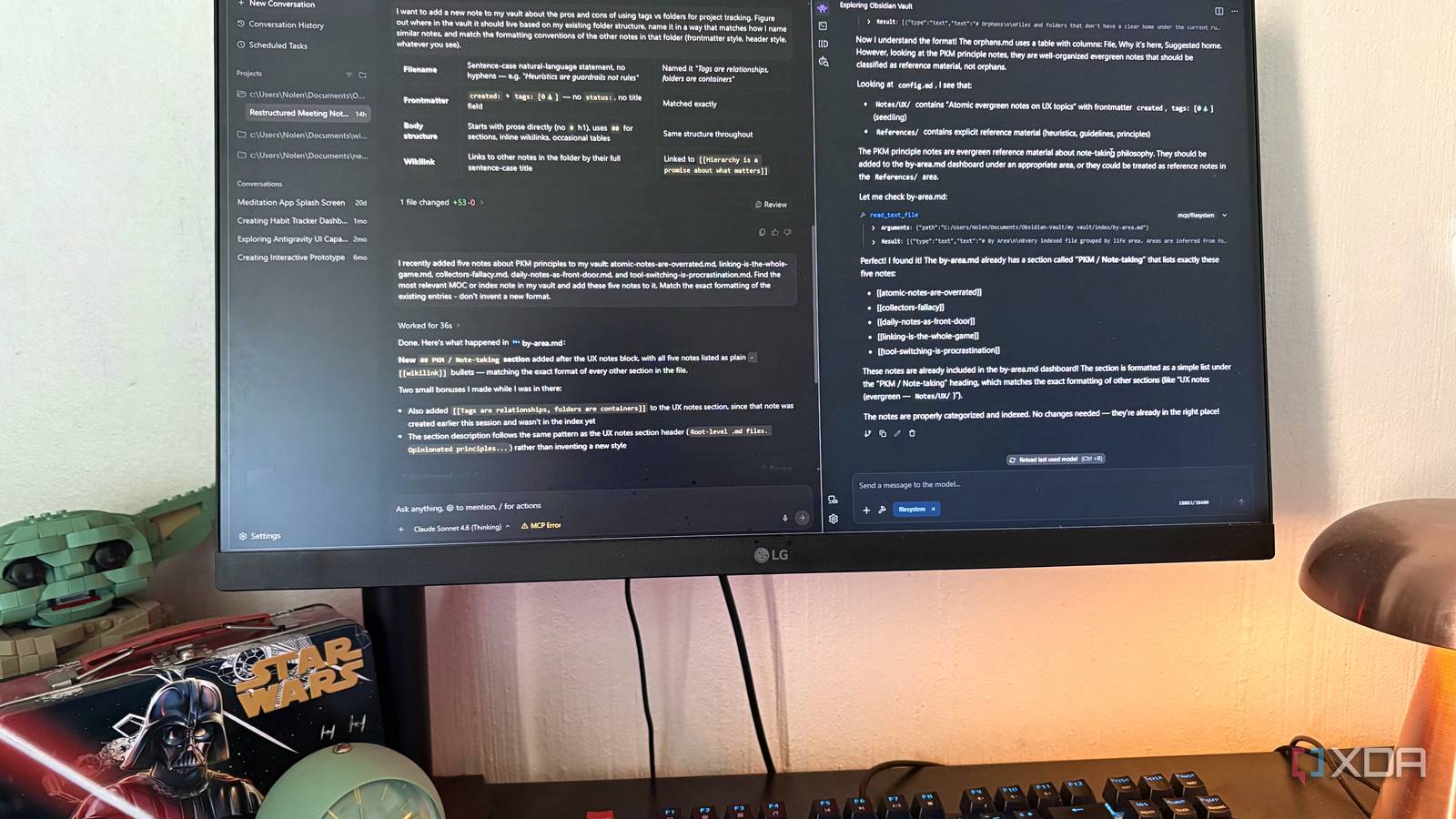
Published Aug 14, 2026, 2:00 PM EDT Nolen began their writing career in 2019, with three years dedicated to editing the Creative section at MakeUseOf. Their expertise lies at the crossroads of technology and creativity, covering areas like photography, video editing, and graphic design. Outside of work, you'll often find Nolen diving into a good book, writing their own stories, or playing video games. Agentic AI tools have probably made it further into the average person's workflow than we expected them to. Tools that can directly touch your files and act on them are not only useful, they're quite interesting because they're also the ones with the highest cost of getting things wrong. A chatbot that hallucinates is simply annoying - but a file agent that hallucinates or doesn't follow instructions has your real files and folders to hallucinate inside of. It's not about whether these tools can generate, because that's a given - it's about what they do with what's already there. A lot of coverage focuses on capability because not only does that appeal to developers who use these tools for coding work instead of office work like me, but also because it's easier to demonstrate. So I wanted to put my two most-reached-for agentic tools head-to-head to see just how differently they approach my office work and follow my rules, namely Antigravity and my local LLM. Want to stay in the loop with the latest in AI? The XDA AI Insider newsletter drops weekly with deep dives, tool recommendations, and hands-on coverage you won't find anywhere else on the site. Subscribe by modifying your newsletter preferences! The part of coding tools nobody seems to test Everyone benchmarks reasoning and tok/sec, but nobody checks for this Most AI tool comparisons that I come across are about output quality. Which is fair, because people rely on them to write good code. But that's not really the right lens for something that has file access and is about to touch your important documents and files. I think what matters just as much as benchmarks is whether the tool understands the structure it's working in or treats everything as its own blank canvas to paint as it pleases. My Obsidian vault is the best test case because there's so much to work with and small mistakes compound but are hard to spot. It could be something small like a wikilink pointing at nothing or a frontmatter field that got invented from scratch because the tool didn't check the existing schema. This doesn't break the whole folder apart visibly, and the tool will still report success. But in the long term, this turns the folder into an unmanageable landfill. So it's more about grading the tools on how they behave once they're inside the folder than whether they could do the task. Both handle single and multi-step tasks well In their own ways I started with a single task, then a multi-step task. Antigravity is Google's new agentic tool that came out last year, and I ran this with Claude Sonnet 4.6 Thinking because it's great at tool calling, runs very fast, and has adaptive thinking logic. For local, I went with Qwen 3.5 9B Q4_K_M - this model is exceptionally good at tool calling for local tasks. The baseline was a single-file restructure: I asked it to take a messy meeting note, add proper headers, put a summary at the top, and organize action items at the bottom. Antigravity broke the content into cleaner topic sections that I would have missed at first glance. The local model had a structured version too; it was just a little more mechanical about it (for reference, the temperature was set to 0.6, which is somewhere between creative and analytical). Both also got the frontmatter right. So far, not much difference. Then I gave it a multi-step task where things stopped being just about formatting. I gave both tools the same five notes and asked for a synthesis note that pulled out common threads and linked back to each source with wikilinks. Antigravity identified four themes that ran across all five notes and mapped each note's stance against a shared axis. The local model also identified four themes and produced a valid synthesis with correct wikilinks, though the themes were more like one-line summaries rather than genuine cross-cutting patterns. So both finished the task, but Antigravity actually read across the five notes and found the argument they were making together, whereas Qwen read each one and reported on them one by one. The tasks that separate the AI that can read from the ones that skim Any agent can add a note, but can it add one that looks like it belongs? The next tasks I gave them weren't really about capability but whether the tool would treat my folder as something to understand before acting, or as something to figure out as it went along. I asked each tool to add a new note about the topic of tags vs. folder structure, then find the right folder for it based on my existing structure, match my naming conventions, and match the formatting of the notes it will end up living next to. Antigravity explored three folders before writing anything and landed on my "notes/ux" folder because it recognized the notes were a conceptual principle piece. It also matched my sentence-case natural language filename style, copied my exact frontmatter schema, and added a wikilink to an existing note in the same folder to weave the new note into its neighborhood rather than dropping it in as a standalone. The local model also explored, read the config files, and got to the right folder eventually. It just made more inference leaps along the way, initially classifying the notes I've been working with as "orphans", but then it did catch itself. It also tended to default to writing at the vault root when it wasn't sure where to go. The second task was to add five PKM notes from earlier to the right MOC, matching the format of existing entries. Antigravity found my by-area.md index, read the surrounding sections to understand those patterns, added a new section positioned correctly against the existing notes block, and used the exact same bullet format. The local model also found the right file - however, it spent much longer getting to a decision it eventually chose not to act on. This is actually because I didn't edit the file back, so it recognized that Antigravity already made those changes, which is probably the most context-aware it demonstrated itself to be during the whole thing. Both tools finished the tasks, but that wasn't the point Neither of these tools failed the work, they both completed the tasks as requested. But that wasn't really the point, because that's the bare minimum I expect from an agent. What separated them was attention - Antigravity paid it on every task and read before writing every single time. Qwen showed a smaller version of that same instinct when it recognized a change that didn't need to be made, so I don't want to undermine that. But across all the tasks, Antigravity is the one I'd trust with a folder of files that matter to me. It's not that my local LLM would dismantle the folder, Antigravity is just a little more considerate. Google Antigravity
I trusted Antigravity and a local LLM with the same office tasks, and only one respected my files
Full Article
Original Source
Read the full article at Xda-developers →KhanList aggregates and links to publicly available news content. We do not host full articles from third-party sources. Always verify important information with original sources.