
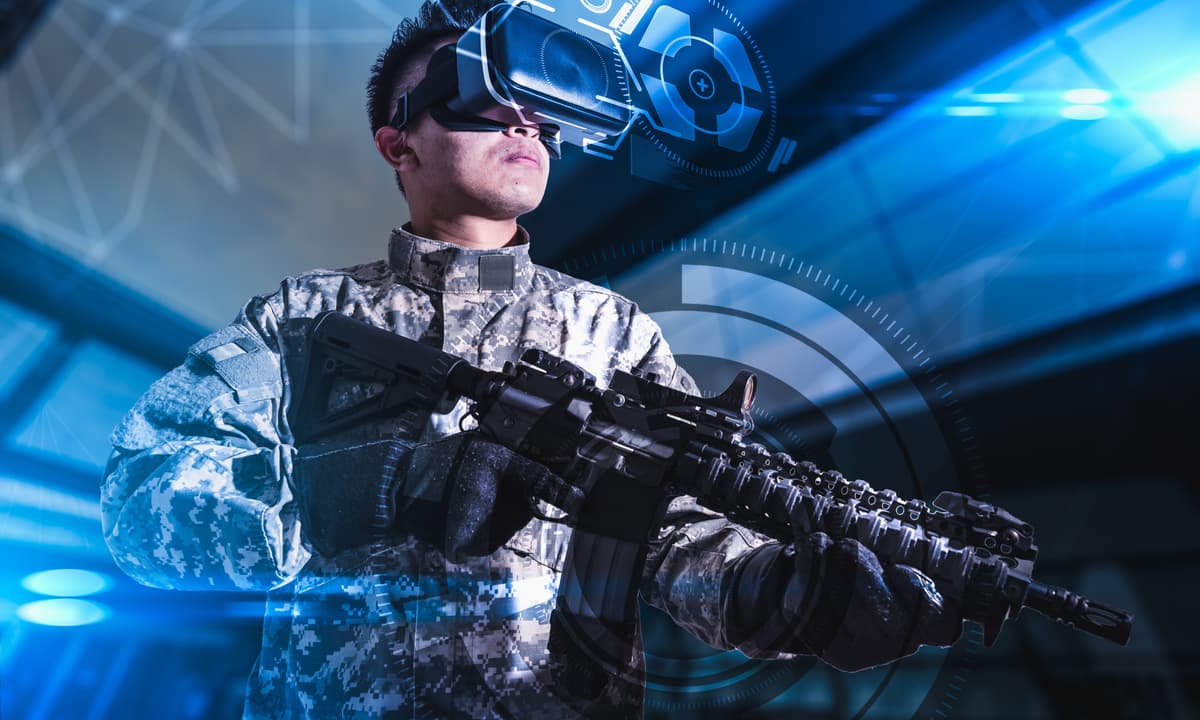
In an unassuming building in Basildon, Essex, is the office for AVRT — Adaptive Virtual Reality Training. It builds virtual reality training for soldiers and police. The company has helped train the British and Singaporean armies, and has been trialled by UK police forces. I want to find out just how realistic these war zone simulations have become.Stepping into the office, I’m met by an amiable team of three, including sales director Andy Higgs. The floor is panelled with interlocking foam mats. To my right, desks are littered with replica guns and miscellaneous bits of hardware. I’m handed a modified Meta Quest VR headset: a chunky pair of goggles that blocks out the room entirely and replaces it with a three-dimensional world. I’m also given headphones and a service-rifle replica.Within seconds of slipping on the headset your brain accepts the new world as real. Higgs says users in the virtual train station regularly “step over the gap between the virtual train and platform edge”. Inside the simulation you’re able to walk around freely.The first scenario I’m beamed into is one in which terrorists are holding a hostage in a pixellated two-bedroom flat. It begins in the hallway. The team have obviously put my adversaries on the easiest mode, because as I peer into the flat, a lobotomised terrorist stares back at me. This gives me enough time to fumble around pathetically for my weapon and, after a very tense 30 seconds, shoot him in the face.I’ve no doubt, if the terrorist had any motor skills at all, I would not have come out alive. Now emboldened with field experience, I storm the flat. In the living room, a hostage lies face down on the floor. Another dangerous, albeit lobotomised, terrorist loiters in the second bedroom looking at me. This time I’m less hesitant, and eventually hit him after no more than six tries.Just as I enjoy the relief of victory, the ungrateful hostage springs to his feet, brandishing a pistolJust as I begin to enjoy the relief of victory, the ungrateful hostage springs to his feet, brandishing a pistol. I’m informed that scenarios such as this can be designed in any unpredictable way a training officer desires. The aggressors trying to kill me are being controlled by one of the team at a computer, but they also have an AI setting in which enemies can act autonomously.“If it’s to prepare soldiers for the realities of war,” I ask Higgs, “how do you simulate the consequences of being shot?” He grins and dashes off to retrieve a Teslasuit — a two-piece haptic suit sold only to defence companies and researchers. Electrodes woven into the fabric use, in Higgs’s words, “electrical impulses to trigger the user’s own muscles”, producing anything from “light rain on the shoulders” to a bullet strike. The biggest shocks, as Higgs shows me in training footage, drop soldiers to the floor, convulsing and shrieking.I have to try it. I’m first shown low-level stimulation, which feels like a tingly buzz all over my torso. Higgs then cranks it up to the point where the muscles in my arms start seizing up. Raising it further, the sensations turn into sharp pains, like cramps in every single muscle above my waist. It is not even at half power. I get the idea.Higgs says the suit is there to eliminate “video-game bravery”. The business is growing: by the end of this year the US Marine Corps is due to receive an infantry trainer that uses its system. Trackers follow each trainee around the room to within a millimetre, and instructors can replay every decision in 3D. Read MoreThe aim, he says, is “to test and train judgement, decision making and tactics” in scenarios too dangerous or too expensive to stage for real. AI is the next step: scenarios “full of life, with individual characters reacting to each other”. In an increasingly dangerous and conflict-prone world, the development of AVRT is both reassuring and frightening.
I tried the military VR simulator that shocks you when you get shot - and it felt all too real
Full Article
Original Source
Read the full article at Standard →KhanList aggregates and links to publicly available news content. We do not host full articles from third-party sources. Always verify important information with original sources.