
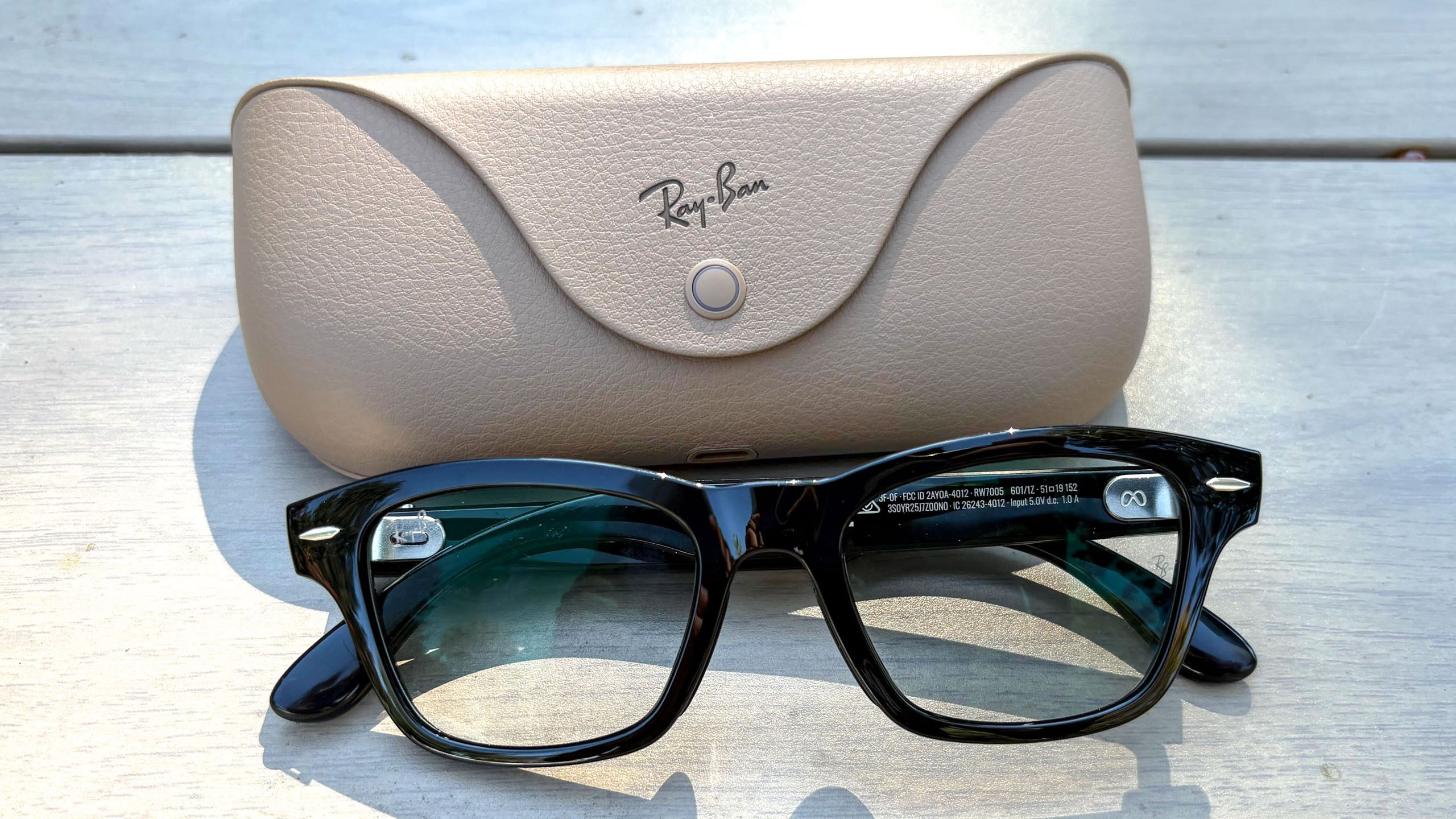
(Image credit: Tom's Guide) I've spent a week wearing Meta's new Ray-Ban Audio glasses, and I have a confession. At first, I wasn't particularly impressed.They're essentially sunglasses with speakers built into the frames. Meta's AI assistant is there when you need it, but nothing about the glasses immediately feels groundbreaking. I've already spent time with Meta Ray-Ban Display glasses, so going from a pair that can see what I see to one without a camera felt like a step backward.Except, a week later, I find myself reaching for the Ray-Ban Meta Audio Burbank glasses whenever I leave the house.I've worn them to my son's soccer game, brought them to the trampoline park with my three kids and used them while driving and running errands. Somewhere along the way, I realized I was checking my phone a lot less.The biggest surprise wasn't something Meta added. It was what the company took away. I've never been completely comfortable wearing a camera on my face. Even when I'm not recording, other people have no way of knowing that. At my son's soccer game, I don't want parents wondering whether I'm filming their children. At the trampoline park, I want to watch my kids without feeling like I'm carrying surveillance equipment.Removing the camera takes that awkwardness out of the equation. The glasses still have microphones, so they aren't completely free of privacy considerations, but they feel far more natural to wear.And after getting past my initial skepticism, I discovered five unexpected ways these audio-only glasses could fit into everyday life.Sign up to the Tom's AI Guide weekly newsletter summing up all the biggest AI news you need to know. Plus, analysis from our AI editors and tips on how to use the latest AI tools!1. An anytime translator (Image credit: Future)Traveling somewhere you don't speak the language usually means pulling out your phone, opening a translation app and hoping everyone is patient enough to wait while you figure out what the other person just said. Ray-Ban Meta Audio offers another option.The glasses support live translation, allowing you to hear translated speech through the built-in speakers while keeping your phone in your pocket. The person you're speaking with can read or hear your translated responses through the companion app.Imagine getting into a taxi in Lisbon or checking into a hotel in Tokyo. Instead of holding a phone between you and another person, you can maintain eye contact and carry on a conversation with translated audio coming through your glasses.Out of everything these glasses can do, translation is one of the features I'm most interested in testing further. And unlike camera-based AI, it doesn't require actually facing the people you're talking to.2. A personal research assistant (Image credit: Future)As a journalist, this might be one of my favorite possibilities. Think about the last time you were speaking to someone and suddenly couldn't remember a date, a name or a statistic. Normally, you'd either admit defeat or reach for your phone.With the Ray-Ban Meta Audio glasses, I can ask Meta AI questions without opening an app. The answer comes directly through the speakers, and I don't have to look away from whatever I'm doing.That makes me think about how useful these could be for teachers, presenters and tour guides.A teacher could check a historical date during a lesson. A tour guide could look up a detail about a landmark. Someone preparing to give a presentation could quickly confirm a fact before stepping in front of an audience.It reminds me of the earpiece a television presenter wears when a producer needs to feed them information. There are some obvious limitations. The assistant can get facts wrong, and speaking a command aloud isn't invisible to the people around you. It also isn't going to quietly interrupt your thoughts with the perfect answer.Still, for quick questions, conversions and facts that don't warrant pulling out my phone, it's a feature I can see myself using regularly.3. Screen-free navigation (Image credit: Future)This is where the glasses genuinely impressed me. As a parent of three, driving anywhere can get noisy. Between conversations, questions and whatever disagreement is happening in the back seat, I've occasionally struggled to hear my phone telling me where to turn.With the Ray-Ban Meta Audio glasses, navigation instructions come directly through the speakers built into the frames. I don't have to turn up the car audio or ask everyone to be quiet just so I can hear the next direction.The open-ear design is particularly useful because the glasses don't seal off my ears the way traditional earbuds do. I can still hear my surroundings, including my kids and important sounds outside the car.That doesn't eliminate the need to stay attentive, and drivers should follow local laws on audio devices. I also wouldn't recommend carrying on a distracting conversation with an AI assistant behind the wheel.But the navigation experience has been one of my favorite parts of wearing these glasses. And there's another benefit I hadn't initially considered: walking around an unfamiliar city.I love exploring new places, but I hate the feeling of staring at Google Maps while everything interesting happens around me. With spoken directions, I can keep my head up, look at the buildings and actually enjoy where I am.4. A discreet way to reach someone when you need help (Image credit: Future)Here's a use I hadn't expected to appreciate: being able to make a call or send a message without visibly reaching for my phone. The glasses support hands-free calls and messaging through compatible services. That means I can ask them to contact someone while my phone stays in my pocket or bag.Of course, that's convenient when I'm carrying groceries or juggling three kids' belongings. But I started thinking about situations where having your hands free could be more important.If you're uncomfortable during a rideshare, walking home at night or on a date that isn't going particularly well, being able to contact a trusted person without searching for your phone could be useful.You still need to speak a command, and anyone nearby may hear you. The glasses aren't an emergency alert system, and I wouldn't rely on them as my only way to get help. They also depend on having a working connection through a compatible phone. But I appreciate having another way to reach someone quickly.5. A screen-free way to stay connected to my kids (Image credit: Future)This is the one that convinced me I would keep wearing the glasses. When I'm around my family I don't want to spend time looking at my phone. I want to stay as present as possible.At the same time, I don't want to miss an important call, a message from my husband or something related to everyone's schedules. It's a familiar problem for parents. You want to be present, but you also need to be reachable.At my son's soccer game, I could leave my phone in my bag and still use voice commands or ask Meta AI a question. When I took my kids to the trampoline park, I didn't feel the same need to keep checking my screen.The glasses can handle calls, supported messages, reminders, music and podcasts. I can use them to ask a quick question while I'm doing something else, rather than stop what I'm doing to find my phone.I especially love that the Burbank frames look like regular Ray-Bans. They're lightweight, comfortable and available with Transitions lenses, which makes wearing them indoors and outdoors much more practical.I've worn glasses since I was two years old, so having another pair on my face feels completely natural. And unlike earbuds, they don't occupy my ears or leave me feeling cut off from everything happening around me.The takewayI went into this experiment assuming Meta had made a less capable version of its smart glasses. I came away thinking the company may have made something more practical for everyday use.The Ray-Ban Meta Audio glasses don't replace my smartphone. They can't identify objects, read unfamiliar signs or menus through a camera, or capture those moments when I wish I'd taken a picture. They're also not cheap. Starting at $349, they're a significant purchase when you consider that a good pair of sunglasses and wireless earbuds can handle many of the same basic tasks.Meta rates the glasses for up to 12 hours of mixed use, but continuous audio playback is rated for up to six hours. That's worth remembering if you plan to spend your day listening to music or podcasts.Still, the fact that I don't have to pull out my phone nearly as often has changed how I think about these glasses. I can listen, communicate, navigate and get answers from AI while wearing something that looks and feels like ordinary eyewear.And without the camera, I feel a lot more comfortable doing it.Follow Tom's Guide on Google News and add us as a preferred source to get our up-to-date news, analysis, and reviews in your feeds. Subscribe to Tom's Guide on YouTube and follow us on TikTok. More from Tom's GuideTurn your PDFs into audiobooks with ChatGPT — here's the simple trickAI researcher warns cyberattacks could take down power, banking and water within a year — here's how to prepare An OpenAI employee allegedly used AI to spy on his own company — then AI helped catch him Amanda Caswell is the AI Editor at Tom's Guide and one of today’s leading voices in AI and technology. A celebrated contributor to various news outlets, her sharp insights and relatable storytelling have earned her a loyal readership. Amanda’s work has been recognized with prestigious honors, including outstanding contribution to media.Known for her ability to bring clarity to even the most complex topics, Amanda seamlessly blends innovation and creativity, inspiring readers to embrace the power of AI and emerging technologies. As a certified prompt engineer, she continues to push the boundaries of how humans and AI can work together.Beyond her journalism career, Amanda is a long-distance runner and mom of three. She lives in New Jersey.
I tried Ray-Ban Meta's camera-free AI glasses — 5 unexpected uses that surprised me
Full Article
Original Source
Read the full article at Tomsguide →KhanList aggregates and links to publicly available news content. We do not host full articles from third-party sources. Always verify important information with original sources.