
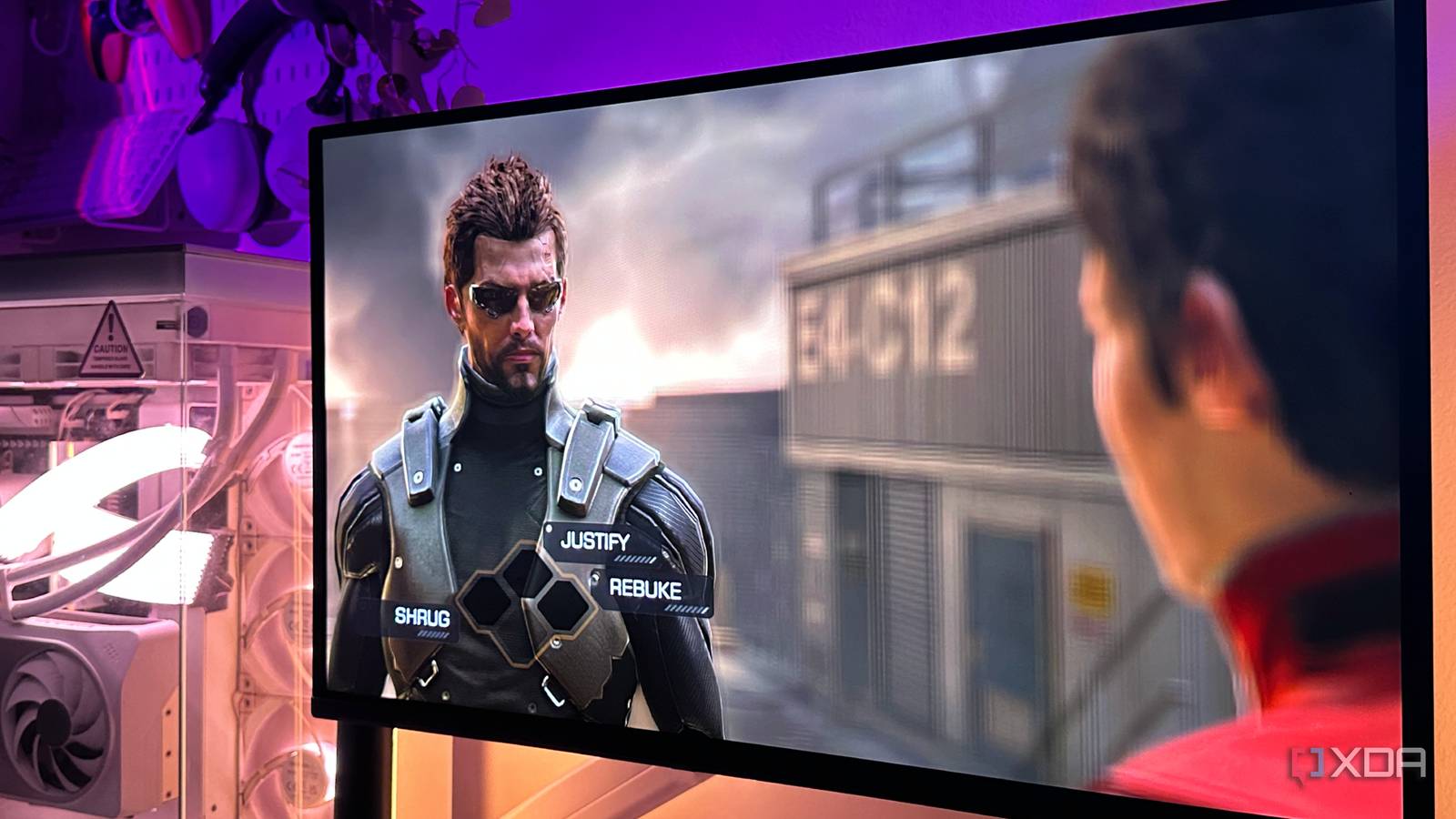
Published Oct 27, 2026, 8:30 AM EDT Gaming has been Samarveer’s greatest passion, and the Literature graduate in him takes immense joy in dissecting games for their themes, messages, and impact. Samarveer holds a deep appreciation of gaming, and considers the platform to be the most immersive and impactful across all media. He can be found engaging with gaming communities online, always ready to debate the finer points of ray tracing or itching to write an 8-page collegiate thesis on any game that impacts him emotionally. I have a complicated relationship with remasters, I'll admit. On one hand, I love the idea of revisiting games that I grew up playing and experiencing them with modern visuals. On the other hand, though, I'm not too fond of how developers sometimes change what made these games so special for me in the first place. That's why I've been on the fence ever since DLSS 5 came along, since it does promise to fundamentally change how games look. I've been throwing Nvidia's new neural renderer at every possible game, but I finally decided to test it with my favorite game of all time. For the past fifteen years, my personal "GOAT" hasn't changed — Deus Ex: Human Revolution remains one of the greatest RPGs of the modern gaming era, and could still go toe-to-toe with the latest titles. Naturally, DLSS 5 took the game to all-new heights, and it's quite possibly the best showcase of neural rendering I've seen yet. I couldn't even run DLSS 5 on my PC version of Deus Ex The Windows version had other plans for my neural rendering experiment Getting Deus Ex: Human Revolution (the Director's Cut) running on a modern Windows PC shouldn't require an engineering degree, but here we are. Despite being a Steam purchase, the game is notorious for not playing well with Windows 11 PCs, no matter how much you play around with its compatibility settings. Turning off Simultaneous Multithreading from my BIOS settings was the only way I could get the game to run. Further, I couldn't even run the game with DirectX 11 enabled if I wanted it to actually boot consistently. Obviously, that proved to be the biggest obstacle in attaching ReShade's version of DLSS 5 into this game. OptiScaler wouldn't have worked here either, since the game came out a decade before DLSS or FSR even existed. Eventually, I gave up and switched to the PS3 version of the Director's Cut, running through RPCS3. Thankfully, I already had DLSS 5 working with my PS3 games, which let me pursue the experiment without continuing to wrestle with the native PC release. DLSS 5 gave me the Deus Ex remaster I've wanted for 15 years I've never seen neural rendering look this good Using RPCS3, the PlayStation 3 emulator, I've seen games like Tekken Tag Tournament 2 and Gran Turismo visually transform into all-new games. That's pretty much what I expected when I ran Deus Ex: Human Revolution and turned on DLSS 5. I was surprised, though, by how little it felt like a different game. The environments looked cleaner and the lighting felt more convincing, but even with two full neural rendering passes, they never once took on any detail of their own. The character models, however, were where things got genuinely impressive. The faces looked incredibly realistic, without making characters unrecognizable. DLSS 5 just added a level of visual fidelity that made my conversations with these characters feel noticeably different, and only in a good way. Adam Jensen still looked like Adam Jensen, and every person, car, sidewalk, and street in 2027 version of Detroit looked just how I remembered it, but just better, cleaner, and more realistic. That's the distinction I wanted neural rendering to get right. Making everything look realistic is easy enough to aspire to; doing so without making every game look like the same generic tech demo is considerably harder. And somehow, DLSS 5 managed to achieve exactly that in this case. For a game that's now 15 years old, the transformation was remarkable. I've experimented with DLSS 5 in plenty of games, but this was the first time it genuinely felt like a remaster I never got. Nobody should ever have to defend their favorite game of all time Very few games have left a mark on me quite like this one I'll admit there's a fair amount of bias involved in calling Deus Ex: Human Revolution the greatest game ever made. It was one of the first games I played on my PS3, back when I was 13, and it left an impression that has somehow survived 15 years of increasingly impressive releases. Regardless, it's not just nostalgia that keeps me coming back. The writing, for starters, remains exceptional. Human Revolution's exploration of human augmentation, corporate power, and the ethical questions that come with technological advancement feel more relevant today than they did in 2011. Even half a decade ago, it gave me plenty to think about at an age when most of us were still figuring out what we believed in. The game's environmental themes also shaped how I viewed the world around me, which is something I appreciate even more in hindsight. Then there's the immense amount of player freedom the game provided. Between its RPG systems, branching approaches to encounters, exploration, and meaningful player agency, Deus Ex: Human Revolution made me feel like I was participating in its world rather than simply following instructions from a quest marker. The choices I made early on had consequences throughout the campaign, and how I approached problems mattered throughout the journey. That's why revisiting it with DLSS 5 felt so special. I'm not looking for an excuse to pretend my favorite game needs fixing. I'm looking for new ways to experience something that helped shape my tastes, my interests, and even parts of my worldview. Few games can claim that much influence over me. It's a shame that we may never get a final entry in what could've been the greatest cyberpunk trilogy of the modern gaming era. DLSS 5 is finally doing what I've always wanted neural rendering to do From DOS games to modern AAA releases, the potential is enormous I've experimented with DLSS 5 across everything — PlayStation 2 classics, the latest AAA releases, and even some great DOS games. And yet, I haven't come across a DLSS 5 implementation that I've loved quite as much as this one. Neural rendering never once bulldozed over the artistic intent and visual identity of Deus Ex: Human Revolution in pursuit of its photorealism, all while breathing new life into the game. That versatility is what makes neural rendering genuinely exciting. Older games could benefit from visual refreshes without requiring full-blown remasters, while modern releases could gain another layer of visual fidelity. Of course, results will vary by game and implementation, but my experiments have convinced me there's considerably more potential here than the usual graphics demos suggest. I realize there could be plenty of raised eyebrows at how my "favorite game of all time" has also become my favorite showcase of DLSS 5, but the screenshots speak for themselves. DLSS 5, as new as it is, has been hit-or-miss in most games, either making faces look too bad or changing environmental details a little too much. With Human Revolution, it seemed to balance neural rendering's changes with original artistic intent almost perfectly, making for a textbook example of how neural rendering can improve old games. DLSS 5 is handing out free remasters There's nothing quite like finding new reasons to love a game that helped shape who you are. I love the new AAA releases as much as the next person, but that doesn't mean we should forget how much creative ambition already exists in the games we grew up with. I'm still not convinced that neural rendering is going to be the silver bullet that Nvidia wants it to be. Too many variables, too many ways for it to go wrong, and too much room for developers to lose sight of the artists behind the original work. Regardless, experiments like this do give me a reason to be pretty optimistic.
I tried DLSS 5 in my favorite game of all time, and it feels like playing it for the first time again
Full Article
Original Source
Read the full article at Xda-developers →KhanList aggregates and links to publicly available news content. We do not host full articles from third-party sources. Always verify important information with original sources.