
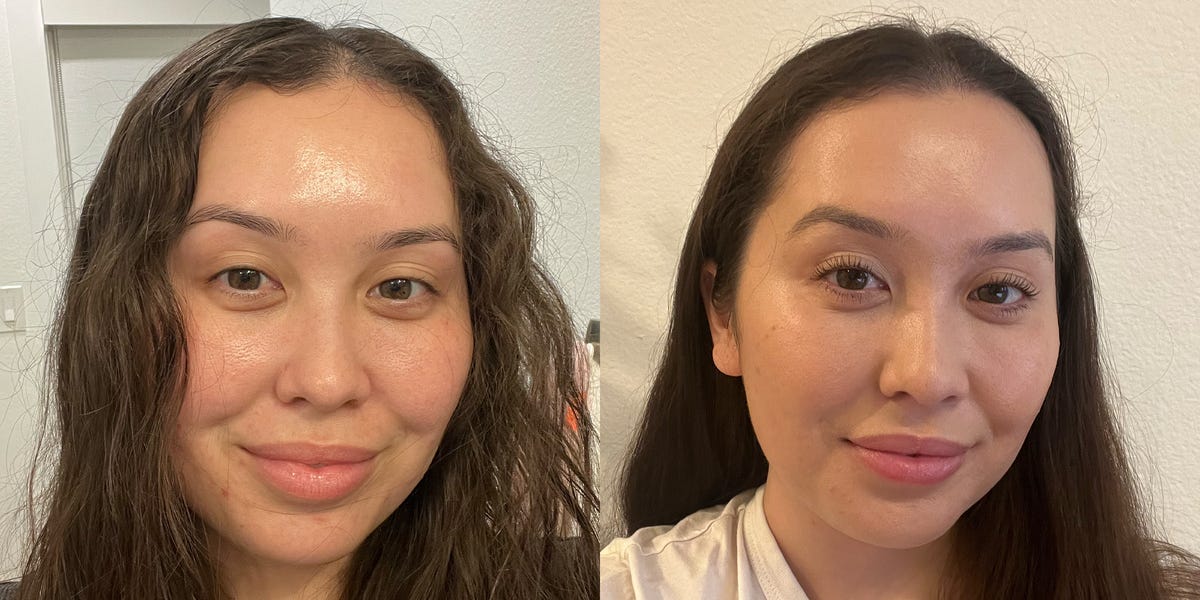
Confession: I’ll try almost anything in the name of longer, more fluttery lashes. That’s especially true if the thing shortens my makeup routine and gets me out the door a little faster in the morning (read: lets me stay in bed even just a few minutes longer). So I was, of course, very excited when I discovered a beauty treatment that promised to accomplish both: the Korean lash lift.I’d previously heard some not-so-great things about lash lifts. The chemical solution used during the process—typically ammonium thioglycolate (TGA)—comes with a risk of dryness, breakage, and damage, especially if the lift is performed incorrectly or too frequently. But Korean lash lifts have been gaining serious attention (Pinterest reports that searches for the aesthetic treatment are up more than 400 percent) as a potentially gentler alternative, since they can feature formulas and techniques designed to minimize stress on the lashes.And as someone with stubbornly straight lashes, I was particularly intrigued. To me, nothing ruins a good makeup day quite like lashes that refuse to cooperate, and trust me, I’ve put in the work to find products that make mine behave. If you’re wondering, after testing dozens of eyelash curlers and mascaras, I’ve landed on my undefeated duo: the Kevyn Aucoin Eyelash Curler and Tarte Tartelette Tubing Mascara. But even those two can’t always convince my lashes to hold a curl all day.So, when I learned that a Korean lash lift could potentially give me weeks of lifted, fluttery lashes, no curler required, I knew I had to try it. Now that I’ve lived with the results for two months—including through a vacation, a wedding, and an apartment move—I have a lot of thoughts.What are Korean lash lifts?So, first things first: A Korean lash lift isn’t the same thing as eyelash extensions. Rather than attaching individual fibers to your natural lashes, the treatment uses chemical solutions to reshape the lashes you already have to give them a lifted, curled appearance. It’s the same basic concept as getting a perm for a whole head of curls, but on a much smaller scale.That technique is similar to traditional lash lifts; the biggest distinction typically comes down to the process and products used. For example, traditional lash lifts tend to use perming formulas with ammonium thioglycolate (TGA), whereas Korean ones usually use cysteamine hydrochloride. The latter chemical is often touted as a gentler or safer alternative, but the truth of the matter is that “we do not yet have sufficient high-quality comparative clinical studies demonstrating that they consistently produce fewer ocular complications than traditional thioglycolate-based lash lifts,” says ophthalmologist Sheri Rowen, MD.Korean lash lifts are also glueless, meaning they use balm instead of glue to get them to stick to the shield that makes the lashes stand up and have that classic curl.“Korean lash lifts are often designed with an emphasis on more controlled processing and conditioning of the lashes, which may reduce some of the dryness and brittleness associated with chemical treatments,” says Dr. Rowen. However, this doesn’t automatically mean it’s better or safer than any traditional lash lift; all that depends on how the perming chemicals are applied.“My overall recommendation is that patients should not assume a lash lift is safer simply because it is labeled ‘Korean,’ ‘gentle,’ or ‘conditioning,’” says Dr. Rowen. “The most important considerations are the ingredients, proper application, careful protection of the ocular surface, and avoiding excessive or repeated chemical processing.”Still, if the treatment is done well, you can expect a natural-looking lift that makes your existing lashes appear longer, more separated, and more defined without the need for extensions.How does a Korean lash lift work?For my appointment, I visited Two of a Kind, a lash and brow studio in Santa Monica that offers lash lifts, specifically Korean and what their team calls “hybrid,” meaning they use techniques from both methods to customize the results. The entire treatment took about 40 minutes, although my lash technician mentioned that she’s particularly quick. If you’re planning an appointment, I’d budget closer to an hour or potentially longer, depending on your technician and the specific service.It was my first time ever getting a lash lift, so I didn’t have anything to compare it to. But Two of a Kind’s founder Jordan Feise told me another difference between the traditional and Korean methods: The former uses one shield that shapes the lashes throughout the appointment. The latter uses two shields, always starting with a flat shield (to straighten the lashes and get closer to the root for more lift, Feise explains), then swapping in a curved shield (to lock in the shape and create a curl, she adds). By using two shields, it separates the softening step and the shaping step, which Feise says gives the technician more control over how your lashes ultimately look. “Using two shields during a lash lift allows us to customize the shape of the lashes during the treatment for a more lifted, natural-looking result,” says Feise. “Together, they give us more control over the final result, helping create a beautiful lift without over-curling the lashes.”Here’s how the appointment went for me: I laid down and my lash tech cleansed my lashes, removing any makeup, product residue, and oil to prep them for treatment. Then, the flat shield was applied to my lid along the upper lash line. She also made sure to separate my lower lashes from my upper ones. Next, the lifting begins. The initial lift is done using balm and the flat shield, which is a thin, flat pad (instead of a curved rod you’d see with a traditional lash lift). This straightens and lifts the lashes. After processing, the tech switched to that traditional curved lift shield to shape and curl. More processing, then neutralizing the formula (to make sure my eyes/contacts wouldn’t sting after), and plenty of conditioning, and I was all set.During the appointment, I did what any beauty editor would do: I asked approximately a million questions.How long would my results last? Around two months, she told me. Could I wear mascara and eye shadow afterward? Absolutely, after the initial 24-hour aftercare period. What about getting my lashes wet? Also fine after 24 hours. And would I have to do anything special to maintain the results?Not really. She recommended applying a lash conditioner a few times during the first couple of weeks to keep the hairs soft and supple. (Full disclosure: I was a bad patient and only remembered to use it once. I still had great results.)Basically, after the first 24 hours, I could go back to my normal routine—showering, washing my face, wearing eye makeup, and all—without worrying about ruining my lashes. “Even if I sleep on my face?” I asked. Yep, even then.I have to admit, I was skeptical. The idea that my lashes could stay perfectly curled through weeks of sleeping, showering, and generally living my life seemed a little too good to be true, honestly. But I was very excited to find out.Spoiler alert: I was so, so wrong to doubt.For two months straight, my lashes looked unbelievably long, lifted, and curled, yet still felt soft and looked completely natural. And the best part? I didn’t have to do much of anything to keep them that way.In fact, I ended up putting my new lashes through what I can only describe as an endurance test. First, there was my birthday trip to Hawaii, where I spent every day swimming in the ocean. Then came a wedding, where plenty of happy tears were shed. Throw in more travel, moving apartments, and a whole lot of stress-induced eye rubbing, and let’s just say I wasn’t exactly treating my lashes like delicate little flowers. Yet, through all of it, they kept their curl.Initially, I skipped mascara altogether because my lashes looked so good on their own. But because I hadn’t paired my lift with a lash tint—a popular add-on that darkens your lashes—I eventually started incorporating mascara back into my routine for a little extra definition.The one thing that stayed the same throughout the months was that I no longer needed my eyelash curler. Like, at all. Instead of spending time trying to convince my lashes to cooperate, I could simply run a clean spoolie through them to separate each lash, swipe on a little mascara, and head out the door. A dream come true.And when I didn’t feel like wearing makeup, a little tinted sunscreen or moisturizer was all I needed to feel put together because my lashes already looked like I’d spent time on them. You know that TikTok trend that’s all about the high-maintenance things we do to stay low-maintenance? Yeah, a Korean lash lift falls squarely in that category.That was probably my favorite part of it all: The results were noticeable without looking done. Of course, I didn’t have the dramatic, obviously enhanced look of extensions, but my natural lashes had enough lift and definition to make my eyes look more awake and fluttery. It was effortless, understated glam, which is exactly my go-to for my everyday makeup.By the three-month mark, my lashes had gradually returned to their natural (read: stubby and stick-straight) state. But I was very happy to notice zero brittleness, unusual fallout, or other obvious signs of damage. A win!Catharine Malzahn for CosmopolitanLike, those are my exact same lashes two days apart, just lifted!!!! It blew my mind to see what a difference it could make.ProsMy lashes looked naturally longer and more lifted. Key word: naturally. The result was fluttery, defined, and natural-looking rather than overly dramatic.It made my morning routine significantly faster. As someone who has spent a [redacted] amount of time trying to curl stubborn lashes, saving even a few minutes every morning was a legit game changer, even if it doesn’t sound like much. I could skip the curler entirely and still have lifted lashes.The results held up through pretty much everything. Between swimming in Hawaii, crying at a wedding, traveling, and moving apartments, I gave my lashes plenty of opportunities to lose their curl. They didn’t. Oh, and I also have been known to sleep on my face. It made no-makeup days even better. Even without mascara, my eyes looked more defined and awake. On days when I only wanted to wear tinted sunscreen and call it a day, the lash lift made me feel considerably more put together.I didn’t notice lash damage. The hairs felt soft during the whole process. And when they returned to their natural state around three months later, I didn’t notice any unusual shedding or brittleness.ConsIt’s not necessarily a replacement for mascara. Because I didn’t get a lash tint, I eventually started wearing mascara again to add darkness and definition. If your natural lashes are light or you love a bold lash look, you may still want mascara (or consider adding a tint to your appointment).The results aren’t permanent. My lashes looked their best for roughly two months before gradually returning to their natural shape. While that’s impressive for a single appointment, maintaining the look means repeat treatments, which can add up over time. A single appointment at Two of a Kind Brows costs $120 for a lift or $160 for a lift and tint.There’s still a risk of damage or irritation. Despite Korean lash lifts having a reputation for being gentle, the treatment does still rely on chemicals to reshape the lashes. Also, “the term ‘Korean lash lift’ describes a technique or product category rather than a universally standardized chemical formulation,” explains Dr. Rowen. “Not all Korean lash lifts contain cysteamine, and not all traditional lash lifts use identical thioglycolate formulations.” So, regardless of whether you’re going with a Korean or traditional lift, finding a qualified, experienced technician is essential. That being said, I wear contacts and experienced no irritation during or after my treatment.Final verdict: Is a Korean lash lift worth it?That would be a resounding yes. After experiencing nearly three happy months with my Korean lash lift, I can confidently say that it’s one of the most worthwhile beauty treatments I’ve tried in a long time. I absolutely loved the look, the experience, all of it.All this is coming from someone whose job is to constantly test new products and treatments in the name of beauty journalism. Plenty of them deliver impressive results, but far fewer actually make my everyday life easier. And even fewer genuinely excite me. This one did all three.I loved how natural my lashes looked, how well the curl held up through trials and tribulations, and how little maintenance was required. But what really sold me was the convenience. Being able to wake up with lashes that already looked lifted and fluttery—and shave several minutes off my makeup routine in the process—was something I appreciated every single morning. It just made me feel so much more confident. One thing to note: It can get pricey. At Two of a Kind Brows, one appointment will set you back $120 for a lift and $160 for a lift and tint.Would I recommend a Korean lash lift? I’d say it’s absolutely worth it, provided you go to a qualified professional and don’t overdo it by getting lash lifts too often. But once you’ve tried one, you won’t look back.Catharine Malzahn for CosmopolitanThese are my lashes about a month after the treatment with mascara on.Meet the expertsSheri Rowen, MD is a Newport Beach, CA-based ophthalmologist and medical consultant to Mama Sol. She is a key opinion leader on dry eyes and the ocular surface.Jordan Feise is the founder of Two of a Kind, a lash and brow studio in Santa Monica that offers lash lifts.Why trust Cosmopolitan?Catharine Malzahn is a contributing beauty writer at Cosmo. She’s covered all things skincare, makeup, haircare, and nails and has tested so many products and treatments that she’s lost count.Catharine Malzahn is a contributing beauty writer at Cosmopolitan and was previously the beauty assistant at Good Housekeeping, Woman's Day, and Prevention.
I Tried a Korean Lash Lift. Did It Really Live Up to the Hype?
Full Article
Original Source
Read the full article at Cosmopolitan →KhanList aggregates and links to publicly available news content. We do not host full articles from third-party sources. Always verify important information with original sources.