
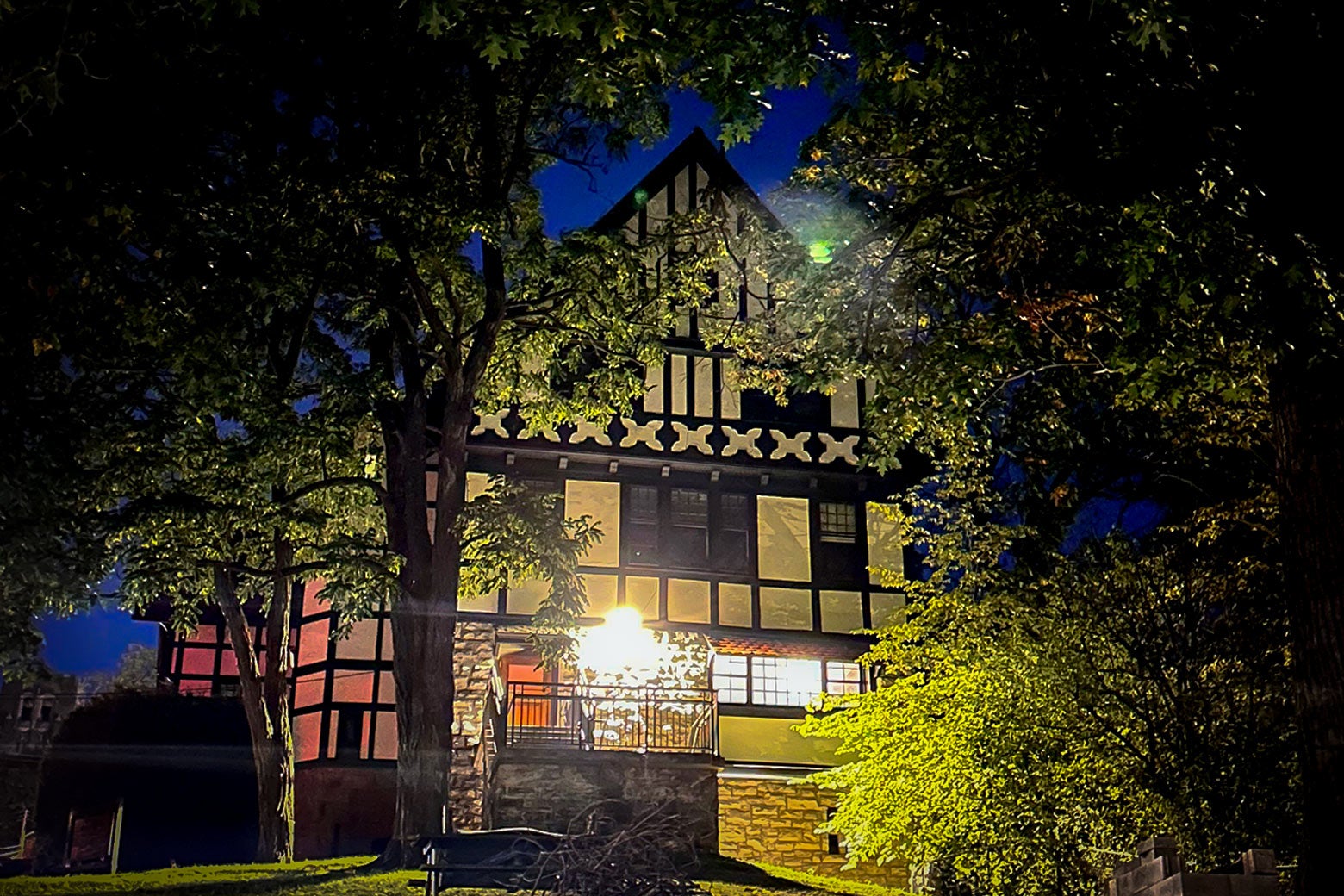
Scaachi Koul Stand outside to get a look at the Tri Delta sorority house, not too far from the Cornell campus, and a security guard will emerge to watch you right back. The three-floor house welcomes 32 sisters every year and seems nicer than Pi Delta Psi’s next door and certainly a lot bigger than the nearby Triphammer Cooperative, a non-Greek housing option. But that all makes sense; after all, Delta Delta Delta girlies are the cream of the Greek crop. Security for little old me, a woman in her mid-30s staring at a sorority house from across the street, holding a notebook? Unexpected, but who can blame the sisters of Tri Delta for these added precautions. They’ve probably gotten used to lookie-loos like me over the past few weeks. This is where a onetime Cornell student known as Jane Doe lived in 2024, when she alleges she was repeatedly sexually assaulted and drugged with ketamine at a frat party. Her former sorority is one of many entities named in Doe’s recently filed civil suit, along with the Chi Phi fraternity, a few local bars in Ithaca, and Cornell itself. Tri Delta. Scaachi Koul Doe’s complaint paints a picture of a 360-degree failure on the part of Cornell and the Greek life it supports. She says that in October 2024, she left her home at Tri Delta to bar hop for a few hours downtown before she “stumbled” to the Chi Phi fraternity, a 20-minute walk away, already too intoxicated to consent to sex. From there, her complaint lays out details of a brutalizing assault: She says that for seven hours, some members of the Chi Phi frat took turns raping her, while forcing her to drink and do ketamine, as members of the fraternity group chat welcomed others to join in. “Free pussy in alum pu,” Chi Phi member Jonathan Newell wrote to the rest of the brothers, using slang for “pull up,” according to a photo of a Snapchat message reprinted in Doe’s complaint. Hours later, she awoke in Chi Phi, and returned to Tri Delta in a shock, covered in bruises. The assault quickly became a piece of campus gossip, and she reported it to the Cornell University Police Department at the urging of her friends. By November 2024, the “Cornell Seven,” as they’re now known, were allegedly given suspensions and offered a chance to write essays “to mitigate their conduct.” The fraternity has since been shuttered. Two of the brothers were expelled, and two were given suspensions, among other lighter school punishments. The worst day of Jane Doe’s life has become a socio-cultural lightning rod. For nearly a month now, thousands of students have been protesting their school, online and in the streets, for its pitiful mishandling of the case. Cornell has become the most recent flashpoint around Title IX in a post-#MeToo era. Six years ago, the Trump administration rolled back Obama-era policies around Title IX, something that critics said would make it harder for sexual abuse victims to come forward. Cornell is now a test case of how much Title IX rollbacks are impacting their student body, but also another example of just how long our colleges have been failing these same women, generation after generation. The protests at Cornell also come at a flash point for student movements around the world. For the past three years, students have been protesting universities around the country, calling for a free Palestine and divestment from Israeli companies. Black college students have been marching to keep attention on several mysterious deaths of young Black people including Nolan Wells. Students in India are protesting as a part of the “Cockroach Janta Party,” calling for the resignation of India’s election chief over millions of names cut from voter rolls. In France, police are violently trying to tamp down protests demanding education reforms. “I think Cornell gets a lot of attention because it is Cornell,” said Emely Gutierrez, a 20-year-old government and Spanish student and one of the organizers of a sit-in held at Cornell last week. “But it’s incredibly important to realize that this isn’t that astounding because it happens everywhere. This happens at every university, and outside of the university. This outrage should be the outrage every day.” Cornell is a classic American campus, all Victorian architecture with a 19th-century clock tower, a place they could have filmed Dead Poets Society. Teenagers in big-C sweaters walk across the quad and fret loudly about their prelim exam schedule. Campus social life happens not predominantly at bars but at the fraternities with a social code of secrecy. It’s all familiar, and the protests are too: The political actions at Cornell last week were reminiscent of every campus protest I’ve seen or participated in before. But at night, Cornell feels far more ominous. Fall is coming, and without the sun, it was cold enough to shiver. After a day of hearing the students loudly protest, the empty and dimly lit corridors of campus give way to a feeling of unease. Walking along Jane Doe’s path from Tri Delta, to the bars, and then to the now-abandoned Chi Phi fraternity house—headphones out of my ears, just in case–was familiar too, even though this school was never my school. Still: It reminded me of every time I’ve felt like prey. Plenty of ink has already been spilled on whether the protests and digital uproar around the Cornell Seven is Gen Z’s #MeToo moment. This is easy to dispense of: not really. “The MeToo movement platformed a lot of mainstream celebrities, which I think was important to understand that it could be anybody,” Gutierrez said. “Like, how many Jane Does have there been that didn’t have her case attached to an elite name or a bigger institution, and it was completely sidelined?” Last week, in conjunction with several actions held across campus, student protesters held a sit-in at Toni Morrison Dining Hall. The plan was to sit for seven hours in alignment with the seven hours Doe suffered being assaulted, along with a commerce-free day at all Cornell-owned stores and cafeterias. The protesters’ demands on Cornell are clear: expulsion and revocation of the degrees of the alleged assailants, a return to independent hearings for sexual assault, an external investigation into the school’s administration, sexual assault training for campus police, and the school’s compliance with New York’s “Enough Is Enough” law, which requires colleges and universities to adopt a specific set of guidelines around campus assault and harassment. Cornell has long been plagued by rape and assault claims. “Literally every frat has at least one rapist,” wrote one Reddit user six years ago. “I feel like every female friend I have has some gross, disturbing story of something that happened to them at Cornell.” Doe’s complaint, meanwhile, describes a school that was already steeped in sexual assault allegations. “She never knew that the University had been the scene of numerous incidents of sexual assault and rape in the months and years prior to her arrival,” Doe’s complaint says. “Students were afraid, protesting, and demanding reforms.” The filing also states that in 2022—when Doe was 18 and had just arrived at the school—Cornell had five reported cases of drugging and two reported cases of sexual assault on campus, all at fraternities. “[Doe] also never knew that the dangers of fraternities were so widespread in the decade before her arrival that they had been ranked as the ‘sixth worst risk for insurance companies—just behind hazardous waste disposal companies and asbestos contractors,’ ” the complaint says. Cornell isn’t necessarily the most egregious example of a campus buckling under its own ineptitude when it comes to investigating sexual assault, but it’s now also a representation of the failure of Title IX. In 2020, the Trump administration made changes to Title IX that raised the burden of proof for survivors and required schools to conduct live hearings with cross-examinations, something that isn’t required in a criminal rape case. In Morrison Dining Hall last week, a few hundred students filtered in and out of the sit-in, the cafeteria filled with the aromas of pasta with red sauce and hot lettuce. Media weren’t allowed to bring in large cameras, so they set their cameras up on the other side of the wall-to-ceiling windows. One econ major in his first semester at Cornell surveyed the crowd while grabbing dinner—he wasn’t participating this time, but he had attended a march earlier in the week. “I know people that were juniors and seniors, and they told me they’ve known about [the Cornell Seven] since 2024,” he said, asking not to be named to protect his family’s identity. “Now that it’s coming to light, there’s just a lot of anger that they tried to sweep it under the rug.” His dad is a ’94 graduate, and his father’s friend sent an angry letter to the school, hoping alumni pressure will make the school change how they investigate claims like Doe’s. “The perception is that men, especially white men with privileged backgrounds, can act immorally if not outright illegally,” the letter said. “Set a righteous example that this type of behavior on the part of men is completely unacceptable.” Eighteen-year-old public health major Hannah Gellert came to the sit-in for the purposes of protest but also just to hang—she had a free afternoon after pulling an all-nighter the evening before “for shits and giggles.” She hopes the protests shame Cornell into reform, but she’s not that optimistic. “I’m sure in two years [since Doe’s assault], there have been multiple instances of this happening again,” she said, peeling a banana and eating a scoop of ice cream, which she calls “lunch.” “More people have been talking, which is important. But it’s also exemplifying why women don’t speak out. If I were Jane Doe and this story broke, I wouldn’t want to ever talk to anyone again.” The same week of the sit-in, on Saturday Night Live, host Shane Gillis made a joke about how women dress “like whores” when they go to the gym. Donald Trump, meanwhile, said that the Cornell Seven “won’t get a fair shake” by New York Attorney General Letitia James. Megyn Kelly took time in her YouTube show last Monday to call Jane Doe “not the most attractive gal, she’s extremely beefy in like, her arms and her legs.” No matter where you look—politics, a show intended to make you laugh, your own school—misogyny remains pervasive. Cornell is just where the match has been lit this time. Two of the more obvious sit-in attendees were a pair of 18-year-olds in superhero masks. Neither attend Cornell, but rape and sexual abuse are problems at their campus too, and they wanted to join in on the protests. Spider-Man and Deadpool—who asked not to be identified by name to avoid getting doxed—are somewhat known entities around campus. Fox News caught Spider-Man at last Monday’s protest, which was still a source of delight for them both. By the end of the day, they had been pulled into no fewer than seven media hits. “Oh no,” Deadpool said. “More attention?” Spider-Man was in a shirt that said “PUBLIC CASTRATION FOR ALL RAPISTS AND PEDOPHILES” and “RAPISTS OF CORNELL ROT IN HELL.” Deadpool’s shirt—“CRIMES NOT ALLEGATIONS”—was comparatively restrained. Scaachi “I have experienced sexual assault in my lifetime, and I’m a trans man, which makes it suck, like, a lot,” Deadpool said. “I heard the story, and I was appalled and, frankly, a bit relieved that media attention was happening on it.” Like a lot of the protesters here, both think a big part of the problem resides with the entirety of Greek life. Ithaca—population just over 33,000, to Cornell’s undergraduate population of over 16,000—doesn’t have a lot of nightlife culture. Most of the parties happening for college students are either held at sororities and fraternities or are hosted by them in the bars around campus. If you want to go to a fun party as a 20-year-old Cornell student, you’ll likely have to go to a frat party. But there’s big money running through Greek life at Cornell. “I would really, really appreciate if we took it upon ourselves to stop the alumni donations until our demands are met,” Gutierrez said. “For action to be taken, we have to cut them at the root with money.” The men who run through fraternities at schools like Cornell bond for the rest of their lives; they go from well-off white boys at Ivy League schools to rich, powerful white men who work in business and politics. They donate back to the institutions that shaped them, which then bolster the frats against calls to end campus Greek life. Frat brothers are also imbued with a culture of sticking together, even after they graduate. Hazing the new brotherhood is still customary—teaching young men that dehumanization is a rite of passage, and that they better keep it to themselves. It’s not a real surprise that other abuses of power like drugging or rape aren’t dealt with or even reported. The Snapchat group where the Cornell Seven allegedly offered Jane Doe up on a platter had more than 50 men in it. No one, it seems, replied to the messages of “free pussy” with disgust or disapprobation. Regardless, even a full dissolution of Greek life at Cornell isn’t a solution to a larger systemic problem of male entitlement to female bodily autonomy. “It needs to be addressed in how we socialize men and women, what accountability measures are placed upon people who commit these atrocities. The lack of accountability, and the constant protecting of abusers, is what lets men like this believe they can do whatever they want,” Gutierrez said. “I’m not the biggest fan of Greek life, but I don’t believe abolishing it does anything. Predatory men are everywhere.” Some faculty joined in the sit-in too, including Victoria Xaka, an associate professor in the music department as well as an abolitionist educator. She brought a stack of books about anti-colonialism, including Freedom Is a Constant Struggle by Angela Y. Davis, which one student protester passed by and said was “one of the first political books I ever read.” The Jane Doe case happened the same year Xaka joined Cornell. In the teaching job she had before this one, she says she was fired for talking about Palestine. “I was an adjunct, I was disposable,” she said. “I’m learning where I am. I’m learning Cornell, I’m learning how far I can push, I’m learning how loudly I can say what I actually think.” On her way into the cafeteria, she says she already got in trouble by the monitoring school administrators for bringing political literature for the students to read. (Cornell did not respond to our request for comment but has published a multipoint response to Doe’s allegations on its website.) But Cornell should be used to protests by now. In the ’60s, students occupied school buildings and ran teach-ins and marches against the Vietnam War and the draft. In the ’80s, they set up an encampment to push Cornell toward divesting from companies that worked in apartheid South Africa. In 2024, the university temporarily suspended four students for setting up a pro-Palestine encampment on the Arts Quad. Xaka is one of only a few fellow millennials in the room, and the protests of the past week felt familiar to her too. “It’s really interesting to be around students that are shocked that bad things can happen, shocked that the university is not going to do anything about it,” Xaka said. “To a certain degree, that’s helpful. This isn’t normal.” College is different for every generation, but for girls and young women, it’s a time to discover just how up for grabs your body is. Fifteen years since the student protests of my university years, the students at Cornell are mad about the same shit I was, and demanding the same kind of respect from their institution. These weeks of protest at Cornell come after the Vanderbilt University gang rape case in 2013, Rehtaeh Parsons’ suicide that same year, Emma Sulkowicz’s Mattress Performance (Carry That Weight) in 2014, Brock Turner in 2015, and years of #MeToo protests and Take Back the Night marches. The dissent from Cornell students is hard to witness because it’s familiar; they’re fighting for many of the basic reforms we were, as did the people before us, and the people before them. Scaachi Koul After the seven-hour sit-in, I retraced the rest of Jane Doe’s night on Oct. 19, 2024, based on her account in her civil suit. I returned to the Tri Delta house just as the sun started to set. It’s easy to imagine her getting ready in one of the windows overlooking an idyllic leaf-strewn front yard, pregaming as she prepared for her evening, then sharing an Uber to the bars downtown. The two bars she went to before going to the frat were closed the night I went, just a deserted rainbow strobe light rotating in the middle of the empty dance floor at Lot 10. It seems likely that the divey bars and clubs in downtown Ithaca didn’t hold the same excitement as a mansion nearby with her friends. The frat wasn’t so far, right? Just up a steep hill that makes your quads burn and across a bridge with no streetlights. Why wouldn’t she go? Where else would she go? Those guys were her buddies. She knew them. She liked them. They liked her. Scaachi Koul The property that Chi Phi once occupied sits on the top of a steep hill on Edgemo0r Lane; it’s a daunting Tudor-style black-and-white manse, strung up with twinkle lights. These days, it’s little more than a spooky house overlooking Cascadilla Creek, but maybe the night that Jane Doe went, it was lit up and festive. All her friends would have been spilling in and out of the house. It was only 11 p.m., so her complaint said, too early to call it a night even though she had so many drinks already. You can imagine how she was hopeful for the night ahead; she says she danced with Matthew Ingalls in the house, drink in hand, and maybe that felt safe and fun enough to keep following him deeper into the house. She must have trusted everything about her surroundings—the frat, the friends, the drinks. This school, this campus, was her home. There’s nothing to see of the old Chi Phi house from the sidewalk, except maybe the glowing “EXIT” sign on the second floor. It’s the kind of thing you see in any large building, any place you’d have some reasonable expectation of your own safety. “Xi Chapter held itself out to the public, and more particularly to Plaintiff herein, as possessing the proper degree of safety measure to adequately protect its invitees and/or guests,” Doe’s complaint reads. Her argument is, in part, that the frat presented itself as a safe place to go. They must have had some concern for safety based on the house’s clear signage: A house that big should have clearly marked fire exits. What if someone got hurt because they didn’t know how to get out of one of those rooms? Doe walked up to the frat house, feeling drunk but maybe feeling hopeful too. She was halfway through the semester, and soon their town would be blanketed by snow, a proper upstate New York winter. You’re only young once, and ideally, only in college for a few short, stressful years. Didn’t she deserve, just for tonight, to have just a little bit of light-hearted fun. College Higher Ed Protests Sexual Assault #MeToo
I Traced Jane Doe’s Path the Night of Her Assault. I Learned Something All the Reports Are Leaving Out.
Full Article
Original Source
Read the full article at Slate →KhanList aggregates and links to publicly available news content. We do not host full articles from third-party sources. Always verify important information with original sources.