
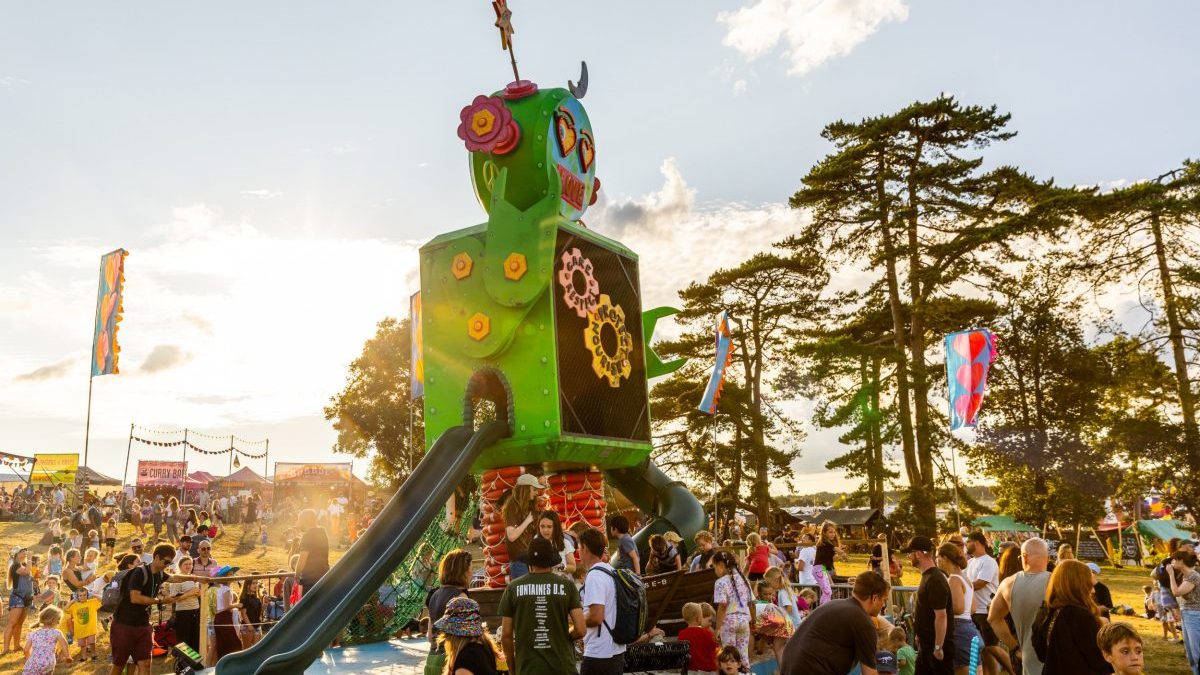
This will never fit, I thought, as I stared at the chaos taking over our living room. Last summer I found myself face to face with an inflatable tent still in its bag (somehow even larger than our coffee table), two sleeping bags, a double duvet, air beds for the whole family, three rucksacks, a large weekend bag, plus a cool box and enough food to keep us going for days. Then came my two under-10s that needed to fit in the back of the car as well. Much to my surprise, we squeezed everything in and set off down the A3, Dorset-bound, for four nights of family adventure. This wasn’t our first trip to Lulworth Castle for Camp Bestival, the award-winning family festival that marks the start of the summer holidays against the dramatic backdrop of the Jurassic Coast. But every time we go, the amount of stuff required feels like a military operation before the fun can begin. With the festival season now in full swing, it felt like the perfect time to look back at the unforgettable family adventure. In previous years, we’ve extended our stay in neighbouring counties, using the festival as a launchpad into our summer break. Last year, we were more focused on maximising our time on site while honing our camping skills. We’d previously rocked up with little more than clothes and food, indulging in the luxury of pre-pitched glamping (bell tents, yurts and trailers are available with varying degrees of comfort and cost). The festival takes place at Lulworth Castle in Dorset (Photo: Camp Bestival) However, a growing crew of Bestival-going friends meant that we wanted to create our own little camping community, hence the military-grade packing list of camping gear. After a last-minute dash to Decathlon, we had what we hoped would create a similar level of luxury: inflatable tent (how hard could that be?), self-inflating mattress, compact chairs and table, solar fairy lights, and a decent cool bag. As camping lore dictates, the reality wasn’t quite so straightforward. It turned out that we had forgotten about a pump for the tent, and even after locating one to borrow, we couldn’t get the tent to stand up. Maybe poles are easier after all. However, after a couple of hours and some friendly intervention from our neighbours, we were set up, cold drinks in hand, as the children ran wild with their friends. The inflatable tent when it was finally up (Photo: Sophie Lam) Other families had brought even more gear than we had. Alice and Mark, from south London, were at the festival for the first time with their two children, aged four and seven. They’d been tempted by the prospect of free tickets for under-fives (festival co-founder Rob Da Bank told The i Paper that this new offer “opened the floodgates to a new audience”), and were travelling on from Dorset to the Isle of Wight for their summer break at a caravan park in St Helens with extended family. “We had to ask my mum to take some of our stuff for us,” Alice explained. “There was no way we were getting two weeks of clothes in the car.” They’re not alone. Recent research by Ticketmaster has revealed that festivals are becoming the go-to alternative for family holidays, with more than two in five parents seeing them as a replacement for a traditional summer break and more than a quarter saying the convenience of staying closer to home is a key reason for picking a festival over a holiday abroad. The proximity of ferries to the Isle of Wight had been a deciding factor for Alice and Mark’s extended holiday. Meanwhile, almost three quarters of parents think festivals beat holidays for introducing their children to new cultures as well as making better family memories. As part of the ticketing platform’s State of Play Report into the shifting cultural trends of festivals, its data also shows that more than half of UK festivalgoers now go with their family. A roller disco was one of many activities (Photo: Leora Bermeister / Farelight Productions/ Camp Bestival) Last year, Camp Bestival tickets cost £210 per adult and £108 per primary-school aged child, which covers three days of live music, performances and a busy programme of activities. Over the course of the weekend, our six and eight year old packed in an hour of football coaching, three hours of pottery and woodland wand making, an hour of potion making, three hours of circus skills, a Horrible Histories: Gorgeous Georgians live show, two circus shows, performances by Taylor Swift tribute act Miss Americana, and hours of street theatre. Wand making in the Dingly Dell woodland area (Photo: Camp Bestival) Working out at less than £40 per day, ticket-wise, that’s not bad going. Recent holidays at European campsites have included just a fraction of that activity with football and tennis clubs and mini discos. We also took advantage of Camp Kids Extra Passes (£49 per child), which we exchanged for cotton bags with refillable water bottles, daily fresh packed lunch with fruit, and daily ice cream and dinners from selected food trucks each evening. Supplemented with plenty of snacks from our tent, I did not hear “I’m hungry” all weekend. The thrust of our experience was keeping the children happy and entertained, but their familiarity with the site meant that we could give them some freedom to explore the Dingly Dell woodland and adjoining Little Town area with its sand pits and hula hoops while we watched from the adjoining campsite. A collection of male peacocks proved endlessly fascinating. Yoga sessions were on offer throughout the weekend (Photo: Leora Bermeister/Farelight Productions/Camp Bestival) I took advantage of the extensive free yoga programming, enjoying an early morning 45-minute session that eased my midlife camping aches, while my husband enjoyed the campsite sauna and cold shower. Friends took off for Lulworth Cove, less than 10 minutes away, for a refreshing morning swim. Now in its 18th year, Camp Bestival has matured, evolving its wellness offering to a festival-within-a-festival. Founders Rob and Josie Da Bank are developing their Slomo Wellness concept with a growing collection of saunas and retreats on their home turf of the Isle of Wight and nearby Dorset coast, which this summer decamped to Lulworth Castle to form the new Slomo Wellness field. “Even from the first festival, we had [a wellness offering] there – it was probably called the yoga tent,” Rob told The i Paper. “It’s an important part of what we do.” The Slomo Wellbeing field (Photo: Camp Bestival) This year’s offering was a sun-drenched haven of tepees and tents offering sound baths, yoga, meditation, reiki, shamanic healing, tarot readings, hot tubs, ice baths and sauna sessions. “It just made sense to make a bit more of a song and dance about it,” added Rob. “This year I think we had one of the best festival wellbeing offerings out there.” Highlights included an ayurveda workshop with the David Lynch Foundation and a sound bath hosted by Jasmine Hemsley. But most impressive was that most of it was free, including yoga sessions for families, women, teens and mental health, and family tai chi, as well as meditation. “That’s really important to us. You don’t have to pay to learn to meditate or try a gong bath,” Rob explained. “There was also some really fun stuff for beginners and family, like a morning shake-out just to get people going,” added Josie. “We wanted to make Slomo more accessible.” Crafts in the Dingly Dell (Photo: Camp Bestival) When it came to packing up our tent at the end of the festival (infinitely easier than putting it up, it turned out), we managed to get everything back in the car. But we had to make space for pottery creations and woodland magic wands, and layers of new memories that are still being talked about. Going back to school holiday camps was going to have a lot to live up to. Final tier tickets for Camp Bestival 2026 (30 July to 2 August) are on sale for a limited time. Now £233 adults, £145.50 teens, £122 for 10-12 year olds, £103 for five to nine year-olds, £85.50 for two to four year-olds, with under-ones going free. DIY glamping: how we did it We used Decathlon’s Quechua Air Seconds inflatable tent (£600), which had two black-out bedrooms at one end with the option to add a third at the other end, to sleep up to six people. We kept this large, standing-height space for storage and changing. The tent also had lots of storage pockets that were useful for keeping things tidy. The Quechua Ultim Comfort self-inflating double mattress (£150) is lightweight and folds into a reasonably sized parcel with a carry handle, which makes it easy to transport. It didn’t deflate like traditional camping mattresses and was warm and reasonably comfortable. We used standard inflatable mattresses for the children. We took two Quechua compact low camping chairs (£35), which fold down into very small and lightweight bags that our children could carry easily. They were also comfortable and felt robust. The Quechua low compact camping table (£45) was useful at mealtimes, for drinks and colouring-in sessions among the children. We boiled a Vango kettle (£14) and cooked on a Campingaz Bistro one-burner stove (£24), using an additional griddle plate (£12) for pancakes and toast. We kept food and drinks cold for a solid 24 hours in the Quechua 35l inflatable fresh camping cooler (£50). Next time I’d freeze a large bottle of water to use instead of ice packs, which melt more quickly. A touch of glamping fun was added with a string of solar-powered camping fairy lights, widely available online for around £11.
I took my children to Camp Bestival – it cost less than school holiday childcare
Full Article
Original Source
Read the full article at Inews →KhanList aggregates and links to publicly available news content. We do not host full articles from third-party sources. Always verify important information with original sources.