
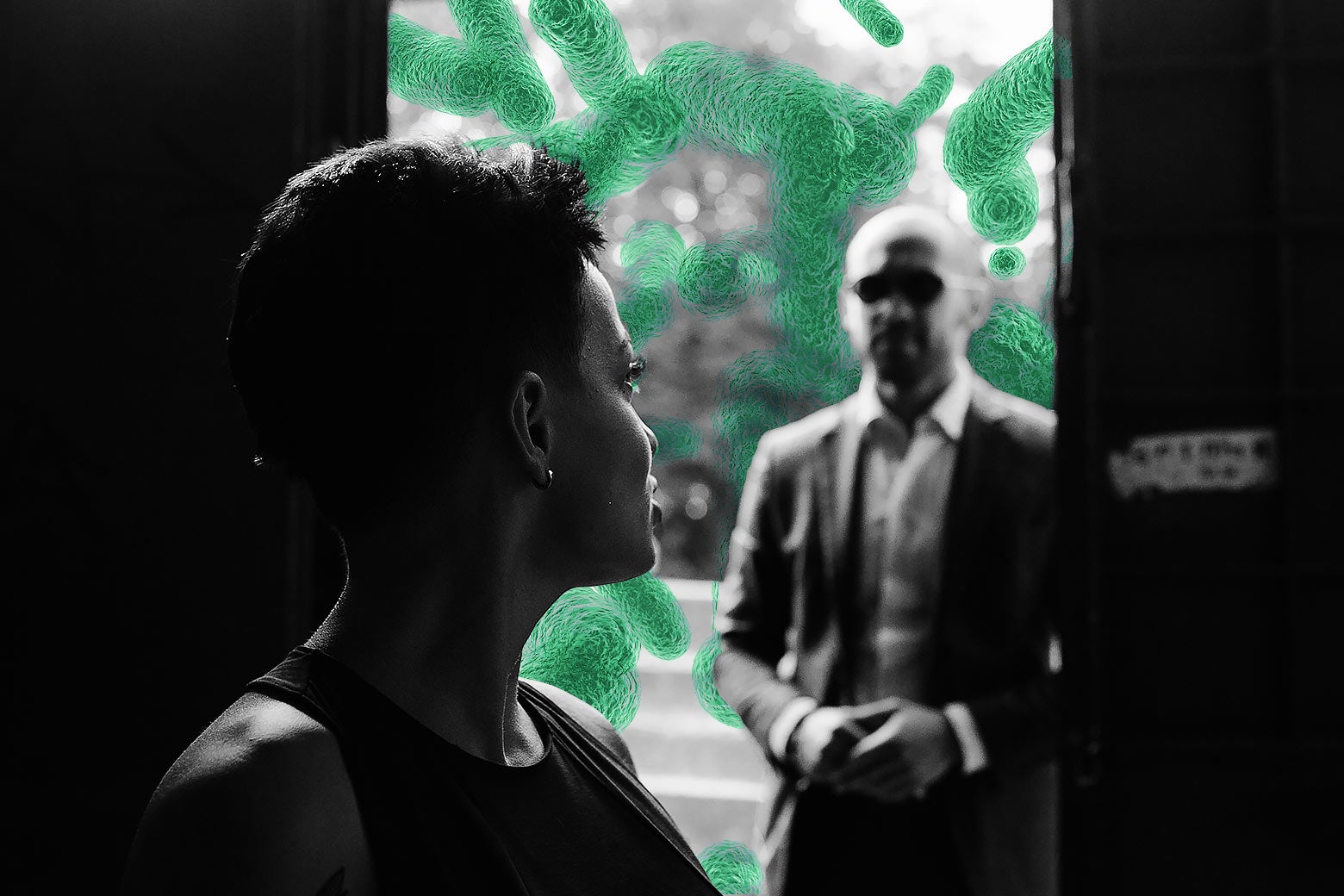
Relationships There’s a Pill for That I thought my kinky, older partner was the healthiest man I had ever slept with. Then a controversial infection tore us apart. Photo illustration by Slate. Photos by teksomolika/iStock/Getty Images Plus and image_jungle/iStock/Getty Images Plus. Sign up for the Slatest to get the most insightful analysis, criticism, and advice out there, delivered to your inbox daily. “You don’t understand.” Jack was talking with his hands. We were sitting at the bar of a new Mexican restaurant where he claimed to know the chef. “Old buddies,” he’d told the waiter. An hour into our taquitos, he was no longer tracing the thigh tattoos that branded me little flirt in French. They were new, so the cursive was still tender and puffy. On my first leg, I had loved the sweet sting of the needle. But by the second, the sensation was just plain pain. Jack leaned in to meet me at my level in the same way I imagined he might parent his two kids. “I’ve been trying everything,” he insisted. He had recently tested positive for Ureaplasma, a bacterium that exists in many people’s urinary and reproductive tracts but can trigger painful, recurring infections when it overgrows. Though not technically considered a sexually transmitted infection, it’s spread primarily through sexual contact. At the time, I had finally come out on the other side of a demoralizing, yearslong battle with the bacterium, and I intended to stay clear. So after Jack slept with his ex—a kosher act, since we were both nonmonogamous—I asked him to test. He obliged and came up positive. The trouble was, he didn’t want to take antibiotics, the only thing known to treat Ureaplasma. Jack rattled off the natural remedies he’d tried, counting them on his fingertips to make me understand. As he ticked away his middle, index, and thumb, I quietly wished he’d be sucked into the ductless air conditioner. By the time he got to oregano oil, one thing was clear: The healthiest man I’d ever had sex with was OK with having an indefinite genital infection he could pass to both me and others. Despite Jack’s age—double mine—he was the image of physical vitality. He was always sending erotic texts from the gym and encouraging me to drink kefir, which he credited with giving him a stellar microbiome. When I didn’t finish the Whole Foods salmon filet he’d salted and baked, he worried about my protein intake. I watched him clean his plate in awe, bristling at the dull scrape of knife on ceramic as he devoured the scaly gray skin. His body was ideal in a way that had never occurred to me—a queer, protein-deficient 25-year-old who regularly counts her subway commute as exercise—to want. It was one of the reasons I chose to overlook his more “holistic” tendencies. Well, that and the sex. Jack was older, dominant, in control. Our age gap heightened the power dynamic. I enjoyed his proportional efforts to impress me, my shameless application of lipstick as he picked up the check. I met him on Feeld, an alternative dating app geared toward nonmonogamy, polyamory, and kink. Apps like Feeld have made subcultural dating scenes more widely accessible, including to men, like Jack, who advertise moderate and identify conservative, despite their conveniently open-minded sexual preferences. On the one hand, this provides an opportunity for people with diverse viewpoints to connect via shared desire. On the other hand, it pisses me off. There’s often a misalignment of values that daters lack the tools to mediate. For Jack and me, this crystallized around health. The first time I introduced him to my primary partner, Jack ordered loose-leaf green tea and offhandedly broached the subject of his disbelief in the COVID vaccine. Had it not been for his ex-wife, pregnant at the time and sharing custody of their kids, Jack would not have opted to vaccinate. If he weren’t so confident in his own position, so charmingly in control, perhaps I would have side-eyed his choice. But what about the invitational quality of risk, itself inherent to nonmonogamy, life-affirming even when it poses some odd threat? “Luckily,” Jack added, “I got the Johnson & Johnson.” That is, he had had to take only a single dose. He seemed just as clueless now about Ureaplasma. Like many people with the infection, Jack was asymptomatic. This enabled him to operate on see-to-believe logic: What he couldn’t himself perceive was not his problem. His problem, the achingly palpable one, was that his genitals could no longer exist in proximity to mine. When I asserted this, with a characteristically dramatic “I guess this is probably it, then,” he topped me with “I know it won’t be like this forever.” How poetic. But also, genuinely, how? There were no signs his microbiome planned to sort this out alone. I, on the other hand, had symptoms. In 2022, before I met Jack, I contracted Ureaplasma for the first time. I woke up one morning to the feeling that my vulva had swollen to thrice its size. My crotch had become, in every sensory way, a bakery-size triangle of the Greek savory pie spanakopita. The collective of gynecologists I saw back then said, That’s not feta, it’s yeast. They prescribed me antifungals, which promptly gave me bacterial vaginosis. They prescribed me antibiotics to clear the BV, which made the yeast return. For four months, nothing helped and everything burned: my vulva, my vagina, when I peed. Sex was unbearable. The pain—described by some as a “hot curling iron” on the “inside of their vaginas”—was too intense. Eventually, I stopped trying to have sex at all. Unsure why I was still having symptoms, my doctors did what most doctors do: tested and treated me for common infections, prescribing countless rounds of the incorrect antibiotics until my immune system responded to nil. Over the ensuing year, immunosuppression encouraged a kidney infection here, an E. coli infection there. As I became sicker, none of my doctors considered that they might be treating the wrong thing, and Ureaplasma was never mentioned to me. Since the bacteria both mimics and triggers the symptoms of yeast and BV, few medical providers realize that it’s the underlying problem. Nor did my gynecologists realize that the longer I had the infection, the greater the chance I had of developing more-complicated symptoms. In addition to BV and yeast, Ureaplasma can cause pelvic inflammatory disease, a condition that, if left untreated, can lead to infertility. Pregnant women carrying Ureaplasma can face complications as serious as preterm birth and miscarriage. Men are less likely to notice symptoms, but Ureaplasma also increases the risk of infertility and even prostate cancer. Despite all of this, because these bacteria already exist harmlessly in most people’s bodies, healthcare providers often dismiss Ureaplasma as not pathogenic enough. Later, when my primary partner and I came to the decision to ask our other partners to test for the infection before sex, their doctors would often refuse. The urgent care and Planned Parenthood clinics they visited were not equipped to test beyond the standard STI panel (on which Ureaplasma does not appear), and their gynecologists discouraged screening as superfluous without active symptoms. At least 60 percent of women carry one of two common strains of Ureaplasma in their genital tract, but most are asymptomatic. This means that if they want it tested for, they often have to fend for themselves. There are countless blogs and forums documenting attempts to do so online. A Reddit thread, titled “The Ureaplasma Bible,” features over 3,000 comments from people struggling with uncooperative doctors, recurring infections, and a growing resistance to antibiotics after repeat infection and treatment. Users have assembled everything from Quest and LabCorp testing codes to a list of “doctors who take Ureaplasma seriously in the USA.” Reading through the comments, it’s clear that these women—many of whom have spent years in pain—rely on themselves and one another to get care. That was certainly true for me. It took four months and a Reddit-recommended gynecologist to diagnose me with Ureaplasma, which she discovered through a simple vaginal swab. All it took was a dose of the right antibiotics for the symptoms to finally disappear. Soon, however, new partners led to multiple reinfections, mostly through oral sex. It wasn’t long before I was back in pain. This meant no sex of any kind, and a host of other no-no’s that could trigger my symptoms: no booze, no sugar, no vice. Each day was pain, rice, and vegetables. It also meant more antibiotics. This time, I needed multiple rounds, each of which seemed to spin my body further out of my control. After what I’d been through, I could understand Jack’s desire for a more holistic approach. But I’d spent years dealing with Ureaplasma, and I was finally in the clear. If he wasn’t willing to take antibiotics, then having sex with him would put me at risk of getting it again. His other partners could get sick too—if they hadn’t already passed it to him in the first place. Jack often cited the hard work he’d done on his microbiome as the ultimate reason not to take these antibiotics. “I can’t start over,” he’d tell me. As we stood up to leave the restaurant, I realized: Neither could I. Jack insisted on calling me a cab. He slammed the door before it sped away, leaving me fuming. Back at home with my primary partner in Harlem, I felt exhausted and betrayed, unheard and angry. “That makes sense,” my partner affirmed. As it turned out, he had been waiting, rather patiently, for me to reach the same conclusion he had come to many months back: This one’s not worth it. Now I use Ureaplasma to suss out who is. These seemingly ubiquitous bacteria have become, in my dating life, their own sort of test: Is this person willing to see my health as their own? Are they capable of caring for me? Jack was not. How could I call that healthy? Dating and Relationships Health Medicine Sex Women Men
I Thought I’d Met a Great Guy. When He Refused to Treat His Genital Infection, I Did Something I Never Wanted to Do.
Full Article
Original Source
Read the full article at Slate →KhanList aggregates and links to publicly available news content. We do not host full articles from third-party sources. Always verify important information with original sources.