
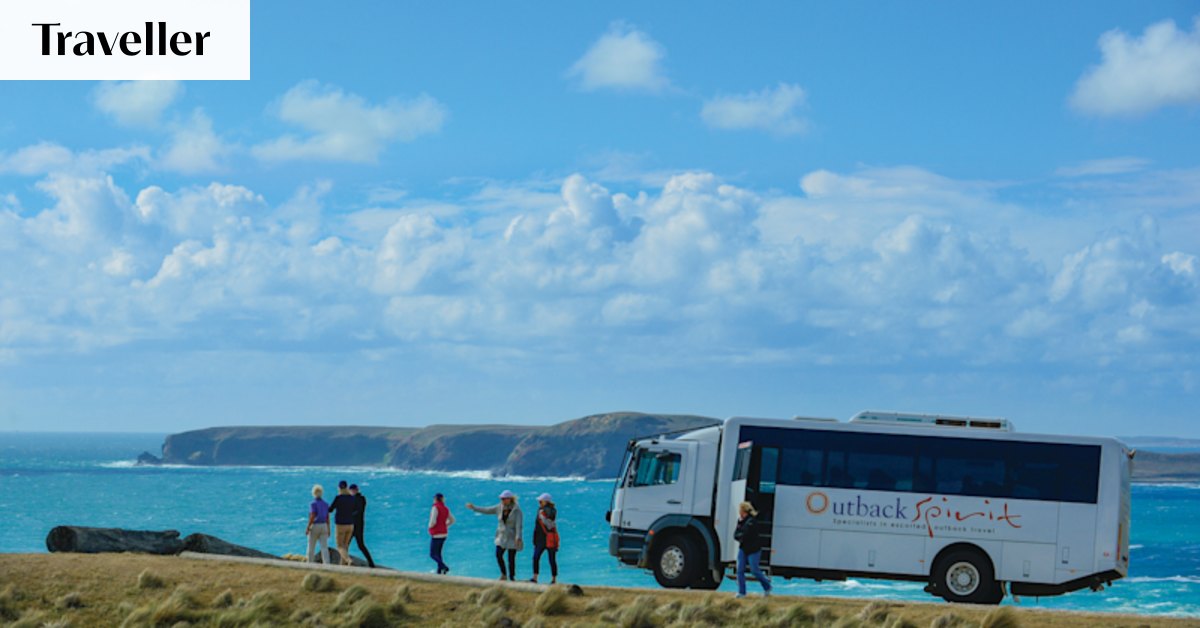
November 3, 2026 — 5:00amWhen the ferns clear and the cragginess of Cradle Mountain comes into high definition above Dove Lake, my breath catches. The 1545-metre-tall igneous dolerite monolith looms large against an uncharacteristically blue sky.I’m on a Tasmanian Wilderness Explorer tour with Outback Spirit, and I’m one of a handful of my 22-person group wandering the six-kilometre Dove Lake circuit this morning. Despite rain following us from Hobart, via pit stops in Coles Bay, Launceston and Smithton, the skies have cleared. The landscape is still and the wildlife is out in force. Mother Nature is putting on a show.Cradle Mountain rises above the glassy waters of Dove Lake.This is a theme of our tour – the natural splendour, that is, not the roaming fauna, although they star along our 1980-kilometre journey, too.Travelling in a Mercedes-Benz 1835 coach-body truck, we watch Tasmania’s landscape change through luxuriously expansive windows. The vehicle is stewarded by Maddy and Robin Gentle, a husband-and-wife pair who have worked with Outback Spirit for many years.“To do this, you really have to love the place,” Robin tells me, “and we really love it. We live here. We’re so proud of what Tassie’s got to offer.”Sign up for the Traveller Deals newsletterGet exclusive travel deals delivered straight to your inbox. Sign up now.Outback Spirit’s coach-body truck pauses along Tasmania’s scenic coastal roads.They spend their summers in their home state of Tasmania and winters doing the equivalent regional tours in Queensland, where the pair once lived.Our 26-seater coach takes the curves and corners of Tasmania’s notoriously narrow roads with ease, bobbing along over the Bass, Midlands and Tasman highways while we’re cushioned in leather with new-season nectarines in a basket within easy reach.Before Cradle Mountain, we experience Tasmania’s convict history with a warm afternoon wander through the Port Arthur Historic Site, fly over Freycinet National Park in a helicopter and see where the stunning pink granite meets the aqua-blue sea of Wineglass Bay. We also stroll the famous rose gardens (and sniff many of the 350 rose varieties) at UNESCO World Heritage-listed Woolmers Estate, and ascend The Nut in Stanley – a giant, flat-topped volcanic rock – after scones at the Van Diemen Ice Creamery. We pull up at road stops, where Maddy and Robin orchestrate multi-course lunches featuring local cheese, vegie boards, DIY wraps and fruit platters, with an ever-present supply of hot water for tea. We explore a Cape Grim wind farm, learn about the origins of the Van Diemen’s Land Company at Highfield House on the north-west coast, and walk across Australia’s oldest bridge at quaint Richmond.The Nut stands tall over the historic coastal town of Stanley.It’s day six of the 12-day tour when I arrive at Dove Lake. When I was a small child, I waddled around the lake with my parents and aunt on a brief holiday. Since then – in fact, months before this trek – I’ve moved to Tasmania. This is my first time back at Cradle Mountain since toddlerdom.I catch pademelons moving through the Ballroom Forest, their bouncing the only noise, and watch a waterfall churn into the tannin-dark lake via mossy arteries. A low branch in front of me is so heavy with moss that it looks fit to snap. It’s otherworldly.A fellow traveller catches up to me at a bench, where I’ve paused to pull out an instant camera and my notepad. Words wouldn’t capture our human insignificance, so instead we nod at each other with goofy grins and a mutual disbelief at our luck. In companionable silence, we eat packed bananas and stone fruit before tucking peels and pits in our packs. I feel a sense of clarity that points me towards reconsidering the direction of my life. (I imagine Gustav Weindorfer and Kate Cowle, the pioneering botanists and conservationists largely responsible for the national park designation of this region, shared a similar sentiment.)We rejoin our group at the Cradle Mountain-Lake St Clair visitor centre, a mountain-shaped edifice of steel and timber. Willamina, a wombat, is here too, scratching against a buttongrass sedge while munching contentedly. We exchange pleasantries with Willamina until she toddles away mid-conversation, then head back to Peppers Cradle Mountain Lodge for an afternoon stroll around the onsite alpine forest.Evening light over Peppers Cradle Mountain Lodge and its serene pond.“Stand still and make way,” Robin bellows from the front as another rotund quadrupedal marsupial jiggles past. “We’re interacting with them on their terms.”Satisfied with the second spontaneous wombat sighting of the day, he leads us further into the foliage as a gentle rain spittles. Our return to the chalet coincides, of course, with a pre-dinner cheese-tasting.In time, the early mornings feel less harsh and the camaraderie among our group is easy. We wear our name badges everywhere, but they’re unnecessary after the third dinner, a menu of share plates of beef carpaccio sprinkled with mauve garlic flowers and crispy capers, grilled asparagus topped with crushed local hazelnuts, and creamy gnocchi at Launceston’s Grain of the Silos.Queenstown on Tasmania’s west coast.We pass the Vale of Belvoir, a conservation area David Attenborough used as the backdrop for Walking with Dinosaurs, when we depart Cradle. Clouds hang low and dense, obscuring the mountain altogether, while spinifex hides echidnas and rust-coloured endemic scrub colours the horizon.My phone loses service en route to the west coast, once known for its impenetrable wilderness and booming mining industry, but flicks back when we pull up outside The Paragon Theatre in Queenstown. The art deco masterpiece has been restored by locals, and retains its character almost 100 years after it opened for “talkies”.“Welcome to the end of the world,” says co-owner and local Anthony Coulson. “You made it.”His voice echoes through quiet streets; it is, after all, mid-morning and many of the town’s 1900-odd residents are at work. (It’s a far cry from the 10,000 who once called this town home, but Queenstown remains the west’s most populated town.)Strahan’s historic waterfront.The stationmaster’s house – designated to the overseer of the Mount Lyell Mining and Railway Company, the instigator for the introduction of the Abt railway system to connect Queenstown to Strahan – commands the hill, and the huge post office stands as a testament to the scale of industry that operated here. It’s also evident in the rust-coloured Queen River, which runs orange decades since the ceasing of mining operations.We trek onwards. After a snooze at cosy Strahan Village, Tasmania’s beauty astounds me anew. We head out on Macquarie Harbour early with Gordon River Cruises, traversing 70 nautical miles through liquid arteries.“We’ll head out to Hells Gates first and the Great Southern Ocean, then back down the western shore,” our captain bellows over the loudspeaker while we nibble granola pots and sip hot coffee.Cruising the winding channels of Franklin-Gordon Wild Rivers National Park.Ribbons of white foam run through the peat-coloured, tannin-rich water. We hop off at Heritage Landing, a 400-metre elevated boardwalk through the temperate rainforest of Franklin Gordon Wild Rivers National Park, where sunlight catches on the canopy of 500-year-old myrtle beech. A Macleay’s swallowtail butterfly flutters over my fingers, an unpaid actor contributing the sheer magnificence of this untouched wildness.Sarah Island, another stop, is a little less picturesque, the eight-hectare island once serving as a brutal penitentiary and shipyard for reoffending convicts. Ferns spill over the bricks that were once the bakery and the jail as wind howls with much the same velocity as it did here in 1822. Thousands of lashes were distributed to 240 men here during the tenure of the prison island; today, daisies and wattle brighten the loam.Seal spotting from our Bruny Island cruise.In the two days it takes to return to Hobart, we visit Lake St Clair – where Maddy points out a sunbaking tiger snake – before exploring The Wall in the Wilderness, a magnificent piece of timber artistry by Greg Duncan and son Daniel that, at 100 metres long and three metres tall, fills a long shed. On its Huon pine panels, stunningly lifelike hands emerge from the timber alongside wet-looking horse snouts, folded maps, thylacine skeletons and the buckles of boots.We also visit Bruny Island. After the high-octane antics of our helicopter ride over Coles Bay earlier in the week, spending one of our final days zipping about on an open-air adventure boat sounds full on. Regardless, I’m strapped into my red poncho as we jet past Bruny’s sea cliffs, seek out seals lounging on the skerries, and slide through The Monument, a narrow gap between rocks, in the relentless drizzle.Sweeping Hobart views from the summit of Mount Wellington.I can’t feel my fingers, but I’m awed by the majesty of the place I now call home. When we venture to the top of Mount Wellington as our final farewell the next day, a light snow begins to fall, as if on cue.“We want the tour to be a reflection of what we love,” Maddy grins. “We could go for months. We’re only showing you the tip of the iceberg.”DETAILS Outback Spirit’s Tasmanian Wilderness Explorer 12-day tour from $10,190 per person, including all meals and experiences. See outbackspirittours.com.auThe writer was a guest of Outback Spirit and Journey BeyondRiley Wilson is a freelance journalist and editor specialising in travel, food, architecture and agriculture. She is a former desk editor at The Sydney Morning Herald and The Age, and the creator of the Greater Good newsletter.Connect via email.From our partners
I thought I knew this Aussie state, but this wild tour floored me
Full Article
Original Source
Read the full article at Smh →KhanList aggregates and links to publicly available news content. We do not host full articles from third-party sources. Always verify important information with original sources.