
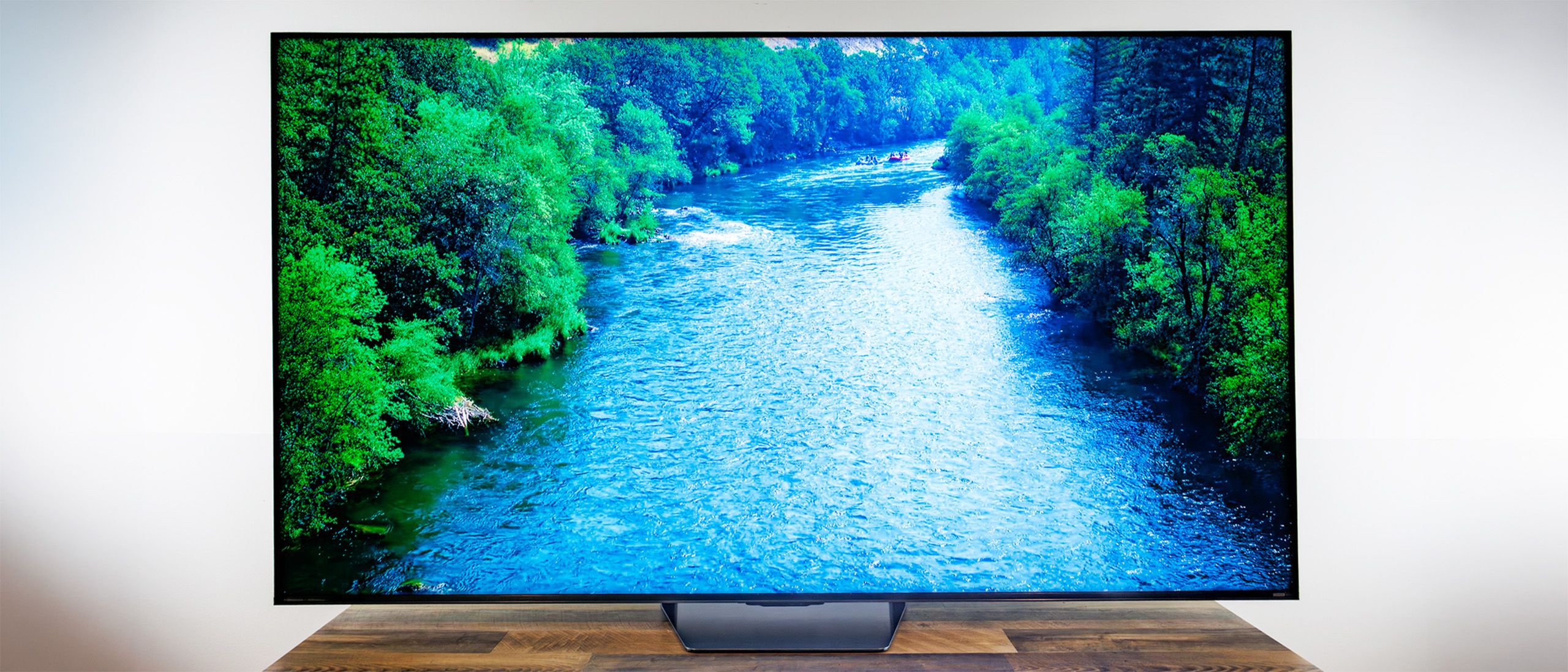
Tom's Guide Verdict Though not cheap, this huge screen's impressive visuals, sound, and game play justify the price. Reasons to buy +Rich, wide color pallette +Luminous high dynamic range +Powerful five-channel sound system +Smooth, no-lag game play +Plenty of tech overhead for the future Reasons to avoid -Chunky, somewhat busy design -Pricey (although often discounted) Why you can trust Tom's Guide Our writers and editors spend hours analyzing and reviewing products, services, and apps to help find what's best for you. Find out more about how we test, analyze, and rate. Jump To: Pricing & availability Design Ports Performance Test results Gaming Audio Interface & remote Verdict Hisense UR8: SpecsPrice: $2,499.99 listScreen size: 75-inchResolution: 3,840 x 2,160HDR: Dolby Vision, Dolby Vision Gaming, Dolby Vision IQ, HDR10, HDR10+ Adaptive, HDR10+ Gaming, HLG, upgradeable to Dolby Vision 2 MaxRefresh rate: 180Hz native (up to 330Hz at 1080p)Ports: 4 HDMI 2.1 (4K/180Hz VRR, one with eARC), 1 USB 3.0, 1 USB 2.0, 1 optical digital audio out, LAN, cable/RF-in, ATSC 3.0 tunerAudio: 2.1.2-channel, up to 50W (Dolby Atmos, DTS Virtual:X)Smart TV software: Google TV with GeminiSize (without stand): 65.7 × 2.3 × 37.9 inches (W×D×H)Weight (without stand): 66.6 lbsHisense has been impressing us for some time with bright screens and full color; the UR8 continues that trend. The company has pinned its fortunes to RGB mini-LED technology, which uses a backlight with a dense array of red, green, and blue LEDs — rather than the white or blue arrays that other TVs feed through the color filters and pixels. It's an expensive technology, reserved for its higher-end models, and a tricky one to get right. But the UR8 nails it, while also providing meaningful brightness, especially in high-dynamic-range scenes. This TV is also a first-rate gaming screen, with imperceptible lag and the ability to support the highest possible frame rates (up to 180Hz). Although the sticker price is a bit high, at about $2500, frequent sales drop it well below $2,000, making it one of the best TVs you can get if the price is right..Hisense UR8 review: Pricing and availabilityThe Hisense 75UR8SG is the 75-inch model of the 2026 UR8 RGB MiniLED lineup, which includes 55-, 65-, 75-, 85- and 100-inch sizes (starting around $1,000). The 75-inch screen lists for about $2,500 (Hisense doesn't post a suggested retail price), but it's regularly discounted substantially. The UR8 sits below Hisense's flagship UR9 RGB MiniLED line and above Hisense's conventional Mini-LED U7 and U8 series. (Image credit: Tom's Guide)At its street price at press time — roughly $1,600 to $1,900, depending on retailer — the 75UR8SG lands in the same bracket as the TCL QM7L and the step-up TCL QM8L (which both impressed us), as well as Hisense's own U8QG. Another option: If you don't "need" a 75-inch screen, you could downshift to the 65-inch UR8, which sells for about $500 less, depending on fluctuating online prices.Latest Videos FromTom's GuideHisense UR8 review: DesignThe UR8 is a tad chunkier and busier-looking than some rival TVs. Instead of just the brand name, the lower left corner of the bezel features the words "Hisense / RGB MiniLED," while the right corner features "TUNED BY DEVIALET." They designate video and audio features we'll talk about below. That bezel has a silvery brushed-metal look, unlike the thinner, plain black we see on most TVs. They designate video and audio features we'll talk about below. That bezel has a silvery brushed-metal look, unlike the thinner, plain black we see on most TVs. (Image credit: Tom's Guide)The UR8 also has a large central pedestal in the same metallic finish. You can also wall-mount the 2.3-inch thick TV using its VESA-standard 400×400mm screw-hole configuration.Hisense UR8 review: PortsHow We TestWe follow a standard testing protocol for every TV we review at Tom's Guide. Our benchmarks include a series of technical and subjective tests designed to rate the set's performance. For our technical tests, we set the TV to Filmmaker mode (usually the most accurate out of the box) and take measurements using a Jeti spectraval 1501-HiRes spectroradiometer, a Klein K10-A colorimeter, a Murideo 8K-SIX-G Metal pattern generator, and Portrait Displays's Calman TV-calibration software. We also use a Leo Bodnar 4K Video Signal Lag Tester for determining the TV's gaming prowess.Subjective tests vary based on the reviewer but usually include anecdotes from a diverse selection of movies, TV shows, and other content reflecting the types of things you may actually want to watch on the TV. For a more detailed look at what we do and how we do it, check out our “How we test TVs” page.The TV has the full assortment of connections you'd expect on a performance model. They include four HDMI 2.1 ports, all supporting 4K video at up to the panel's native 180Hz refresh rate. (Only a few very high-end gaming PCs can serve such a signal. Consoles typically output up to 120Hz.) One of the HDMI ports supports eARC, which can output Dolby Atmos audio to a capable soundbar or home theater sound system. The UR8 also has an optical digital audio out port.I lost track of time while reviewing this TV, as I couldn't pull myself away.The RF/antenna in port connects to an ATSC 3.0 tuner, supporting NextGen TV features such as 4K resolution and high dynamic range. (This matters only for over-the-air broadcast signals. Streaming services and cable boxes generally also support these features, independent of the tuner.)Tom's Guide: Direct to Your InboxGet instant access to breaking news, the hottest reviews, great deals and helpful tips. (Image credit: Tom's Guide)There are also two USB ports, and for good measure, the generally useless LAN port. (Of course, the TV has Wi-Fi and Bluetooth or network connections.) At press time, Best Buy's listing stated that a, "Multi-Functional USB-C Display Port supports 4K display output, file transfer, and up to 10W charging with a single cable." There is no such port on this TV.Hisense UR8 review: PerformanceI lost track of time while reviewing this TV, as I couldn't pull myself away. The UR8 aced dark scenes, including Chapter 2 of the "Top Gun: Maverick" Blue-ray, in which our hero tries to push an experimental jet to 10X the speed of sound. It's a gorgeous interplay of light and dark: the dim control room and cockpit pierced by bright screens and controls, the plane taking off at sunset then climbing into a darkening sky. (Image credit: Tom's Guide)This TV features Hisense's "Ultra-Low Reflection Obsidian Panel,” which it claims renders dark scenes “up to 3x darker,” as well as cutting reflections. I don't know if that's what did the trick, but this TV does excel in dark content and keeps reflections to a minimum. (Image credit: Tom's Guide)The UR8 also nailed the challenging Chapter 10 of "Dune," Part 1. Duke Leto awakens in a dark bedroom, with the set's HDR capability providing plenty of light on his face. (The Theater and Filmmaker picture modes look about the same.) Later on, as the evil Harkonnen ships descended by night, faces of the soldiers stayed pretty discernable in the glow of the fires. The orange and blue explosions are overwhelming — in a satisfying way. (Image credit: Tom's Guide)I did noodle with the settings to get the best look, especially in "Dune." (Local dimming: Low; Peak Brightness: Medium; Brightness: 90; Contrast: 70, Black Level: +3; Dark Detail: On.) My experiments illustrate the great level of control the TV provides to tweak performance to your taste, or to what you are currently watching. (Image credit: Tom's Guide)This TV also made quick work of Netflix's "Brigerton" (Season 1, Ep 3, 17:00-19:00). The Dolby Vision Standard setting was perfect for a bright room and passable in a dark one. (Dolby Vision Pro Reference is ideal for the latter.) It captured the rich riot of dresses in outdoor and indoor scenes, without overdoing their subtle hues. The wide variety of skin tones displayed well, a woman's face that tends to look a bit ashy on lesser screens. The UR8 even preserved detail in the Prussian Duke's blond hair under bright sunlight. (Image credit: Tom's Guide)For material that doesn't use Dolby Vision to specify picture modes, the TV defaults to Energy Saver. It looked quite good in a bright room in tests with the Bruno Mars "Risk It All" YouTube video and a collection of still photos (many shot for our camera tests over the years). Images sometimes appear a tad warm in Energy Saver, which many people may like. If it's too much for some content, Standard mode provides a slightly cooler appearance. For darker content, Movie Maker mode had a fine appearance. If you want a bit more light, Theater Day and Theater Night are attractive options — and to my eye, looked nearly identical to each other.Hisense UR8 review: Test results* Swipe to scroll horizontally Row 0 - Cell 0 Hisense 75UR8SG TCL QM7L Hisense UR9 65-inch TCL 75QM8L Sony Bravia 7 II (65-inch) Vizio VQM65-C (65-inch) LG QNED92 SDR Brightness (10%, in nits) 197.6 196.9 218.8 229.2 100.1 218.7 511.8 Delta-E (lower is better) 4.80 2.64 2.72 3.74 4.79 4.63 1.57 Rec. 709 Gamut Coverage 99.99% 99.48% 99.92 99.55% 98.95 96.82% 97.80% HDR Brightness (10%, in nits) 3542.7 2270.3 3405.3 3719.2 2077.7 781.4 1248.1 UHDA-P3 Gamut Coverage 143.10% 97.64% 99.83 97.97% 97.73 92.94% 95.57% Rec. 2020 Gamut Coverage 95.04% 90.28% 93.1 90.34% 87.17 71.37% 77.42 Input Lag (ms) 12.0 9.4 12 9.5 10.4 9.9 13.3 *As measured in Filmmaker mode. Input lag is measured in game mode, if a TV provides one. (Image credit: Tom's Guide)Our lab tests jibe mostly, but not entirely, with my impressions. We've tested only a handful of 75-inch LCD TVs in recent years (2025 and 2026), so we expanded our comparison to include recent 65-inch models. (Image credit: Tom's Guide)HDR brightness is indeed impressive at 3,542.7 nits (as measured in the 10% window method). That ranks well above the 1,928.6-nit average. Standard dynamic range brightness in Filmmaker mode featured on our results table looks timid at 197.6 nits, vs. an average of 351.1 nits. But people may well view this kind of fare (YouTube videos, older TV shows, the news) in the far-brighter default image mode, which pumps out 1,685.9 nits, vs. a 848.1-nit average for rivals. (Image credit: Tom's Guide)Color accuracy is where instruments and impressions seem to diverge, with a caveat. Delta-E measures the difference between the signal sent to the TV and the colors that appear on the screen, so a lower number (lesser difference) is better. This set's Delta-E of 4.80 looks pretty poor, placing 25th of 26 in a field that averages 2.87. But a color meter is more sensitive than most people's eyes. A Delta-E off by 4.8 is on the edge of what most people would notice. (Image credit: Tom's Guide)This TV does excel in the range of colors it can reproduce. It beat all rival LCDs in reproducing the three color gamuts we measure — including a whopping 143.10% of one known as UHDA-P3. The next-closest LCD in this pool registers 99.99% and the best OLED posts 100.81%. Is this meaningful in the real world? Probably not, as there isn't yet content that fully fills, let alone exceeds, this and other gamuts where the UR8 excelled. But it is some indication of how capable the set's RGB mini-LED color technology is and its potential longevity as content further improves.Hisense UR8 review: GamingI'm all thumbs when it comes to gaming. So I asked my dextrous fellow reviewer Dylan Haas to take the controls on one of his favorite titles, "Spider-Man Across the Spiderverse," on a PS5 in the TV's Game Mode. We both agreed that it looked fantastic — with the bright and vibrant colors the game designers had in mind. The 4K screens rendered cleanly, with no obvious glitches, sustaining the 120Hz refresh rate the PlayStation put out. Dylan noticed zero lag while playing. In lab tests, the 75UR8SG posted a 12.0ms input lag. While we've clocked some TVs as low as around 9ms, this TV's lag is still imperceptible to a human.Gaming fanatics can push the UR8 even harder, as it supports input up to 180Hz via its GameBooster feature. Only top-end gaming PCs supporting technologies such as AMD FreeSync can achieve that currently. Once again, it's a nice bit of future proofing.Hisense UR8 review: AudioHisense doesn't skimp on sound. It has a 2.1.2-channel built-in audio system that can decode high-end Dolby Atmos and DTS Virtual:X signals. Translated, that means two stereo speakers, one low-range speaker (handy in action movies), and a pair of height speakers to capture material that encodes overhead sounds, like a helicopter (or spaceship). Fifty watts of power divided among all these speakers certainly helps. (Image credit: Tom's Guide)This hardware worked as intended in action movies, as in "Dune" 1, Chapter 10. It yielded rich audio in a music track that ranges from low-menacing to soaring-dramatic. Deep voices were indeed deep, and the soldiers' screams echoed in battle. The sounds of explosions were tremendous. Hisene credits a partnership with the French luxury acoustic manufacturer Devialet for its audio chops — hence the prominent branding on the bezel. (Image credit: Tom's Guide)I got the best effect by shifting the TV from its default Standard Mode to Theater Mode. I preferred that for music, as well, such as Bruno Mars's "Risk It All" video. Music was not quite as impressive as action sequences, but still well above average. The UR8's sound system is a worthy competitor to some of the best I've heard, such as that of the Samsung S90H OLED (which lacks the two height channels but still delivers brilliant 2.1-channel sound).Hisense UR8 review: Interface & remoteThe UR8 has essentially the same Google TV operating system that Hisense tends to use on its higher-end models, such as the recent (and cheaper) U7SG ULED. A large carousel of promoted content dominates most of the first screen. Below it comes a "Top Picks for You" recommendation section, and finally a side-scrollable row of installed-app icons at the bottom. (Image credit: Tom's Guide)Scrolling to the next screens reveals sections such as "Continue Watching," "Top Free Movies on Google TV Freeplay," and other ways to categorize content. Gemini voice control provides reliable navigational capabilities and offers good suggestions to even complex requests, such as asking for movies staring multiple chosen actors together (Image credit: Tom's Guide)If you prefer a simpler look, try Apps Only Mode, which provides a minimalist layout in the style of Best Roku TVs. The promoted content section remains up top, but below it, you'll see simply a scrollable grid of rectangular icons for installed apps such as Netflix, Amazon, etc. You can switch to this layout by going to Settings (top of the home screen) > Accounts & Profiles > Apps Only Mode. Hisense's own content selection — a separate section accessible from a button on the top of the home screen — has a similar minimalist look by default. It features hundreds of free (ad-supported) channels.There are a few settings worth looking at if you want to limit the information Google collects. Under Settings > Privacy, you can decide whether to toggle on or off or adjust data-collecting items such as Location, Microphone, Cameras, Usage and Diagnostics, Ads, Voice Assistant, and App Permissions. Another useful adjustment: Settings > Advanced System > Do Not Sell or Share My Personal Information. (Image credit: Tom's Guide)The UR8 also includes Hisense's signature chunky remote control, in a brushed metal finish matching the TV's bezel. It's festooned with buttons — bucking the trend of other, minimalist, black remotes. They include shortcuts to apps such as Netflix, YouTube, Prime Video, Disney+KiD, and Free TV.Hisense UR8 review: VerdictThe Hisense UR8 checks all the "big" boxes: screen size, color gamut, brightness, sound, gaming capabilities. The sticker price is also big, but real-world prices are often quite lower. And if you can live with (or only fit) a mere 65-inch version, the price drops lower.For those on a tighter budget, the $500 Vizio VQM75-C is worth considering (I quite liked the 65-inch version I tested) as is the TCL QM7L, which is half the price of the Hisense set. But if you are up for the investment, the UR8 is well worth it for its stellar performance today and cutting edge technology that could hold up well into the future. Sean Captain is a freelance technology and business journalist and former Tom's Guide editor. He has reviewed TVs, cameras, and online services for Tom's Guide. Sean has also written and edited for Fast Company, The Wall Street Journal, Techlicious, and The New York Times. You must confirm your public display name before commenting Please logout and then login again, you will then be prompted to enter your display name.
I tested the Hisense 75UR8SG RGB MiniLED TV — and I could barely tear myself away from the great visuals and sound
Full Article
Original Source
Read the full article at Tomsguide →KhanList aggregates and links to publicly available news content. We do not host full articles from third-party sources. Always verify important information with original sources.