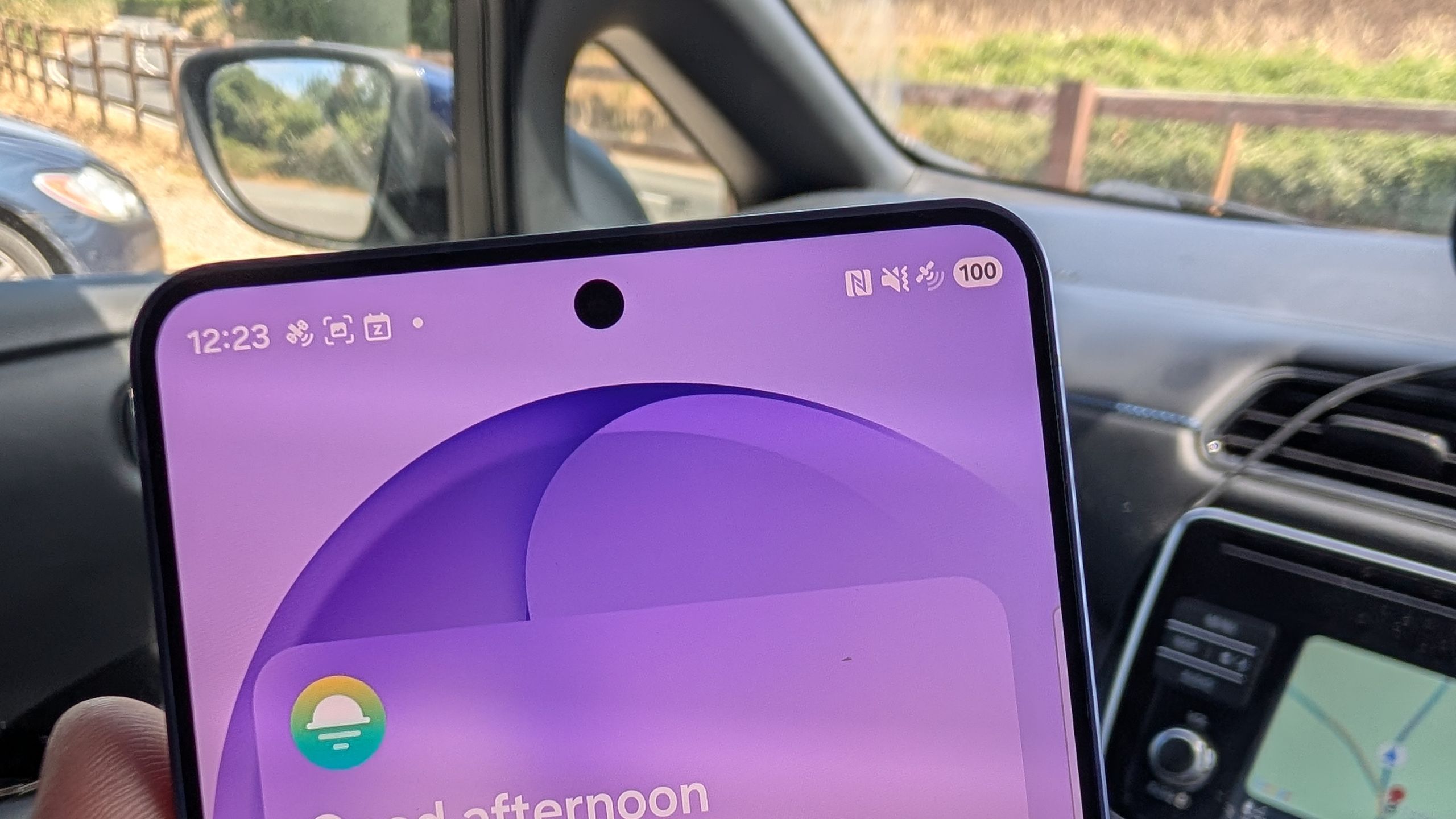
(Image credit: Future) Satellite-based internet is nothing new, but the idea of getting satellite internet on your phone is something that has eluded us for a while. A number of smartphones now offer satellite connectivity of some kind, but that's mostly reserved for emergency situations, but the real question is, when will we be able to ditch cellular service and beam our mobile data from space?Big tech has already been mulling over this idea for a while now. Elon Musk has talked about making Starlink a direct-to-cell service. And just this week Semafor reported that SpaceX (the parent company of Starlink) may be looking to acquire spectrum at government auction to compete directly with AT&T, Verizon and T-Mobile. Or it may decide to acquire another wireless carrier altogether.Meanwhile, Amazon has filed an application to launch its own satellite-based internet service. Fortunately, we don't have to wait for the to get their act together, because carriers around the world have started offering satellite services to their customers.Being the curious type, I decided to give one a go and see whether it was actually worth signing up for full time.How satellite 4G works (Image credit: Future)Those reading this from the U.S. may be aware that T-Mobile offers a satellite service powered by Starlink. I live in the U.K., and naturally don't have access to T-Mobile, but the carrier O2 offers a similar service as an optional extra. This extra is also powered by Starlink, costs £3/$4 a month, and gives you access to satellite-based 4G should you find yourself without a cell signal or Wi-Fi connection.That lack of additional connectivity is crucial to the whole process, because of the way modern smartphones connect to satellites. If there is another form of data connection, be it cellular or Wi-Fi, then the phone will refuse to look for a satellite. The satellite is essentially a last port of call to get your device connected.This has led to some amusing instances of my phone looking for a satellite when there's zero chance of making a connection — such as when I was traveling several feet underground on the London Underground's Central Line. That's because I disconnected from cell service for more than a few seconds.Get instant access to breaking news, the hottest reviews, great deals and helpful tips.Finding the right spot Blue is good, orange is ok and white is complete loss of service (Image credit: O2)Surprisingly, the connectivity aspect actually caused a problem for me, because O2's outdoor 4G coverage is surprisingly good in my part of the country. There are plenty of areas in the U.K. that don't get any 4G cell signal, let alone 5G, but the official coverage map shows they're mainly in very rural areas — notably mountainous regions of Wales, Scotland and Northern England.I live in the South East, roughly around 40 miles from central London. Anyone from different parts of England will be well aware that this is the region where most of the money goes. So, even though I live in a village in a fairly rural area, the cell signal is remarkably robust when you're using an O2 SIM card. (Image credit: Future)That's not to say 4G connectivity is universally available. There are various dead spots scattered around the place, according to both O2's own coverage checked and the independent map from mobile regulator Ofcom.I just had to find one that intersected with a road, ideally one that had ample space to pull over and let me play on my phone. If you've had any experience with British country roads, you'll know that they're often too narrow to do this safely.Thankfully, I found a spot roughly 30 minutes away by car. Not only is it a good-size deadspot, it also contains a pub with a sizable parking lot. There are certainly worse places to stop and test some new phone features.The actual connection is easy and automatic (Image credit: Future)It took a couple of minutes to drive through the deadspot and park my car, by which point my Galaxy S26 Ultra had already connected to Starlink's satellites. That was rather surprising, considering that satellite connectivity typically needs a direct view of the sky to actually make the connection.And no, before anyone asks, my car does not have a sun roof. It's totally solid, though I'm unsure of what materials were actually involved in its construction.Admittedly, the signal wasn't particularly strong inside the car, illustrated as one bar out of three in the S26 Ultra's status bar. This doesn't change the fact that my phone was connected to the satellite through the car roof, and was receiving data from some Starlink satellite in space. (Image credit: Future)My next move was to stick the phone out of my window and raise it up towards the sky. It took about a minute for the S26 Ultra to register that circumstances had changed, and there were no obstacles in the way — at which point the signal jumped up to two bars.It never hit three bars, though, despite the fact I was in an open area with relatively clear skies. I should also note that moving inside the pub, a 350-year old building with a thatched roof, cut off all access to the satellite. So while the signal may be able to penetrate my car, it isn't magic. (Image credit: Future)Accessing Google Maps from inside my car was a slightly drawn out affair. The app warned me that it was connected to the satellite, with lower loading times, and it took between 30 and 60 seconds for the actual map interface to load up fully. Shifting things outside and the load times were significantly reduced, though nowhere near as quick as they are with a 4G connection, let alone 5G.So you're not going to be tapping your feet staring at your phone waiting for an all-important app to load over the course of several minutes. But your speeds aren't going to be as instantaneous as they might be with full bars of cell signal.This isn't unrestricted 4G like you're used to (Image credit: Future)It was a surprisingly effective system, though the main drawback is that there are limitations on the apps you're able to use. These limitations seem to have been coded in at a system level by your phone rather than by the carrier. My personal guess is that this is due to modern phones treating satellite connectivity as an emergency feature, rather than a stable source of data.This means that you will only be able to use the bare minimum of apps you need to communicate, navigate and potentially allow yourself to be found in an emergency. We're talking about things like Google Maps, Google Find Hub, Messages and the weather. (Image credit: Future)The latter may seem like an odd choice, but if you're out in the sticks by yourself with no vehicle or shelter, being able to keep tabs on the weather is essential. It could be the difference between you being stuck in a freak storm and finding somewhere to hunker down and ride it out in relative safety.Your more frivolous apps, like social media and web browsers, are all disconnected and behave as though you don't have any active data connection. So don't expect to be sitting on a mountain somewhere catching up on your favorite Netflix series. That's not what this system is for, and the app straight up won't work if you try it.Likewise, any third-party apps that could prove useful in precarious situations, such as mapping apps, still behave as though they are offline. The good news for wilderness-enthusiasts is that you can still get GPS with no data, but if assets haven't loaded, or are hilariously out of date, then the lack of data to update could end up being a problem. (Image credit: Future)If you live out in a deadspot, or regularly find yourself in one, then gaining satellite access through your carrier is not going to make up for the fact there's no cell signal. The limitations in what the satellite connection can or can't do means that it's not a true replacement for cell service in the way a full Starlink setup would be for home internet.But this sure as heck beats being stuck with zero access to the internet. Carrier-supplied 4G may not be able to give you access to web browsers and streaming, but it keeps you hooked into the apps that you might actually need in a pinch. In short, it means that you will always be able to reach the outside world in the event that you desperately need to.Some may not like the fact that it's getting harder and harder to disconnect, but this means that you won't be stuck in the middle of nowhere without support. The fact that satellite access still worked in my car, and loaded up Google Maps, will easily be a major boon for navigating areas with little to no cell service. Which isn't a bad deal for $4 a month (or $10 a month with T-Mobile).Follow Tom's Guide on Google News and add us as a preferred source to get our up-to-date news, analysis, and reviews in your feeds. More from Tom's GuideI turned my iPhone screen completely gray for two weeks — here's how making it boring helped me get my brain backI shot the same 25 photos with a $329 budget phone and $1,199 flagship — here's the resultsI got sick of buying cases for my phones, so I decided to 3D print them at home — here's what happened Tom is the Tom's Guide's UK Phones Editor, tackling the latest smartphone news and vocally expressing his opinions about upcoming features or changes. It's long way from his days as editor of Gizmodo UK, when pretty much everything was on the table. He’s usually found trying to squeeze another giant Lego set onto the shelf, draining very large cups of coffee, or complaining about how terrible his Smart TV is.
I tested Starlink-powered 4G on my phone — here's what actually happened in a dead zone
Full Article
Original Source
Read the full article at Tomsguide →KhanList aggregates and links to publicly available news content. We do not host full articles from third-party sources. Always verify important information with original sources.