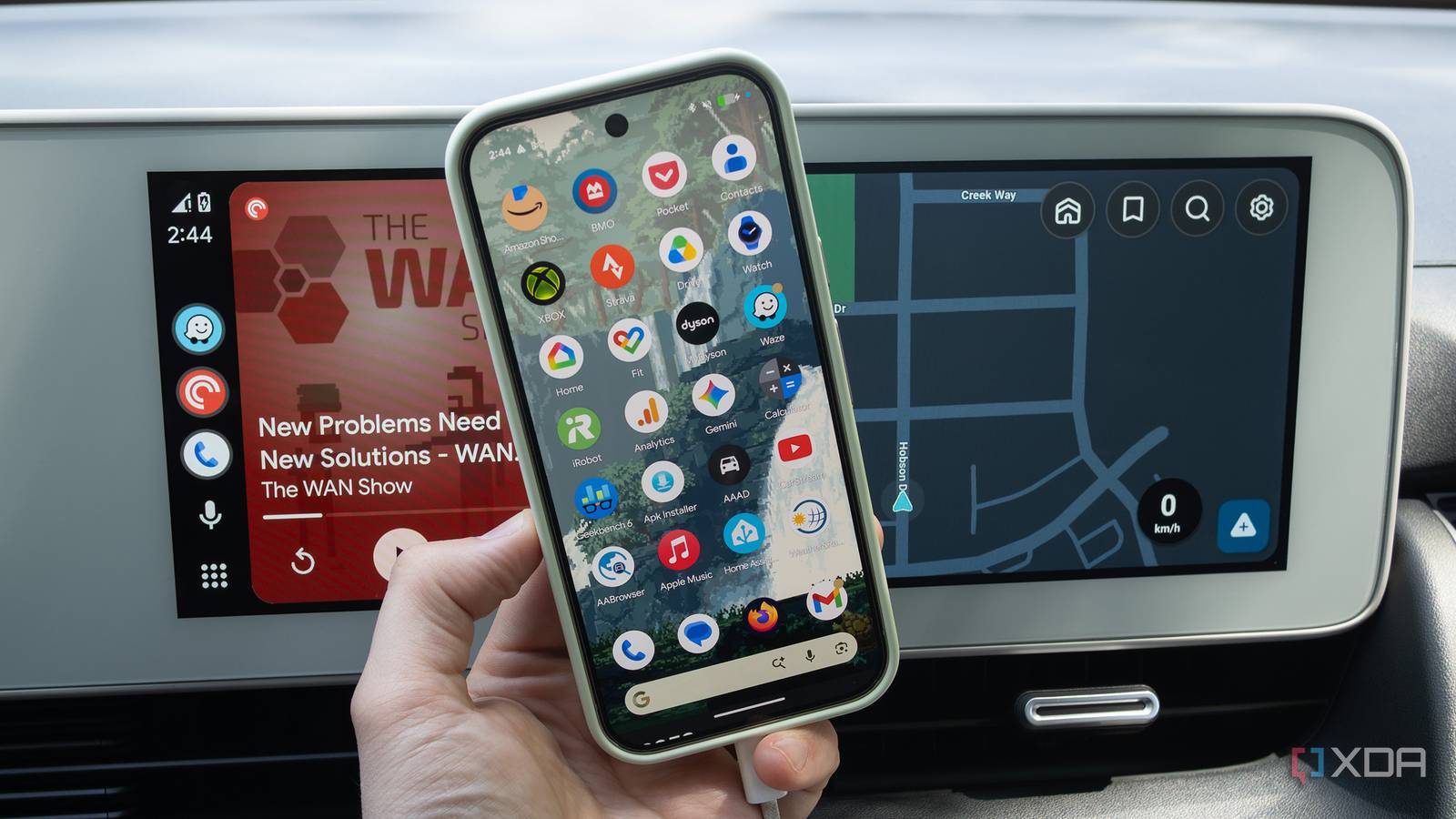
Published Aug 12, 2026, 8:30 AM EDT With over five years of experience in the tech industry, Kazim excels at simplifying complex topics, making them accessible to tech enthusiasts and general readers alike. He has extensively covered the Windows ecosystem, from Windows 7 to Windows 11. When he’s not writing, you’ll find Kazim planning weekend getaways or diving into tech verticals beyond his expertise. I've been using CarPlay for the past five years, quite regularly and extensively, and there have been only a handful of instances where I felt the need for wireless connectivity. Those too were not design limitations, but rather consequences of my own mistakes. All this time, I never really understood why people hype wireless Android Auto and CarPlay as if it's a much-needed feature. I agree, it can be convenient at times, but the trade-offs, I believe, are far too significant to ignore. To clarify, my car doesn't support wireless Android Auto or CarPlay, but I have tried a wireless adapter for a few weeks. In that period, I realized that, much like everything else, wired connectivity triumphs over wireless here as well, whether it's reliability or the overall experience. Since then, I have always connected my phone to the same USB port using a cable, the one that trickle-charges it. And frankly, I don't see the need for wireless CarPlay anymore. Wired connectivity means fewer problems Reliability is what I want, not convenience The best thing about wired CarPlay or Android Auto is that it's more reliable. I've never really experienced any lag or delay in registering inputs or launching apps, nor have I ever had to troubleshoot the connection. And that's the most reassuring part. It starts working instantly as soon as I plug in the cable. Wireless connectivity, on the other hand, introduces occasional issues. It's not necessarily your car or smartphone at fault; that's just how wireless works, generally less reliable than wired connections. The issues may be more frequent for a few, while for others, they may show up less than 1% of the time, but they're still there. For me, that's a problem. Because when I am cruising on a highway or navigating a narrow street, that tiny delay in changing tracks or entering a new destination in Google Maps matters. Also, we all know how phones behave when they overheat, and if that happens while the phone is connected to your car, it can increase the input lag and overall delay in responsiveness. I noticed that my phone was noticeably warmer when connected wirelessly than when connected via a cable. This was one of the main reasons I ditched the external adapter. Even for cars that natively support wireless connectivity, the problem persists because your phone has to work harder, actively relying on both Wi-Fi and Bluetooth. And the only solution is to switch to the good old cable. Wired keeps my phone charged Even slow charging is better than no charging Given that we rely extensively on our phones, it's important to keep our batteries charged. And wired connectivity, unlike wireless, offers that. I agree that the USB ports in cars are not the fastest, sometimes increasing battery levels by less than 5% even after an hour. But it's still better than nothing. Before someone points it out, I tried the 12V cigarette lighter socket to charge my smartphone and connect it wirelessly to the system. That does eliminate the charging problem, but it reintroduces the lag that wireless creates. That made me realize I am trying to solve a problem that isn't even a problem in the first place. Besides, regardless of the connection type, your phone is still not leaving the cabin. So, why not choose something that's more reliable? Wireless can get complicated when more people are involved Wired connectivity eliminates all that hassle If you are the only person driving the car, wireless is convenient, but if you are sharing it with someone, say your spouse, other family members, or even a friend, wired is the way to go. Because if multiple phones have previously been connected to the car, and two or more of them are brought inside at the same moment, there can be some confusion about which gets connected. Sometimes, it connects to the phone that enters first, while on other occasions, it picks the one that was last connected. And while you can configure some parts of it, not every system offers granular controls. When you use a cable, there's no such uncertainty or confusion. My car has two USB ports in the front, and only one supports CarPlay and Android Auto. So, whether I want to use my iPhone or my spouse's Android device, I know which one to connect to that specific port. Even when someone else is driving, all they need to do is plug in their phone instead of configuring things from scratch. To me, this clarity matters more than the inconvenience of plugging in a cable every time. Wireless Android Auto and CarPlay make sense on shorter trips But I am still losing out on things that matter I genuinely appreciate the fact that wireless Android Auto and CarPlay are much more convenient for short 5-10 minute drives or when you have to make multiple stops along the way. That was the primary reason I got an adapter in the first place. This eliminates the need to constantly plug and unplug my phone. Besides, there was an instance where my phone detected liquid in the charging slot, and it wouldn't connect. While wireless would have helped me entirely bypass the problem, I had to actually clean the port right there before I could leave, which delayed my plans. But that's it. Beyond that, wired Android Auto just feels like the right choice. And over time, you just get used to the routine. Every time I get in the car, I plug in my phone and turn the ignition. It's been the same way for the past five years, and the phone even has a fixed spot right in front of the USB port so that I don't have to deal with the cable. I am sticking with wired, wireless doesn't solve any problems for me If switching to wireless CarPlay solved any major problems beyond the added convenience, I would have gladly kept using the adapter. But for me, it proved counterproductive, as it made the connection less reliable, led to minor overheating, and increased battery drain. And those are the things that actually mattered. Of course, for many of you, the experience may be entirely different if your car handles things better, but that doesn't change the fact that wireless connectivity is less reliable than using a cable, irrespective of what we are dealing with.
I switched back to wired Android Auto and CarPlay, and I don't miss wireless for one key reason
Full Article
Original Source
Read the full article at Xda-developers →KhanList aggregates and links to publicly available news content. We do not host full articles from third-party sources. Always verify important information with original sources.