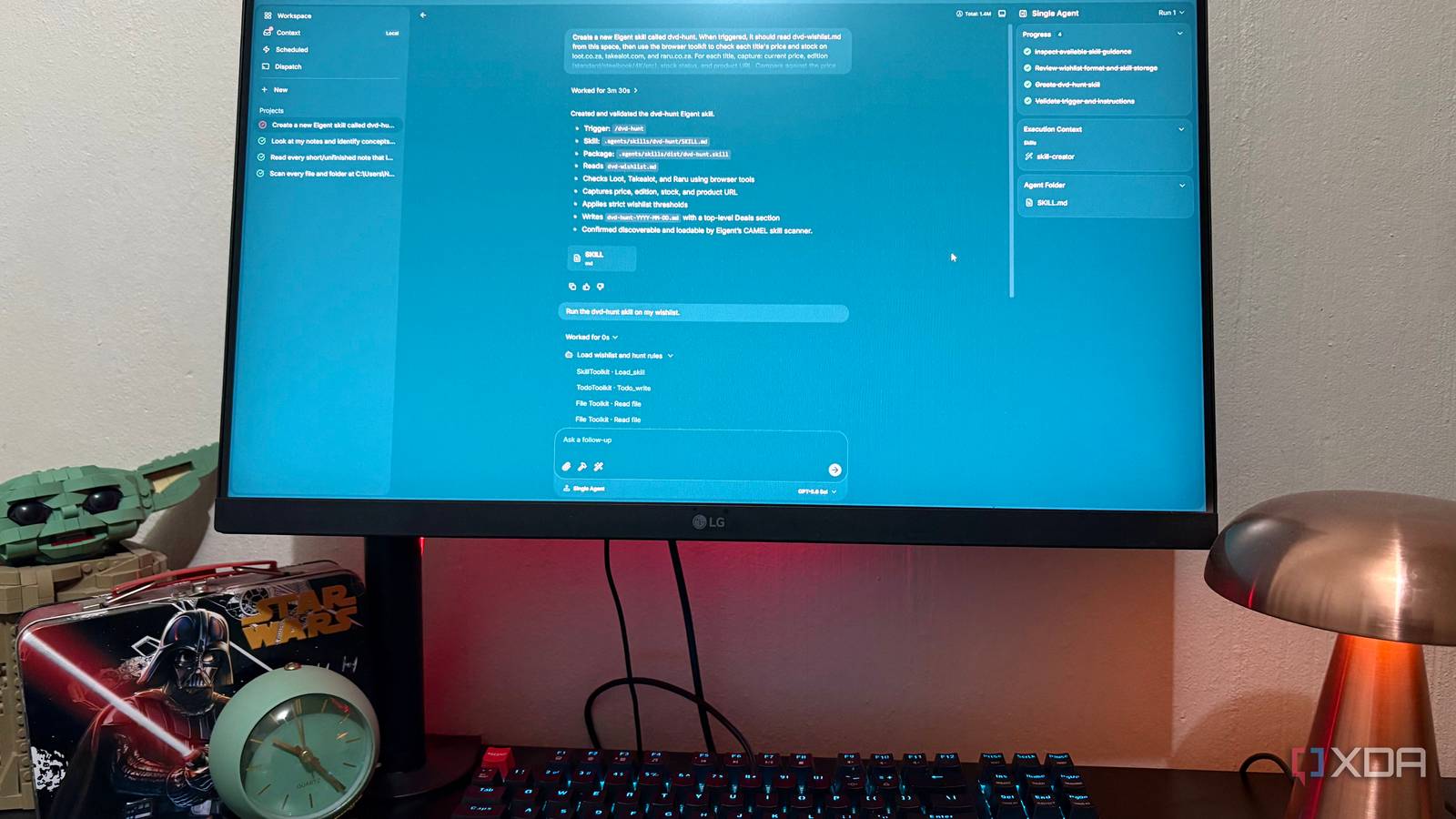
Published Aug 9, 2026, 10:30 AM EDT Nolen began their writing career in 2019, with three years dedicated to editing the Creative section at MakeUseOf. Their expertise lies at the crossroads of technology and creativity, covering areas like photography, video editing, and graphic design. Outside of work, you'll often find Nolen diving into a good book, writing their own stories, or playing video games. Cowork apps have turned into a subscription problem. Claude Cowork, Codex, and Antigravity are probably the biggest three in the game right now, and each one asks for a login, monthly fee, and permission to watch what you do. Individually, it feels like a fair trade, since they're all highly capable, and honestly non-negotiable in certain workflows at this point. But it's when you count how many pipelines have moved to how many companies that the picture gets weirder. At the same time, open-source and self-hosted solutions are popping up alongside them. And one I haven't seen get a lot of coverage is called Eigent. It's an open-source desktop cowork app that markets itself, in its own words, as the free local alternative to Claude Cowork and Codex. The claim is pretty bold, so I wanted to see how it would hold up… Want to stay in the loop with the latest in AI? The XDA AI Insider newsletter drops weekly with deep dives, tool recommendations, and hands-on coverage you won't find anywhere else on the site. Subscribe by modifying your newsletter preferences! An open-source cowork app with no opinion on which model you pick The pipeline nobody else lets you own Eigent is an open-source desktop app built on the CAMEL-AI multi-agent framework with an Electron front-end and a Python backend. The entire setup is just downloading and installing it. What "cowork" means here is the same thing it means everywhere else. I hand it a task, it plans, executes, uses tools, and hands back a result. So I'm not talking about Claude Cowork in particular (although it's included), but a tool that's a similar shape as the other three big players. Except it's running on my own hardware. The settings screen lets me pick from Ollama, LM Studio, vLLM, SGLang, and LLaMA.cpp for fully local setups, or bring my own key for Gemini, Anthropic, OpenAI, Grok, Qwen, DeepSeek, Moonshot, and a bunch more. I ended up defaulting to GPT-5.6 Sol via Eigent Cloud at first just to poke around and get a lay of the land, because sometimes hooking these things up to a local LLM on my small GPU can cause lag. But the option for local AI being there is the point. Claude Cowork is locked to Anthropic's models, and Codex and Antigravity are locked to OpenAI and Google. Eigent doesn't care - pick whatever you want, cloud or local. Even using it the way I did with a cloud model, I'm still one dropdown flip from a fully local setup. What I actually got done with Eigent Specialized agents, MCP tools, and a Skills system Now, I'm not a dev, so I don't exactly have a codebase to point this at. But Claude Cowork and Codex aren't only for developers either, and I've been using both for personal knowledge management, admin, planning, and research. Eigent slots into that same space, and I'd actually say it slots in a little better because of what it ships with. Out of the box, Eigent gives you a set of specialized agents - Developer, Search, Document, Multi-Modal, and Social Media. They're all bundled with their own toolkits so you're not building a full workflow from scratch. The Developer agent alone has terminal access, code execution, and file operations, which means even non-developer tasks work fine, because the underlying filesystem-and-shell muscle is already there and available to non-code work. Point it at a folder of notes and ask for a clustered summary and it'll handle it without a hitch. On top of the agents, Eigent ships with over 200 MCP tools built in - the same Model Context Protocol standard Claude uses for its connectors. There's Notion, Google Calendar, Slack, and GitHub, just to name a few, plus the option to plug in your own. Then there's Skills, which have been carrying my entire workflow. They're the ideal feature to utilize for a personal workflow like mine. A Skill in Eigent is a folder with a SKILL.md file describing a trigger and a behavior, structurally identical to the Claude Skills pattern. You can install ones the community writes, but I ended up building my own with a Markdown folder I populated myself. What I've been running is pretty ordinary. I pointed Eigent at one of my Obsidian vault folders and had it audit, cluster, and summarize the contents. This is all good and well, but any AI hooked into Obsidian can do that. Once again, what really pulled through for me were the Skills. For example, I wrote one that reads a wishlist file for old DVDs, checks a few local retailers for prices and stock, and then writes a dated report. Now, if I want to expand my DVD collection, I just trigger it with one command instead of spending an hour doing research. There's one potential friction point, however. Eigent sandboxes every task to its own working folder by default, which meant my first prompt aimed at a folder outside that sandbox got refused. The fix was creating a Space in the app pointed at the folder I wanted, which is one dropdown, but it did trip me up the first time. The browser that doesn't know who I am An isolated Chromium session that starts from zero every time Eigent's browser toolkit does something the other three don't. It's not a scraper and it's not hijacking my real browser. It spins up its own isolated Chromium instance via Playwright, running inside the app itself, so I can watch the page load in a tab next to the chat. The architecture splits it in two - a TypeScript layer handles Playwright natively and a Python layer handles the agent orchestration, and the two talk over WebSocket. Each agent gets its own CDP port for concurrent sessions. What this looks like practically is super simple. Every task starts from a fresh disposable browser, with no cookies or logins or history carried over from my actual browser. Nothing about my identity comes with it. This is pretty cool compared to how something like Antigravity handles it, which can see all my logged-in sessions. But with Eigent here, we've got a tool that does the exact opposite. The open-source agent app that made me rethink the big three I'm not saying anyone should ditch what they're paying for. Claude, Codex, and Antigravity are a little more polished and faster. But Eigent is the first tool I've used that treats local and open and model-agnostic as the starting point, instead of features you hunt for later. Eigent
I swapped Claude Code, Codex, and Antigravity for an open-source local alternative, and the difference is massive
Full Article
Original Source
Read the full article at Xda-developers →KhanList aggregates and links to publicly available news content. We do not host full articles from third-party sources. Always verify important information with original sources.