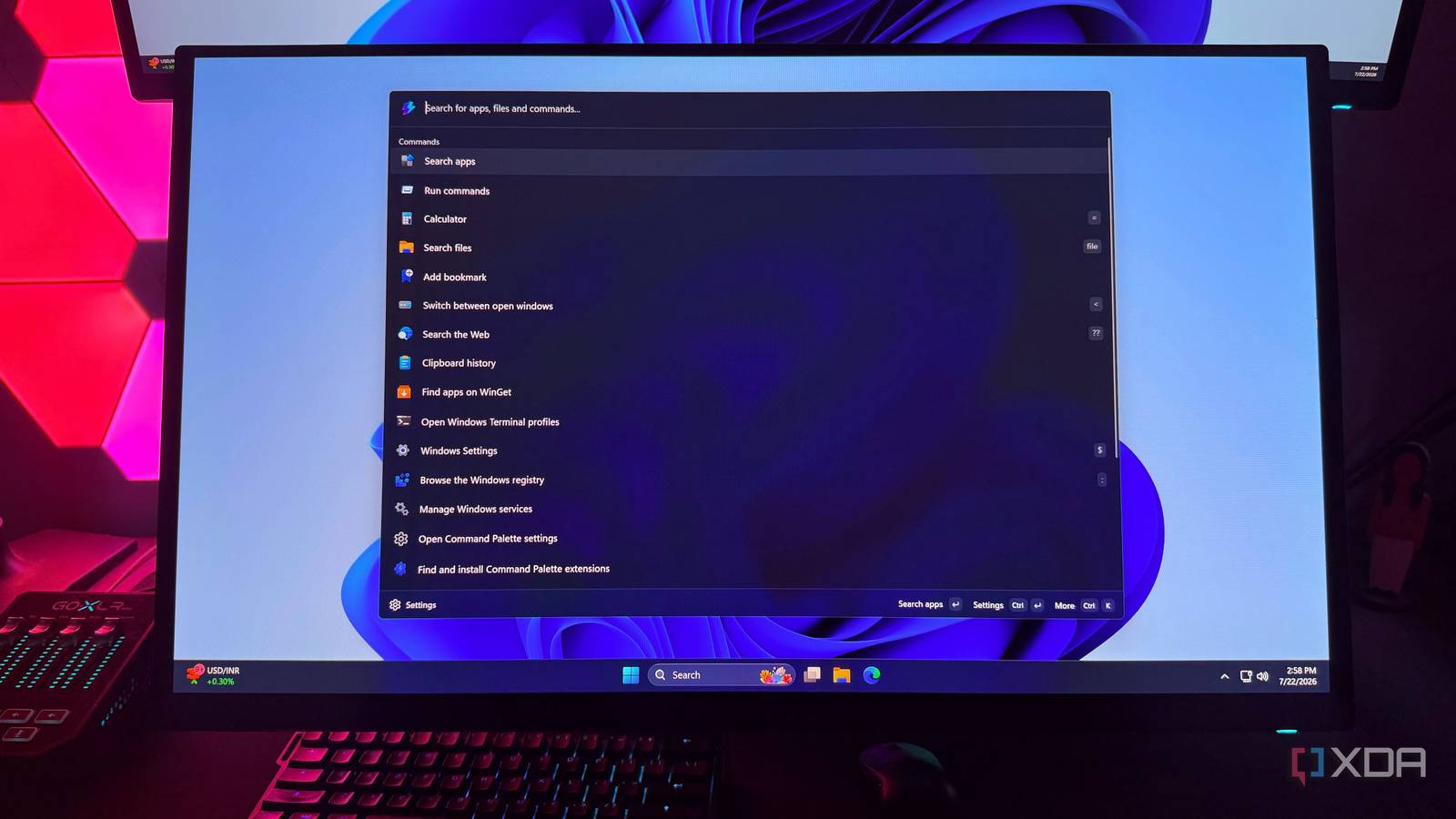
Published Jul 26, 2026, 4:00 PM EDT Hamlin has been in the tech field for over nine years. Since 2017, his work has appeared on MakeUseOf, Android Police, OSXDaily, Beebom, and more. He served as the Senior Editor at Valnet's MakeUseOf for over two years before joining XDA. He uses a high-end gaming rig for desktop use and a MacBook for traveling, but dislikes some of the quirks of macOS. You're more likely to catch him at the gym or on a flight than anywhere else. Pressing the Windows key and immediately typing the name of an app is something I've done without even thinking for years. It's a lot faster than pointing the cursor at the Start menu and scrolling through a long list of installed apps. But Windows Search, ever since I upgraded to Windows 11, has always given me the impression that it's trying to do too much for the way I use my PC. It wants to show web results, recent files, and settings when I'm just trying to open an app as quickly as possible. That's why I wanted to give Command Palette a try shortly after I installed PowerToys for features like FancyZones and Always On Top. The first thing that stood out to me was its clean, Spotlight-like interface, which I was already familiar with from using my MacBook. It only took me a couple of weeks to get used to pressing Win + Alt + Space, and I've since reassigned it to Win + Space. Nowadays, I only press the Windows key when I want to access my pinned apps from the Start menu. Command Palette gets straight to the point The app I'm looking for always comes first Since Command Palette has no opening animation like Windows Search, it does feel more instant, but that's not the only reason why I say it's faster. When I press the keyboard shortcut, I almost always want to launch an app, not search the web or see files and settings mixed in with the results. And that's exactly where Command Palette has the upper hand. I type a couple of letters, and the app I'm trying to launch appears right at the top. I can hit Enter without glancing at the results to make sure a web result isn't highlighted. Now, I'm not saying Windows Search is doing anything wrong by surfacing more than just apps. I know many of you use it to find documents and settings, but that's rarely how I use it. If I need to find a file, I just open File Explorer. Or if I want to search the web, I launch Chrome. Since Command Palette prioritizes apps unless I add a prefix, the search experience feels a lot more focused and predictable. That's exactly what I want from a launcher most of the time, even though I now use Command Palette for so much more. Launching apps is just the tip of the iceberg At this point, I'm comfortable calling it a command center If you want to use Command Palette strictly as an app launcher, you absolutely can. In fact, that's how I used it for the first week until I started messing with prefixes and realized it could adapt to what I needed. For instance, I can enter a prefix to see a list of all open windows, type a couple of letters to narrow down the results, and jump straight to the one I'm looking for without having to use my mouse. I can also type $ to make sure Command Palette only lists Windows settings instead of mixing other results. Then, there's the = prefix, which I often use for quick calculations instead of opening Calculator like I used to with Windows Search. If that's not enough, Command Palette also supports extensions. A bunch of extensions are already preinstalled, like Clipboard history, which lets me search through everything I've copied right from the search window. With the WinGet extension, I can install apps directly from Command Palette without having to open Terminal and enter commands manually. You can install more extensions from the Extension Gallery. If I had to pick a favorite, it'd be Everything, which lets Command Palette use Everything's search index instead of the slower Windows Search index. This extension only works if Everything is already installed on your PC, though. Windows Search has its wins But they're not enough to win me back I'm not going to act like Command Palette is better across the board. Windows Search still has a couple of advantages, especially since it's integrated into the Start menu. For instance, I do like that I can pin apps and access them by simply pressing the Windows key. Yes, it's easier to press one key than two, and I wish I could bind the Windows key to Command Palette. Windows Search also does a better job of surfacing some obscure Settings pages. With Command Palette, there's obviously a bit of a learning curve, as you've probably seen by now. Having to remember all the prefixes may not be everyone's cup of tea, and if you're already happy with how Windows Search works, there's no reason to change your workflow. But now that I've gotten used to Command Palette, Windows Search just feels cluttered and limited by comparison. I still press the Windows key accidentally sometimes, but I'm confident it's only a matter of time before I stop doing that altogether. It's now my favorite PowerToys feature For the longest time, FancyZones was my favorite feature in PowerToys, with Always On Top a close second. But Command Palette has quickly overtaken both of them. If I was willing to ditch the Windows key after years of muscle memory in favor of something new, I think that says everything you need to know about how much I enjoy using it. All I wanted was a faster app launcher, but now that I know how capable it is, going back to Windows Search just feels like a downgrade. Microsoft PowerToys is a collection of free, open-source tools that can improve Windows productivity.
I stopped using Windows 11's built-in search and switched to something faster
Full Article
Original Source
Read the full article at Xda-developers →KhanList aggregates and links to publicly available news content. We do not host full articles from third-party sources. Always verify important information with original sources.