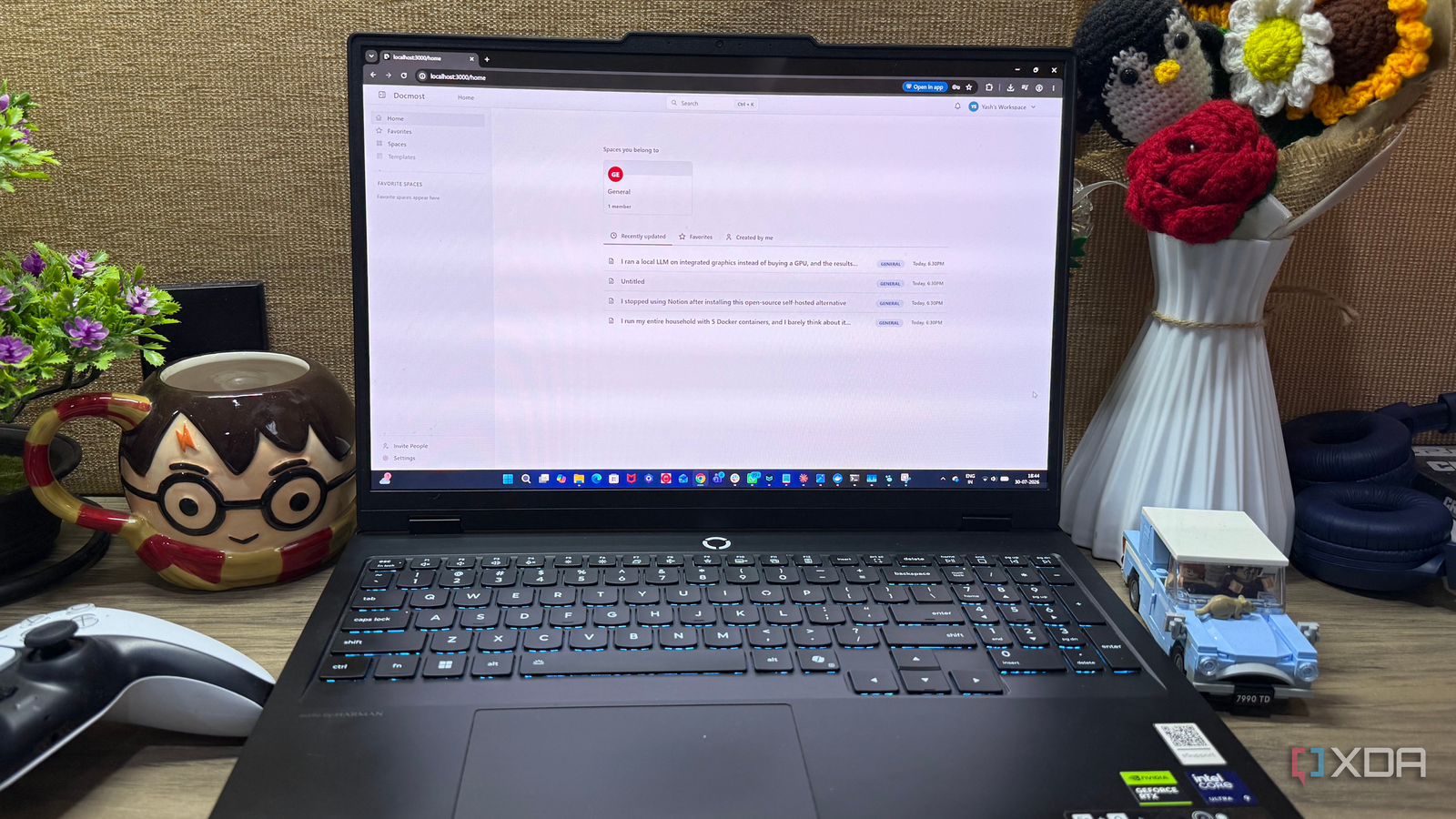
Published Aug 3, 2026, 6:00 PM EDT Beginning his professional journey in the tech industry in 2018, Yash spent over three years as a Software Engineer. After that, he shifted his focus to empowering readers through informative and engaging content on his tech blog – DiGiTAL BiRYANi. He has also published tech articles for MakeTechEasier. He loves to explore new tech gadgets and platforms. When he is not writing, you’ll find him exploring food. He is known as Digital Chef Yash among his readers because of his love for Technology and Food. Notion was my go-to app for notes and documentation for years. Like many people, I assumed I'd keep using it because it had everything I could possibly need. But over time, my workflow started changing. I moved more of my apps to my own server and began questioning whether I really needed such a feature-packed platform for something as simple as managing knowledge. That led me to try Docmost. I wasn't expecting it to replace Notion anytime soon, but after using it for a while, I found myself opening Notion less and less until I eventually stopped using it altogether. Docmost is a self-hosted knowledge management system Notion, but completely under control After deciding to move more of my workflow to self-hosted tools, I started looking for a knowledge management app that didn't depend on someone else's servers. That's when I came across Docmost. It's an open-source, self-hosted alternative to Notion that focuses on documentation, team knowledge, and collaboration without locking you into a cloud service. What immediately stood out to me was how familiar everything felt. The editor, page structure, and overall layout reminded me of Notion, so I didn't have to spend hours learning a completely different way of working. At the same time, I knew my notes and documentation were running on my own server, which gave me far more control over my data. I also liked that Docmost doesn't try to replace every productivity app. Instead, it has a clear purpose: helping individuals and teams organize knowledge in one place. That focused approach made it much easier to decide whether it was the right fit for me. The features that made me switch Everything I actually needed was already there Once I started using Docmost daily, I realized I wasn't giving up as much as I expected. It had almost everything I actually used in Notion, without the extra complexity that I rarely touched. The block-based editor felt familiar from day one, so creating pages and formatting content came naturally. I could organize documentation into sections, build nested pages, and keep related information together with minimal effort. The built-in search also made it easy to find older notes instead of digging through folders. I was also impressed by the collaboration features. Multiple people can edit documents together, leave comments, mention teammates, and manage access with permissions. That made it useful not only for my personal notes but also for shared documentation if you're working with a team. Another feature I appreciated was version history. Knowing I could review or restore earlier versions of a document gave me extra confidence while editing important content. Support for Markdown was another big plus since it keeps my notes portable and easy to move if I ever decide to switch tools again. Docmost also supports diagrams, tables, code blocks, file attachments, and rich-text formatting, so I never felt limited when writing technical documentation. It even includes AI features if you want them, but they're optional rather than being the center of the experience. The best part was that none of these features felt overwhelming. Instead of trying to be an all-in-one productivity platform, Docmost focuses on doing knowledge management really well. Given the way I work, that focused approach proved far more valuable than having dozens of features I would rarely use. Notion still has an advantage in a few aspects The trade-offs were worth it for me Switching to Docmost doesn't mean I think Notion is a worse product. In fact, I still believe Notion is the better choice for many people. If your workflow depends heavily on databases, advanced automation, project management, or a large library of templates and integrations, Notion is still difficult to beat. It also benefits from years of development and has a much larger ecosystem around it. Whether you need third-party integrations, community resources, or advanced workspace customization, Notion offers far more flexibility than Docmost today. For me, though, those advantages weren't enough to keep using it. I realized I spent most of my time writing documentation, organizing notes, and sharing information rather than building complex workflows. Once I looked at how I actually used the app instead of everything it could do, moving to Docmost became an easy decision. It may not replace every Notion feature, but it replaced the ones that mattered most to me. The switch made me rethink what I actually needed Moving away from Notion wasn't about finding a perfect replacement. It was about finding a tool that matched how I actually work today. After spending some time with Docmost, I realized I value simplicity, data ownership, and a focused writing experience more than having every possible productivity feature. That may not be the right trade-off for everyone, and that's perfectly fine. But for me, this switch was a good reminder that the best software isn't always the one with the longest feature list; it's the one that best fits your workflow. Docmost Docmost is an open-source, self-hosted collaborative wiki and knowledge-base.
I stopped using Notion after installing this open-source self-hosted alternative
Full Article
Original Source
Read the full article at Xda-developers →KhanList aggregates and links to publicly available news content. We do not host full articles from third-party sources. Always verify important information with original sources.