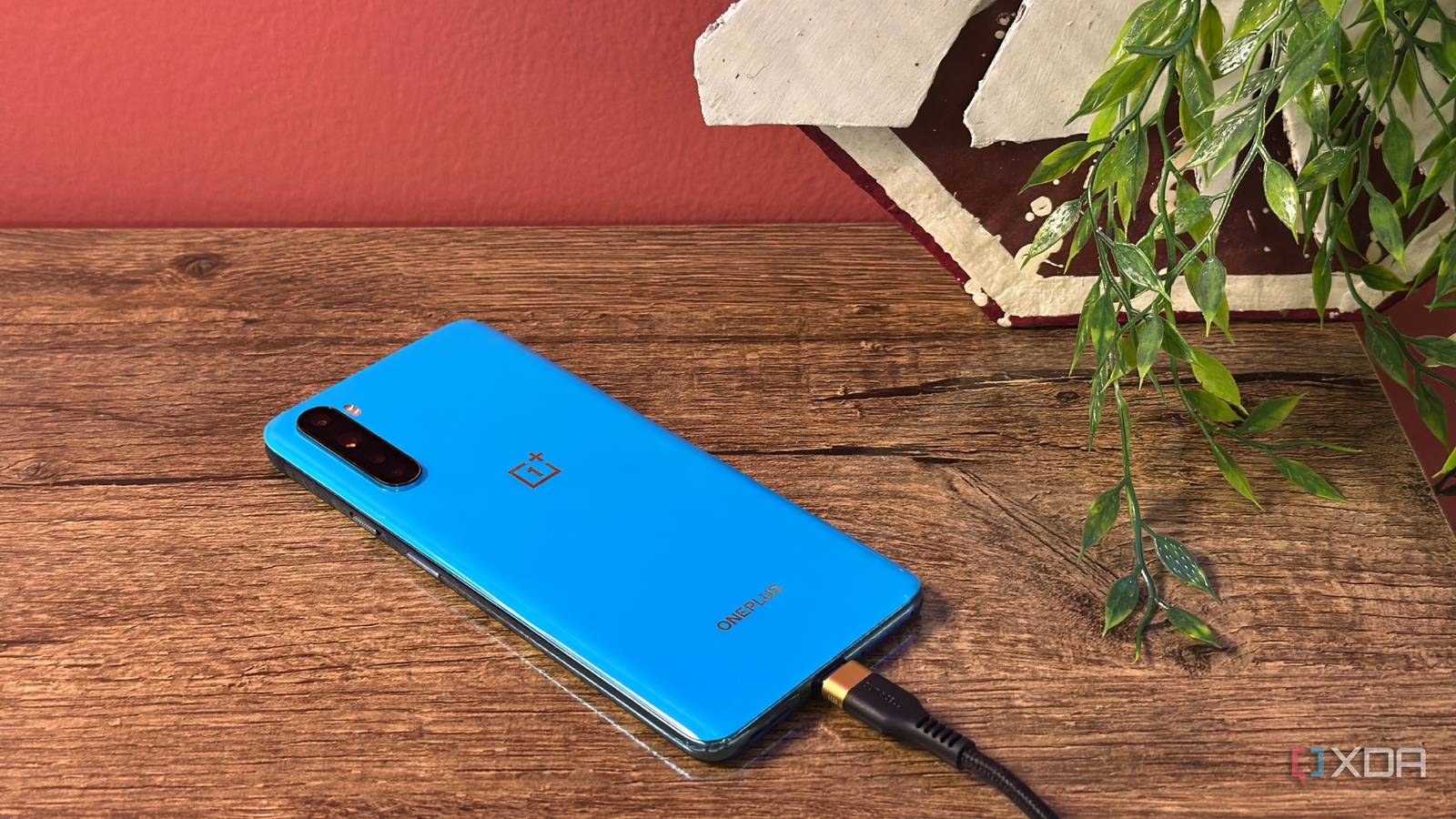
Published Aug 16, 2026, 9:00 AM EDT Gaming has been Samarveer’s greatest passion, and the Literature graduate in him takes immense joy in dissecting games for their themes, messages, and impact. Samarveer holds a deep appreciation of gaming, and considers the platform to be the most immersive and impactful across all media. He can be found engaging with gaming communities online, always ready to debate the finer points of ray tracing or itching to write an 8-page collegiate thesis on any game that impacts him emotionally. I genuinely thought my old OnePlus Nord phone had earned permanent retirement duty. This phone I bought back in 2020 had somehow survived years of daily use, and was still pulling double duty as a backup handset and, more importantly, my surprisingly capable PS2 emulation machine. By 2026 standards, it wasn't nearly fast enough, but it sure worked, which was enough. Then, I made the mistake of treating its USB-C port like every other USB-C port in my house. For the past few months, I'd been plugging the phone into a cheap 65W charger, assuming that because the Nord only supported OnePlus' 30T fast charging, the phone would simply draw what it needed. Instead, I ended up with a phone that would no longer charge, boot, or do anything particularly useful. That's when I stopped thinking of USB-C cables and chargers as interchangeable accessories, because the cheapest part can often be the one that costs you an entire device. I ignored OnePlus' warnings because USB-C looked universal The warning signs were easy to dismiss, too I'll admit that I ignored OnePlus' warnings about using charging accessories with my phone because USB-C looks universal, after all. My Nord supported Warp Charge 30T, and when its cable needed replacing, I grabbed a 65W USB-C cable for around $5. The phone's significant age definitely was a factor in me deciding to cheap out here, and I assumed the phone would draw what it needed. Then, the annoyances started. Charging became slower, and the connection felt less reliable. The Nord's main purpose was to act as a PS2 emulator for flights, and when plugged into a 20,000 mAh power bank, it was only after using the new cable that I noticed the phone becoming hotter than ever. Cables can develop higher resistance, reducing current, while bad connections can interrupt charging or interfere with fast-charging behavior. That's why phone manufacturers always warn users that non-genuine or damaged accessories can cause slow charging, interruptions, or failure. I can't prove the cheap cable alone killed the OnePlus, but the timing was impossible to ignore. In a damage-control effort, I swapped the cheap cable for the Samsung cable I was using with my newer Galaxy, expecting the Nord to snap back to normal for me. Sadly, it didn't. Charging remained painfully slow, which should have told me that something beyond the cable had gone wrong. Instead, I assumed its aging battery was showing its age. Within a week, that assumption became pretty expensive. The Nord stopped charging altogether and became unusable. I can't prove the cheap cable alone killed it, but the timing was impossible to ignore. After years of trouble-free use, one questionable cable caused increasingly strange charging behavior, and then I ended up with a dead phone in my hands. That changed how I treat USB-C accessories. USB-C isn't nearly as interchangeable as I thought A 65W charger doesn't mean your phone gets 65W The embarrassing part here is that a 65W charger doesn't just shove 65W into whatever happens to be plugged into it. A properly designed USB-C charging setup negotiates power, with the phone requesting what it can safely accept. My Nord supported 30T charging, so the fact that I used a 65W charger wasn't, by itself, particularly alarming. The cable is where things get less straightforward. A cheap USB-C cable can have higher electrical resistance, poor connectors, inadequate current handling, or simply lousy construction. Any one of these issues could have translated into slower charging, intermittent connections, the excess heat I experienced, or the phone repeatedly falling back from fast charging. In other words, USB-C may have given us one universal-looking connector, but that doesn't make every cable behind it equally competent. That's where the manufacturers' official warnings make more sense. The phone's fast-charging system was designed around specific charger-and-cable combinations, rather than the assumption that anything with a USB-C plug at its end would behave the same way. I had spent years treating that warning like accessory upselling, much like millions do. After watching my Nord's charging behavior deteriorate, I wasn't quite so dismissive anymore. One cheap cable was enough to change how I charge everything My DualSense gave me another warning The OnePlus Nord wasn't the only device that made me suspicious of that cable. I had a 2,000 mAh replacement battery pack for my DualSense controller on the way from AliExpress, so I decided I had nothing to lose. As such, I kept using the same $5 USB-C cable until the DualSense's battery replacement arrived. Two weeks later, the controller's battery life had noticeably deteriorated, giving me just an hour of wireless time, and the timing was impossible to ignore. I replaced the battery with the new 2,000 mAh pack and went straight back to Sony's included cable for charging, and I haven't used the cheap one since. That still doesn't give me a smoking gun for the Nord. I can't tear open the phone and conclusively point at that $5 cable and say, "Yep, that's what killed it." What I do know, however, is that the cable coincided with increasingly erratic charging on two devices, and replacing it fixed the problem on the one I could actually test. The DualSense controller doesn't require the official cable, but it is recommended to use a high-quality USB-C cable if going with a third-party unit. That's more than enough evidence to change my habits. USB-C may have standardized the connector, but it didn't make every cable plugged into it equally trustworthy. I still buy inexpensive cables from time to time, but I no longer buy the absolute cheapest one I can find. After losing a perfectly good phone that could act as a backup on a rainy day, that's a lesson I'm perfectly happy to have paid for only once. Anker USB-C Cable Grab this two-pack of USB-C to USB-C braided nylon cables from Anker at an incredibly affordable price. A $5 cable taught me a rather expensive lesson I've always found it slightly ridiculous when people tell you to spend more on something as mundane as a charging cable. It's a piece of wire, after all. But clearly, there's a very real difference between being frugal and assuming that every accessory is built to the same standard simply because it ends in the same USB-C connector. I never intended to make my OnePlus Nord a collector's item in the first place, but it still taught me a lesson I probably should have learned years earlier: when a device is worth hundreds of dollars, saving a few bucks on the thing feeding it power isn't exactly the cleverest way to economize.
I stopped using cheap USB-C cables after one of them killed my OnePlus
Full Article
Original Source
Read the full article at Xda-developers →KhanList aggregates and links to publicly available news content. We do not host full articles from third-party sources. Always verify important information with original sources.