
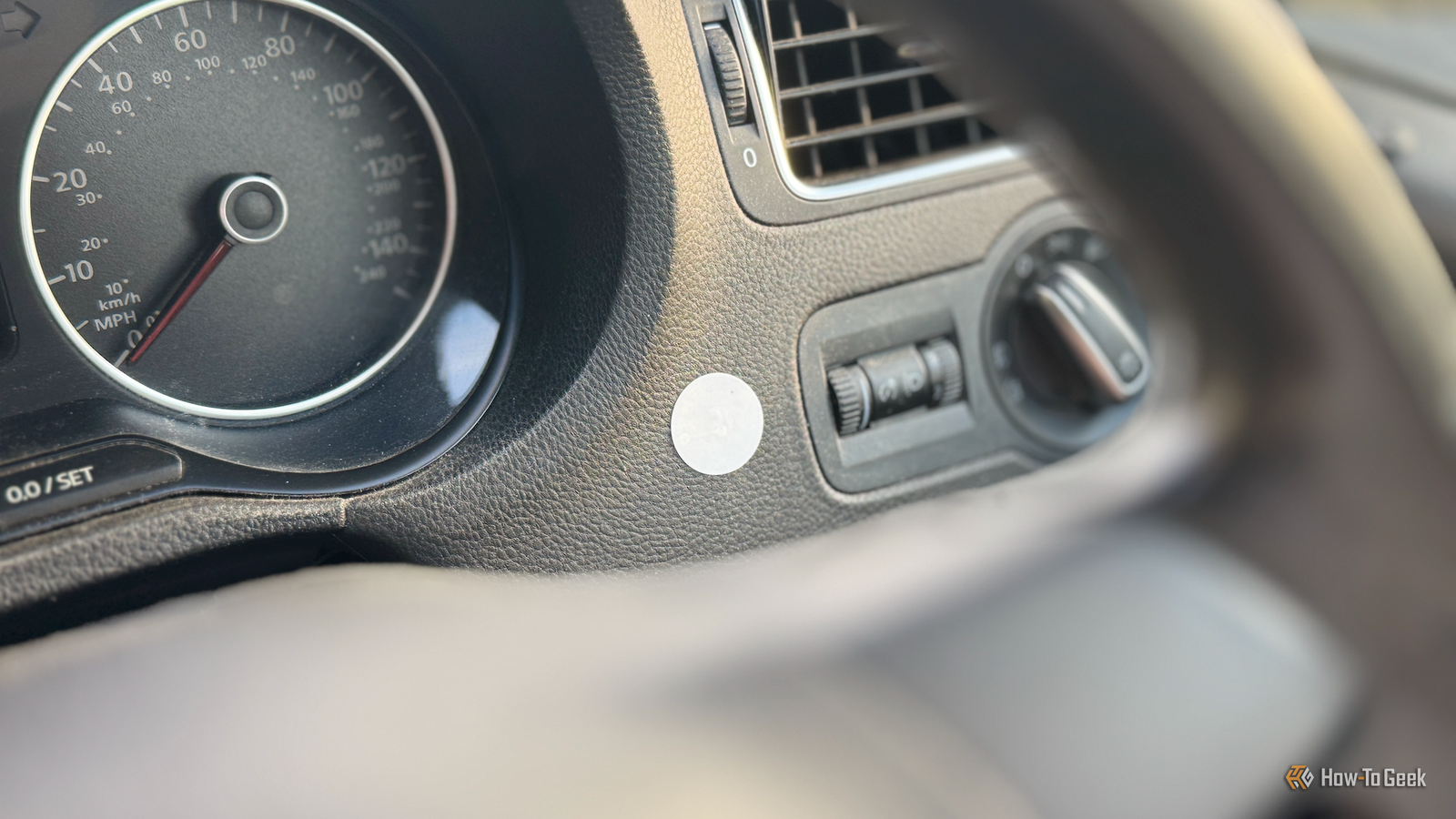
Published Aug 14, 2026, 1:00 PM EDT Adam has a degree in Engineering and has a life-long interest in technology. He has been writing for over a decade for various print and online publications, with a focus on consumer tech. He joined How-To Geek in 2024 while working at Pocket-lint. As well as being a long-term fan of Apple products, he also has a strong interest in smart home tech, running a Home Assistant server at home to automate all his smart home devices. He believes that the ideal smart home should work with minimal interaction from the user, with automations running as if by magic rather than requiring you to push buttons on a control panel. You can find more of his work on Muck Rack. I love using tech to solve real-life problems. After getting parking tickets for staying too long in a parking lot, I decided to see if I could solve this problem using just my phone and a cheap NFC tag. The solution works even better than I expected. I've been fined twice for parking too long My local grocery store gives three hours for free Credit: bilanol / Envato Elements My case is a little unusual, but the same solution can be applied to any situation where you're parking for a limited amount of time. The parking lot of my local grocery store gives three hours of free parking on the condition that you buy something from the store. It uses automatic license plate recognition, and if you stay more than three hours, you get a parking ticket sent through the mail. I've fallen foul of this twice now. The reason is that my grocery store is right next to the main street, and it's the only free parking available. Almost everyone parks in that parking lot whether they're visiting the grocery store or going to the other stores nearby. It's easy to get sidetracked. I received my first parking ticket when we discovered that there was a small music festival happening in the park, so we stayed to listen to the bands. By the time we got back to the car, it was long past the three-hour limit. The second time it happened, I knew that I needed to find a solution. Since you don't have to pay to park, there's no app that will pop up to remind you that your parking is due to expire. I wondered if I could build my own. NFC Tags Sticker with NTAG215 Blank Chips These affordable NFC tags use the NTAG215 chip that can hold up to 504 bytes of memory. They're easy to stick onto any surface, providing you with a convenient way to trigger automations in your smart home. I wanted a simple way to know when parking was due to expire An NFC tag was the ideal trigger Credit: Adam Davidson / How-To Geek I was pretty sure I could build something using the Shortcuts app on my iPhone. There are actions that allow you to set timers for specific lengths of time, which was exactly what I needed. My first prototype was very simple. Launching the shortcut started a timer for 2 hours and 45 minutes, so I'd know I had 15 minutes left to get back to my car. This was fine, but it would only work for the grocery store's parking lot. I added a Choose from menu action to the shortcut, which lets me select one, two, or three hours, or enter a different time manually. The timer is then set for ten minutes less than the selected amount of time. The final step was to come up with a simple way to trigger the automation when I parked my car. I settled on using a cheap NFC tag that I stuck to the dashboard. When I scan the tag, the shortcut runs, and I can select the amount of time that I want to park for. I added a feature that also saves the current location It's easy to find where I've parked in a rush The shortcut works really well. The NFC tag is prominent enough in the car that I rarely forget to scan it when I park, and the timer is loud enough on my phone and Apple Watch that I don't miss it. One issue is that the parking lot is so big that when I'm in a rush, it can be hard to find my car. I added another step to the automation that solves this problem, too. By default, Apple Maps will save the location of your parked car when you disconnect your phone from CarPlay or from your car's Bluetooth connection. I don't have CarPlay, and I don't always connect my phone to Bluetooth, so the location isn't always saved. There's a Set Parked Car action in Shortcuts, so when the automation runs, it gets the current location and runs the Set Parked Car action, which saves the parking location to Apple Maps. When the timer goes off, I can open Apple Maps and follow it to find my car before my parking time runs out. You can make something similar on Android phones Saving your car's location isn't quite as simple Credit: Nick Lewis / How-To Geek I set this up on my iPhone, but you can make something similar on Android phones. It's a little more complicated, since Android doesn't have a built-in Shortcuts-style automation system that lets you trigger an automation from an NFC tag. You can use an app such as Tasker, although it doesn't come free. You can then create an automation that asks for the input time, subtracts a set number from that time, and starts a timer for that duration. There's no automatic save your parking feature on Android either, although Android Auto has a Save Parking option that you can enable when you reach your destination. If you're using Tasker, you can get Tasker to save your location when you scan the NFC tag. You could then use the Notify action when your timer has run out to open Google Maps to the saved location when you tap the notification. It's a little messier than the Shortcuts solution, but it should still work. A 20-cent NFC sticker could save me a lot of money I've already had to pay two parking fines for the same location. You can buy packs of 50 NFC tags for less than $10, so it's effectively costing me around 20 cents to save myself from getting a parking ticket ever again.
I stopped getting parking tickets thanks to one NFC tag
Full Article
Original Source
Read the full article at Howtogeek →KhanList aggregates and links to publicly available news content. We do not host full articles from third-party sources. Always verify important information with original sources.