
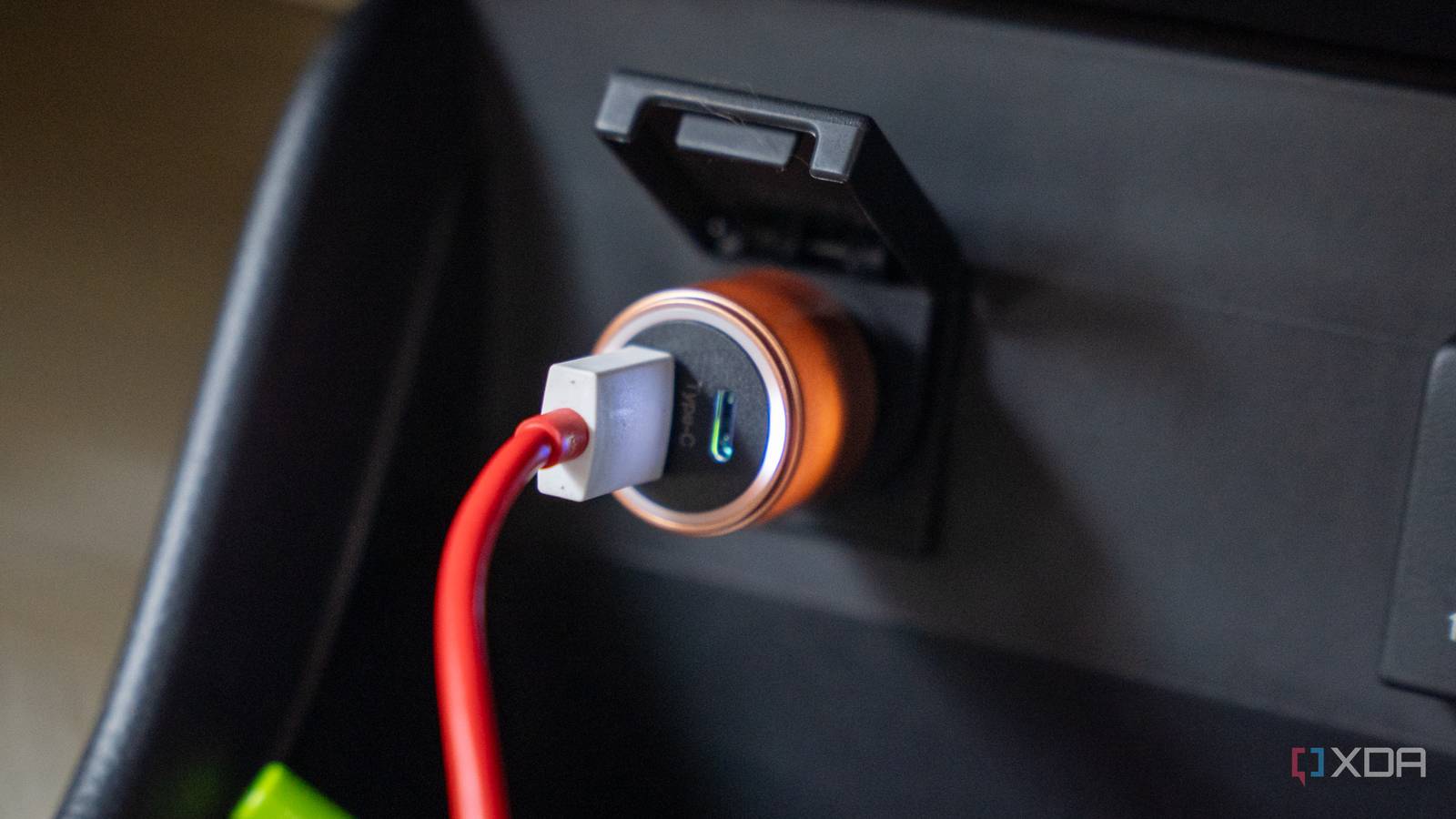
Published Aug 4, 2026, 3:00 PM EDT Dhruv Bhutani has been writing about consumer technology since 2008, offering deep insights into the personal technology landscape through features and opinion pieces. He writes for XDA-Developers, where he focuses on topics like productivity, networking, self-hosting, and more. Over the years, his work has also appeared in leading publications such as Android Police, Android Authority, CNET, PCMag, and more. Outside of his professional work, Dhruv is an avid fan of horror media spanning films and literature, enjoys fitness activities, collects vinyl records, and plays the guitar. Have you tried charging your phone through your car's USB port recently? If you're actively using your phone alongside, be it to run Android Auto or just watch some YouTube while parked, you might have observed your phone's battery dipping even while plugged in. Recently, while on a long drive with my phone running full tilt, serving up Android Auto, streaming music and handling calls, I noticed I arrived with less battery left than when I'd started. It turns out, your car's USB port just doesn't output enough power to keep up with the phone's needs. At best, it'll keep the battery at around the same level; at worst, your battery might actually be draining out. The solution to that is astonishingly simple. It's another port, usually placed right near the car's USB port. Just buy a USB-C charger that plugs into the car's 12V accessory socket, and it'll completely upgrade your in-car charging game. My car's USB port can no longer keep up with my phone's charging needs Modern phones and accessories demand more power than a car's USB port can supply Look, I'm not saying that your car's USB port is broken. It works exactly as designed. Except, unless you have an absolutely new car, the USB port was designed to meet the standard from a few years ago. Five years ago, smartphones consumed far less power than they do today. That's before we even get to the fact that the pace of smartphone development vastly outpaces that of cars. Depending on your personal driving habits, your phone is usually doing a surprising amount of work. I know mine is. I've got Google Maps handling navigation and checking on traffic. Meanwhile, Android Auto outputs all that to my car's entertainment system. Elsewhere, I invariably have Spotify streaming music or podcasts. Add that to a work call or two, and you get a fair idea. Your phone is constantly working. And that workload is enough to overwhelm the modest power output of most cars' USB ports. Switching to a USB-C charger that plugs into the 12V cigarette lighter socket fixes that problem immediately. These chargers tend to be much more powerful, with some outputting as much as 65W or even 100W of power to top up the fastest charging smartphones today. Instead of barely keeping the battery at par, you can expect your phone to be fully topped up when you arrive at your destination. And that's with navigation running, and you're using the phone as normal. Ever since making the switch, I haven't even thought about battery drain while driving. Nor do I worry about charging before leaving my home. I know that the charger in my car can handle the job just fine. In fact, over a 30-minute drive, I might even be able to fully charge my phone. That's something I can't imagine doing from a regular USB port in the car. Just plug into the 12V USB charger, pair your phone over wireless Android Auto, and you're good to go. Useful for far more than charging just your phone One charger to power them all Let me let you in on a secret. Your phone isn't the only thing that benefits from a 12V socket USB charger. In 2026, practically everything charges over USB-C, and this charger works with practically every device. Think wireless earbuds while on your way to the gym, a power bank while heading to a concert or game, or even your tablet or laptop while on your way to work. A regular USB charger simply cannot power most of these devices, while the right 12V USB-C charger can easily output as much power as a desk charger. This also comes in handy when you've got passengers in the car with you. I've had friends power up their Nintendo Switch from the 12V socket while on a long road trip and, let me tell you, it made the journey a lot better. The simple upgrade also means that I'm no longer locked behind whatever hardware the manufacturer installed years ago. For a few dollars, I can pick up an adapter that brings my car up to modern charging standards. In fact, it's become an integral part of my car setup. The 12V charger isn't something I remove from the car. It's fixed right in the slot and has become my default charger for everyday use. It helps me spend less time worrying about battery drain or picking the right USB cable. I carry fewer accessories and chargers with me, and it lets others in my car charge whatever they want without having to think about it. An easy in-car upgrade for everyone For the most part, I no longer use the USB port in my car. Once in a while, if I'm facing flaky Android Auto connectivity, I'll switch back to the car's built-in USB port for wired Android Auto, but for the most part, the USB charger plugged into my car's 12V socket is my default go-to. It simply does a better job of keeping modern phones topped up no matter how aggressively you use them while driving. It's a small, inexpensive upgrade, barely a few dollars, that makes a world of difference in your daily driving experience. Unless you have an absolutely new car with a high-powered USB-C port built in, I'd absolutely recommend making the splurge. UGREEN 130W 3-Port USB C Car Charger
I stopped charging my phone through my car's USB port after making one simple upgrade
Full Article
Original Source
Read the full article at Xda-developers →KhanList aggregates and links to publicly available news content. We do not host full articles from third-party sources. Always verify important information with original sources.