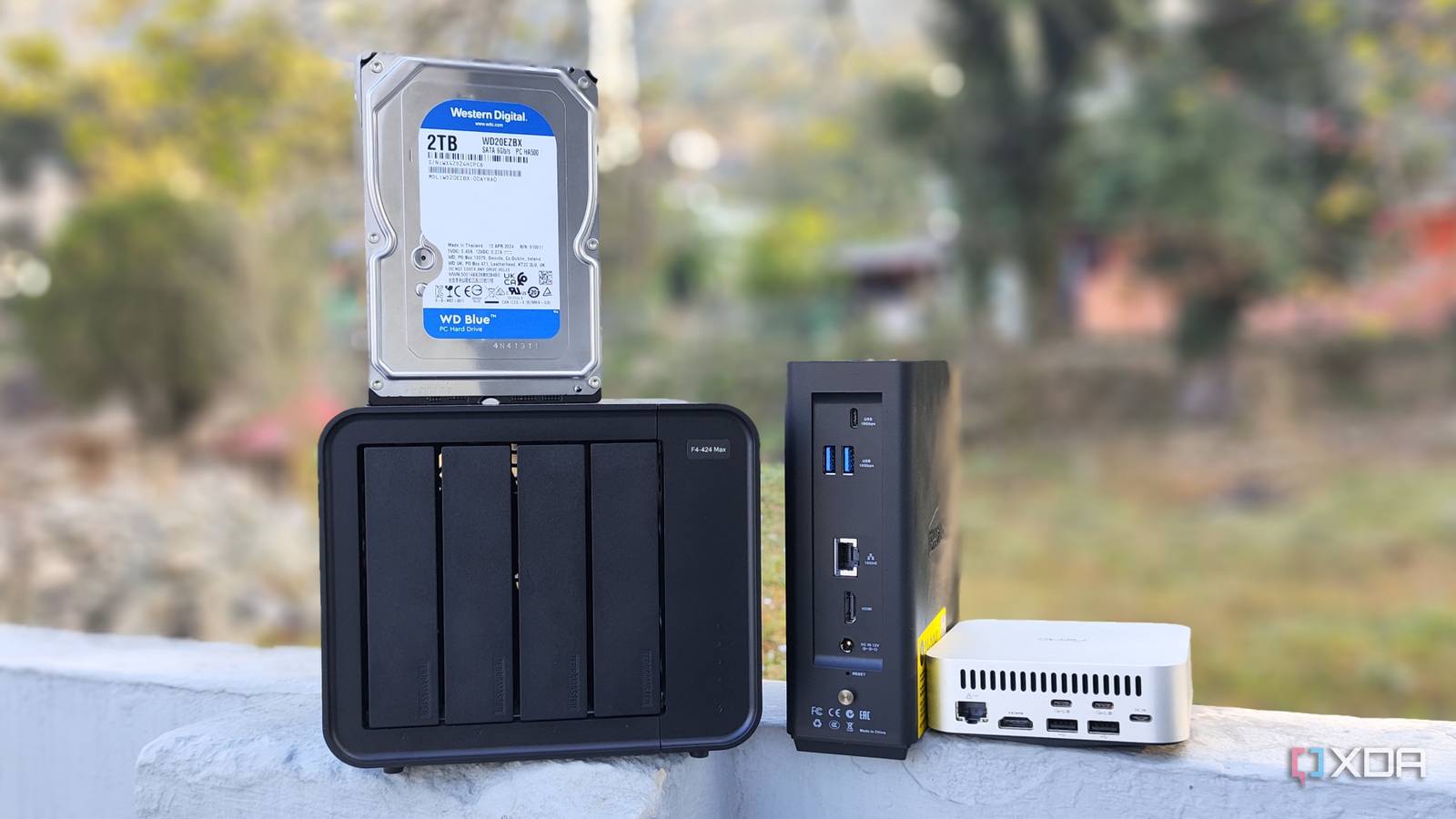
A NAS that does nothing but serve files feels increasingly underused. Even modest systems now have enough processing power, memory, and software support to run containers, media servers, backup tools, and a few other useful services without getting in the way of storage. I also don’t think the answer is to keep installing things until the NAS becomes responsible for the whole network, because that gets annoying surprisingly fast. The useful middle ground is to let the NAS handle tasks that already revolve around the data stored there, then stop before every important service depends on the same machine. Storage-heavy services are usually better on the NAS Keeping these workloads nearby removes a lot of friction Media servers are the obvious place to start. If Jellyfin or Plex spends most of its time reading movies and TV shows stored on the NAS anyway, running the server there removes another machine and another network mount from the chain. You’re not asking one computer to pull files from the NAS just to send them somewhere else. As long as the NAS has enough processing power for the transcoding you expect, that arrangement makes more sense than adding another box just because you can. The same logic applies to applications that organize, download, or otherwise spend most of their time touching files on the NAS. Photo management software, document archives, download clients, and similar tools don’t gain much from living elsewhere if nearly everything they work with already sits in network storage. Container support has made this much easier than it used to be, though it’s still possible to lose time to permissions, storage paths, and networking if you get sloppy with the setup. I’d still rather untangle one of those problems on the NAS than maintain a second machine whose main job is reaching back into the NAS all day. Backup software belongs in roughly the same category. The NAS is already where I want centralized copies of important files to end up, so letting it receive, schedule, organize, or replicate those backups feels like a natural extension of what it’s there to do. That doesn’t make the NAS the entire backup strategy, especially if the original data lives there too. It just means I don’t see much value in running another computer solely to move backup data into the storage system that was already built to hold it. Consolidating the right workloads makes maintenance much easier Every additional computer in a home lab carries a small maintenance cost, and it adds up faster than it seems. There are updates, monitoring, network settings, backups, and the inevitable moment when a service stops working, and you have to remember which machine it even lives on. One extra mini PC is easy to justify because it’s cheap, small, and barely noticeable on a shelf. A few of them later, though, you can end up maintaining hardware that mostly exists because you never stopped to ask whether the workload needed its own system. Consolidation stops helping when every service fails together. Moving the right workloads onto the NAS cuts some of that clutter without forcing everything onto one machine. A media server, a few download tools, and storage-related utilities can usually coexist with ordinary NAS duties without turning the system into a circus. That leaves separate hardware available for jobs that genuinely benefit from it. I’d rather add a server because a workload actually needs more isolation or resources, not because I decided every application deserves a dedicated box by default. It also makes troubleshooting less tedious. When an application mainly works with data stored on the NAS, running it there means fewer network mounts, credentials, and intermediary systems to inspect when something stops behaving. I still have to work out whether the application, permissions, or storage is the problem, and that can be irritating enough on its own. At least I’m not starting by tracing the same failure through three different machines before I can even get to the service I care about. The stopping point is anything that needs independence Some services should survive when the NAS does not This is where the temptation usually gets me. You install a media server; it works fine. Then you add another container, then another, and suddenly the NAS looks capable of swallowing half the home lab. Modern systems encourage that because some now ship with processors, memory capacities, virtualization support, and expansion options that go well beyond simple file sharing. The hardware being capable of running something still isn’t the same as that service belonging there. I draw the line at infrastructure I may need when the NAS itself is unavailable. DNS is the easy example because a storage problem is annoying enough without turning it into a network problem at the same time. If the whole network depends on a DNS service running exclusively on the NAS, routine maintenance can suddenly have consequences that have nothing to do with the drives. The same goes for management or monitoring tools I might want available while I’m trying to figure out what went wrong with the NAS in the first place. A useful rule is to ask what happens if the NAS goes offline. If the service mainly reads, writes, organizes, or protects data stored on the NAS, it probably belongs there. If losing the NAS would also take down something you need to troubleshoot the network or recover the system, that service is better off somewhere else. Heavy compute workloads deserve a similar boundary, though for a different reason. Large virtual machines, development environments, databases, and other demanding applications can compete with storage services for CPU time, memory, and disk I/O. Some NAS hardware can handle that perfectly well, and I’m not against using the resources that are sitting there. Once I have to schedule storage maintenance around unrelated applications because they can’t be interrupted, though, I’ve probably pushed consolidation past the point where it was helping. Running everything on one NAS can still be tempting One powerful machine can replace several smaller servers There’s a strong case for complete consolidation. A sufficiently capable NAS can host virtual machines, containers, media servers, network utilities, and storage on the same hardware without requiring a pile of separate systems. You get one machine to power, one physical device to maintain, and potentially one interface that covers a large part of the environment. If your main goal is reducing hardware and you don’t enjoy babysitting a collection of computers, that’s an appealing setup. It can also save money. If the NAS already has a capable processor and plenty of unused memory, buying another mini PC for a couple of lightweight services may just spread the same workload around. Consolidation can reduce idle power consumption too, especially if the alternative is leaving several lightly loaded machines running all day. I’m not convinced there’s much value in creating extra servers just because a home lab somehow feels more complete with more hardware. NAS manufacturers clearly expect people to use these systems for more than file sharing anyway. Container platforms, virtual machine support, PCIe expansion, and increasingly capable processors aren’t there solely to make SMB transfers faster. If you paid for that hardware, using some of those capabilities is perfectly reasonable. A powerful NAS that never does anything beyond exposing shared folders can leave a surprising amount of useful hardware sitting idle. Your NAS should not become one giant dependency Consolidation stops helping when every service fails together The weakness of the everything-on-the-NAS approach becomes obvious the first time the NAS goes offline. Storage systems need updates, drives fail, hardware occasionally needs attention, and sometimes a reboot is the only thing standing between you and getting on with your day. If every major application in the house lives on that same machine, routine NAS maintenance can take out far more than your files. That’s where the convenience starts to wear thin. It can also make experimentation more stressful than it needs to be. I’m much happier rebooting a virtualization host, changing its operating system, or breaking a container configuration when I know my primary storage isn’t tied to the outcome. A NAS holding important data benefits from being a little boring. Using that same machine to test every new service I come across works directly against that. The alternative doesn’t require filling a rack with servers. A NAS paired with one small secondary machine is enough to create a useful boundary between storage-centric applications and infrastructure, experiments, or heavier compute workloads. You keep most of the convenience of consolidation without building one system that can take everything with it when it has a bad day. For most home users, that strikes me as a much more practical place to stop. The best NAS setup sits somewhere between both extremes A NAS should do more than sit quietly in a corner, exposing shared folders. Modern hardware is too capable for that, and applications that already live close to the data can simplify the setup rather than complicate it. Media servers, backup tools, download applications, and other storage-heavy services are usually perfectly comfortable there. Using the NAS for those jobs gets more value from hardware you’re already running without automatically creating another server to maintain. The key is knowing when useful consolidation turns into a dependency problem. I want storage-related services close to the storage, but I want infrastructure, experiments, and demanding workloads somewhere that can fail independently. That leaves the NAS doing plenty of useful work without forcing everything else to follow it down whenever it needs maintenance. For me, that’s the point where a NAS stops being underused without quietly becoming the entire home lab. Ugreen DXP4800GT $560 $660 Save $100 Brand Ugreen CPU Ryzen Embedded R2514 Memory 8GB DDR4 Drive Bays 4 Expansion 2x M.2, 2x DDR4 The powerful capabilities of this NAS might tempt you to move all your containers to it, but there's wisdom in maintaining some segmentation.
I stopped adding containers to my NAS when I realized what actually belongs there
Full Article
Original Source
Read the full article at Xda-developers →KhanList aggregates and links to publicly available news content. We do not host full articles from third-party sources. Always verify important information with original sources.