
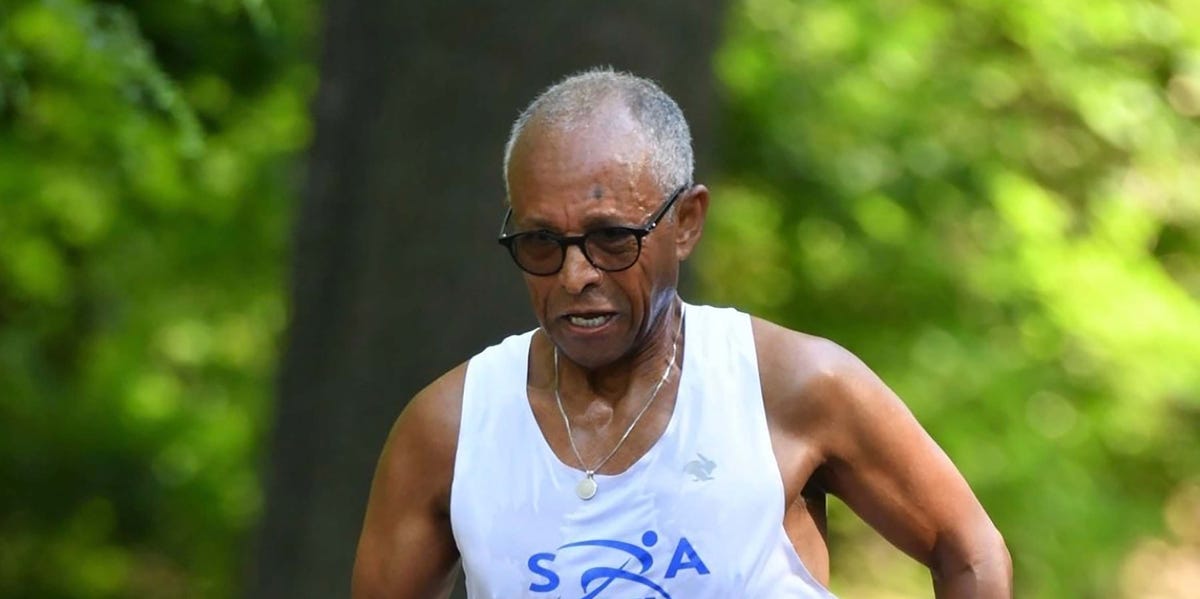
Last year, at age 70, I trained for a 2:50 finish at the Chicago Marathon. I was hoping to break what was then the age-group world record—2:54:19—by three or four minutes.My training was going really well: Two weeks beforehand, I had finished the Urban Cow Half Marathon in 1:20:57, maintaining an average 6:10 pace. In that race, I set American records in the 70–74 age category not only in the half marathon, but in the 10-mile distance, with a split of 1:01:35.Running 6:30 pace after that should have felt easy in Chicago, and it did, until about mile 19. That’s when my hamstring totally cramped. I stopped at the medical tent, and they massaged me and gave me electrolytes. I got back out there, but it kept tightening.After I tried three or four times, I decided to stop and walk off the course. I knew I could finish, but it wasn’t going to be a record time anymore, and I didn’t want to risk getting injured again. In the past, I just ran through my injuries, but not anymore.Courtesy Jacob NurIt was hard mentally, because I knew I had everything it took to break the record. But at the end of the day, if you fall, you have to get up. It was a disappointment, but it was temporary. I just moved forward.I came home to Sacramento, took a few weeks off, and then started training again. I ran the California International Marathon (CIM) in December without doing too much more. I finished in 2:59:01, which placed me second in the Abbott Age Group World Rankings and qualified me for the 2027 Age Group World Championships in Tokyo in March.This year, I’m coming back to Chicago, with my eye once again on the world record—there’s a new one, 2:54:18, which Korean runner Haeng-cheol Shin ran at the Seoul Marathon in March.All this success in running has been a dream, but it’s not even something I had in mind, either during my childhood in Eritrea or when I started running in my 50s.What Inspires Me to Break RecordsI’m motivated to chase records because I’ve learned that nothing is impossible. I’m very thankful to have the talent that I would not have discovered unless I went out and tried, and then tried harder.I was born in Eritrea, which was then a part of Ethiopia. I joined the rebels fighting for freedom at age 17, and fought in the jungle for five years. I was so fortunate to survive. An estimated 100,000 people died in that war, including many of my friends and my brother.When I finally left, I went to a few countries—Sudan, Saudi Arabia, and then Italy—until I was accepted into the United States in 1984. I moved to Florida first, where another brother lived, then to California the following year.I was 29 years old and didn’t speak any English. I took ESL classes while working two jobs, as a window washer and at a gas station. In 1986, I started going to community college. I got an associate’s degree, then I got accepted to nursing school and got a bachelor’s degree.Eventually, I got a job with the Veterans Affairs Department. I had been a fighter, and these men had had similar experiences on the battlefield in the Vietnam War and other conflicts. We had so much in common, and talking to them healed me.Then I started working in oncology. I saw people who had a few weeks, a few months left in life, and they were laughing and doing things. It was amazing how happy and positive they were.So many of my patients through the years pushed to do the most they could despite their limitations. That gave me a lot of encouragement and appreciation of life. So here I am. What is there that I cannot do?I am forever grateful to Eritrea, my birthplace, for giving me the strength and shaping who I am, and to the United States for welcoming me, embracing me, believing in me, and giving me the opportunity to pursue my dreams and build the great life I have today. I carry both countries in my heart, always.How Running Helped Me Take Charge of My HealthI kept going in my career: I earned my master’s degree in my 40s, and got promoted to running departments at the hospital. Once I reached my 50s, I knew plenty about the risk of chronic diseases. As you get older, you’re at risk for getting diabetes, high cholesterol levels, cardiovascular issues, and dementia.I was quite aware that movement is essential. So I started exercising once or twice a week—going to the gym, weightlifting, and running on the treadmill. But I didn’t really have any structure to my training.After about two or three months, there was a guy who saw me run 10 miles on the treadmill. He said, “Why don’t you run a race?” I had no clue races were even happening in my community.I went and signed up for the Run to Feed the Hungry in November 2008, when I was 53, without even really training.I ran well, in my opinion. I finished the 10K in 46:29, a 7:29 pace, and had a lot left in me. I thought, “My goodness, this may be something.” The next year, I went on to do a half marathon and then another marathon, CIM, which I finished in 3:53:41.After that, I joined a team and got plenty of training advice. I’m a go-get-it kind of person. I committed myself and talked to people and dreamed about what might be possible. I started a structured training plan, adding threshold runs, speed training, and cross-training. I finished CIM in 2:57:23 in 2011, cutting almost an hour off my time two years earlier. Every marathon I’ve run since has been sub-3 hours.Thirteen years after I started running, I set my first American age-group record. I went back to the race where I started, the Run to Feed the Hungry, in 2021 and ran 35:42—5:45 pace, faster than any U.S. man, aged 65–69, had gone before. I worked hard to get there, but I knew it was attainable.I looked into some of the other records and thought, “Maybe I can break those, too.” By the time I turned 70, I had four national records in the 65–69 age group, including the 5K (17:00), 10 miles (58:34), and half marathon (1:18:00). When I was 66, I ran my personal best in the marathon, 2:45:21, and won my age group, in the 2022 Boston Marathon.The more I did, the more I learned about myself. I have good endurance and I have speed. Growing up at high altitude in Eritrea probably played a role. But also it’s my mental state and mental toughness. Going above and beyond helps, and I continue to do that—getting up at 5 a.m. to train when I’d rather stay in bed and doing speed workouts with other runners, some of them much younger than I am. Once I break one record, I train harder to break another record.Adjustments Allow for Big GoalsI have had to change a few things about my training in my 70s, especially since Chicago last year. I don’t have an official coach, but I’ve taken advice from many people over the years, including the amazing teammates at the club I belong to now, SRA (Sacramento Running Association) Elite.To start, I reduced my mileage. Last year, I was averaging 70 miles per week, but this year I’m closer to 60. I run six days a week, and I used to do four hard workouts—a long run, a speed workout, and two tempo runs. Now, I only do three: one speed workout, one tempo, and the long run.I reserve Sundays for long runs, up to 20 miles during marathon training, often with some marathon-pace miles. Tuesdays are my speed days, just to keep the VO₂ max up. I love my speed workouts, especially with friends or other members of SRA Elite. As I was sharpening for the marathon, I did six reps of 800-meter repeats at 5:44 pace, with three minutes of rest in between. It felt good; it felt doable.I do tempo work on Thursdays for at least 20 to 30 minutes. Friday is my day off, and the other days are easy runs, where I don’t push myself.I also do a lot of cross-training, probably eight to 10 hours a week. I have time, because I retired a few years ago. I do Spin classes, strength classes, Pilates, boxing, and yoga. My wife, Feruz Abduselam, is very into yoga too. We go to classes together, but we also practice at home. Yoga clears my mind, and I believe it helps me prevent injury.We walk a lot, too—several miles, three or four times a week. Sometimes, I go to the bike trails and walk and do push-ups on the bench, as well as squats, which adds some strength and keeps it from being boring.Now, at age 71, I have no chronic diseases. I check all my labs. I have a very supportive primary care physician, and I see him as needed when any symptom worries me. My health is really good, with just a little bit of arthritis, which isn’t affecting my training. My knee hurt worse before I started running.I’m hopeful I get to break the record in Chicago. If not, I’m happy with what I’ve done so far, though I plan to continue to dig deeper.This year, I’m registered for the New York City Marathon and CIM, too. I also signed up for a 50K in February, where I’m fairly certain I can break the American age-group record of 3:56:44.I’d also like to lower my mile time—it’s 5:32, a record-breaking time I ran in May, but I’d like to shave a few seconds off it. And eventually, I’d like to get the record in the 50-miler, too.For me, running and racing is not a duty or a responsibility; it’s enjoyable. There is a little bit of pain to it, but it’s a joyful pain. It’s a way to explore the world and learn about yourself.Courtesy Jacob NurI always have a little jitter, a little nervousness before a race starts. But once I get to the starting line, that goes away; I’m ready to go and I’m excited. I give it 100 percent. I think of my wife, my children, teammates, and everyone who has supported me. I remember everything that has happened in my childhood—the limited resources, the limited food, the limited opportunities—and that gives me strength.3 Tips for Running Faster in Your 70sKeep Your Joints MovingI start warming up and lubricating my joints before I even get out of bed. I spend close to 10 minutes moving my hips, legs, and glutes. I also do neck mobility to get rid of any stiffness.When I get up, I do some easy yoga. Then I do foam rolling and dynamic stretching. I touch every muscle group in my body—I do leg swings and work on my plantar fascia with a massage ball to get bloodflow to my feet. I also have an incline board where I stretch my calf.Before a speed workout, I do lots of stretching with a band, too.Address Injuries QuicklyI visit my physical therapist once or twice a month to maintain healthy mobility. I address any injuries right away, because I know it’s not going to just go away. I get advice from my PT or my chiropractor about whether I should be running and how to treat it.A couple of months before the Chicago Marathon, I strained my adductor in the middle of my long run. I stopped and did all the right stuff—resting, stretching, strengthening, and seeing my therapists. In about 10 days, I was nearly back to 100 percent.Don’t Skimp on SleepNaps are an essential part of my recovery. After I run, I come home, shower, and then go take a nap. I sleep long enough to recover, usually about an hour. Naps clear out the aches and pains, and my legs feel so much fresher. If I miss my nap, I go to bed an hour early.I try to get at least eight hours of sleep, minimum. Your body does so much work at night to help your systems reset. You also get mental clarity after you rest.Cindy is a freelance health and fitness writer, author, and podcaster who’s contributed regularly to Runner’s World since 2013. She’s the coauthor of both Breakthrough Women’s Running: Dream Big and Train Smart and Rebound: Train Your Mind to Bounce Back Stronger from Sports Injuries, a book about the psychology of sports injury from Bloomsbury Sport. Cindy specializes in covering injury prevention and recovery, everyday athletes accomplishing extraordinary things, and the active community in her beloved Chicago, where winter forges deep bonds between those brave enough to train through it.
‘I Started Running at 53. At 71, I’m Still Going Sub-3 in the Marathon and Breaking Records. Here’s How.’
Full Article
Original Source
Read the full article at Runnersworld →KhanList aggregates and links to publicly available news content. We do not host full articles from third-party sources. Always verify important information with original sources.