
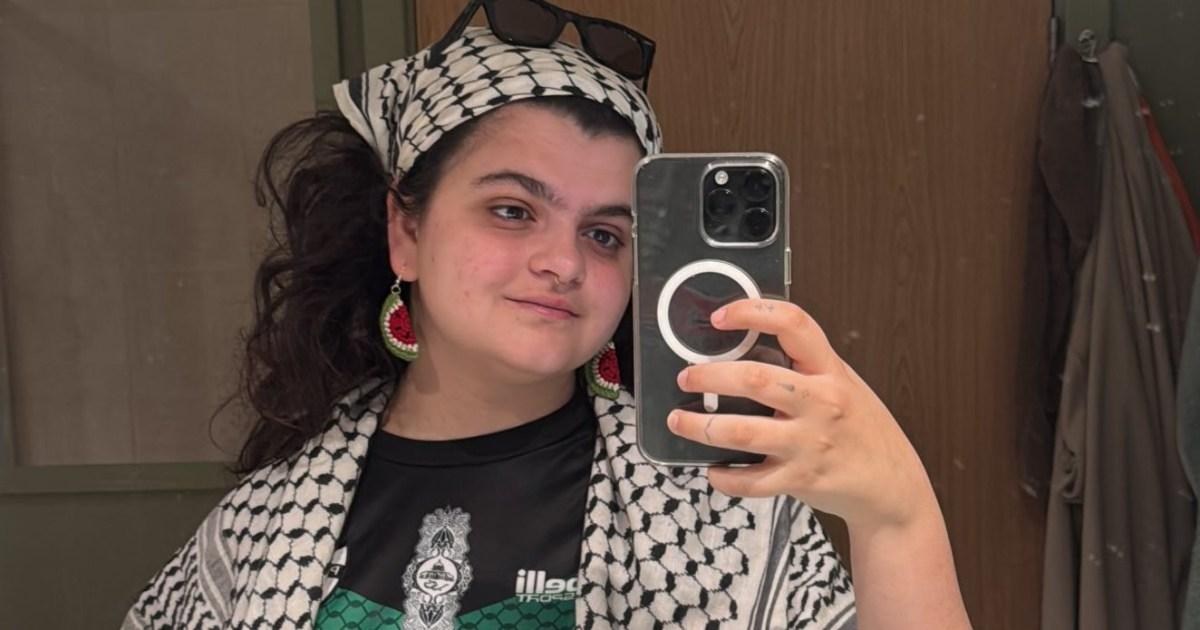
I had openly been out since thirteen, and was the first in my grade to do so (Picture: Nisreen Fox) ‘Yeah you’re a lesbian, but you’re not Muslim as well are you?’, a Christian boy barked at me in my school’s library. ‘No’, I responded adamantly, ‘of course not’. ‘Okay good’, he said. Later that day, I felt so guilty for lying about my faith, that I asked Allah for forgiveness. I had openly been out since thirteen, and was the first in my grade to do so. What I didn’t expect was the years of confusion, interest, even fear over my identity, that would lead to uninviting questions like these. But little did I know that years later, I would be fully embracing both sides of my identity, very far from home. I was born in 1999 in Geneva to a British father and a Lebanese mother. When I came out to my mother as a lesbian in 2013, while we were still living in Geneva, she cried, hugged me and told me that life was going to be more difficult than it already was. I had lost my father suddenly as a child, then my mother suffered a life altering stroke a few years later – so things were tough. Join Metro's LGBTQ+ community on WhatsApp With thousands of members from all over the world, our vibrant LGBTQ+ WhatsApp channel is a hub for all the latest news and important issues that face the LGBTQ+ community. Simply click on this link, select ‘Join Chat’ and you’re in! Don't forget to turn on notifications! I wish I could tell you that I threw myself into my culture, learning everything about Palestine (Picture: Nisreen Fox) Ask Metro Use AI to go deeper into the stories you care about – powered by Metro and trusted publications. However, she has been my biggest supporter since then, and was there for me when I came out to the rest of my family in 2020, where I was met with even more unconditional support. But, unexpectedly, Mama also told me a secret. That she had been born and raised in Lebanon, with a Lebanese passport. But, she wasn’t Lebanese at all – she was Palestinian. My grandmother, who had been forced out of Palestine during the 1948 Nakba, told her not to tell me – she knew I would ask questions and they didn’t know how to protect me from the trauma of the Palestinian experience. At school, I wish I could tell you that I threw myself into my culture, learning everything about Palestine. Instead, struggling with my gender identity, I changed my name to Alex, and told people I was British-Arab but ‘mainly British’ with a passport to match. I moved to Brighton – and life suddenly looked very different (Picture: Nisreen Fox) I was so far removed from my culture at the time because I was worried my sexuality would be an issue. When I began to embrace it, by connecting and learning with queer communities online through Instagram, my identity was questioned. It reminded me of when I was 17 and offered to do a presentation on the Israel-Palestine conflict for our politics lesson at school. During study hour, a group of boys confronted me, asking if I was spreading ‘terrorist propaganda’ about Israel. Holding my ground, I told them I would just present historical facts, but that was the first time I truly realised how alienating my identity could be. Geneva is an extremely multicultural city, so I was regularly around people from different backgrounds. But then in 2017, I moved to Brighton – and life suddenly looked very different. Brighton & Hove is only 10.9% non-white according to the 2021 census compared to London’s 46.2%, while 39.2% of Geneva’s population are non-nationals. I tried to find solace in gay clubs, but even there people would call me ‘exotic’ (Picture: Nisreen Fox) I felt lost. No one knew about Palestine or my culture – at least it was rare. Then, after the October 7 attacks, the whole city shifted and everyone had an opinion. The first few years in Brighton were tough, everyone loved the fact that I was a lesbian, experimenting with my gender, however as soon as it came to my religion, my name, my politics – they turned their backs. I tried to find solace in gay clubs, but even there people would call me ‘exotic’ asking me ‘where was I really from’. They would touch my curls and not even ask for permission. Dates would question how could I be Muslim if I’m gay, followed swiftly by ‘it’s okay if your family don’t accept you’. But they do. My mother loves me, and nothing about me will change that. I felt different to everyone else, not white enough to be in a gay scene, but not Arab enough to be in with my community, known as SWANA (South West Asian and North African). Queer Hope & Joy Metro is sharing stories of Queer Hope & Joy, where we are centring stories that platform the vibrancy, diversity and resilience of the LGBTQ+ community. This is running alongside LGBT Foundation's Hope Starts Here campaign, and will represent as many LGBTQ+ identities as possible, while spreading hope and joy at a time it is very much needed. Find out more about LGBT Foundation's campaign here. To submit your story of your Queer Hope & Joy send your pitches to: sharan.dhaliwal@metro.co.uk Many Arabs use SWANA to identify ourselves, since it feels more true to where we come from. But because I don’t speak Arabic and I subconsciously feel ‘othered’ because of my sexuality, I assumed I couldn’t enter SWANA spaces and connect as well as others. That didn’t stop me from living my life the way I wanted, and now, nine years after moving to Brighton, through visiting the Old Palestine House and local fundraising events put on by Queers for Palestine Brighton, I have expanded my LGBTQ+ SWANA network. I have a community that supports me in my activism, my efforts to fundraise for Palestinian and Lebanese causes, and to be there for me when I need advice. As a community, though, we have faced hardships – like being told by the white queer community in Brighton and local Zionists that we’re hypocrites for being LGBTQ+ and Pro-Palestinian. I was there with my partner, friends, and local aunties, and it felt like finding the people I had been yearning for all my life (Picture: Nisreen Fox) We’ve had far-right thugs yell ‘Chickens for KFC!’ At us on our marches. Once, a Palestinian fundraiser I was hosting got cancelled by a prominent LGBTQ+ venue last minute due to ‘concerns from the local community’ around ‘safety’. But nonetheless, we get to experience true queer joy together. Like this year, for the 2026 Brighton Pride weekend I attended my first ever SWANA Pride Party at Old Palestine House – a local community centre. It was joyous – we danced to music from our culture, did the dabke (a dance popular among Lebanese, Jordanian, Palestinian, and Syrian communities) over and over, laughed, ranted and cared for one another. For the first time in my life I felt like I understood what it meant to be Palestinian and queer, because I was just being me. I didn’t have to defend myself, I didn’t have to explain, I just got to dance as authentically as I ever had. I was there with my partner, friends, and local aunties, and it felt like finding the people I had been yearning for all my life. Being Palestinian shouldn’t be alienating, and being queer shouldn’t be controversial. When you combine the two it shouldn’t be shameful. It should be, and will always be, joyous. Do you have a story you’d like to share? Get in touch by emailing Ross.Mccafferty@metro.co.uk. Share your views in the comments below. Arrow MORE: I’m considering freezing my daughter’s eggs after she started puberty as a baby Arrow MORE: Ireland make decision on boycotting Israel match after player refuses to play Arrow MORE: It was the perfect date – until I told him how I felt
I spent years struggling with my identity as a Queer Palestinian
Full Article
Original Source
Read the full article at Metro →KhanList aggregates and links to publicly available news content. We do not host full articles from third-party sources. Always verify important information with original sources.