
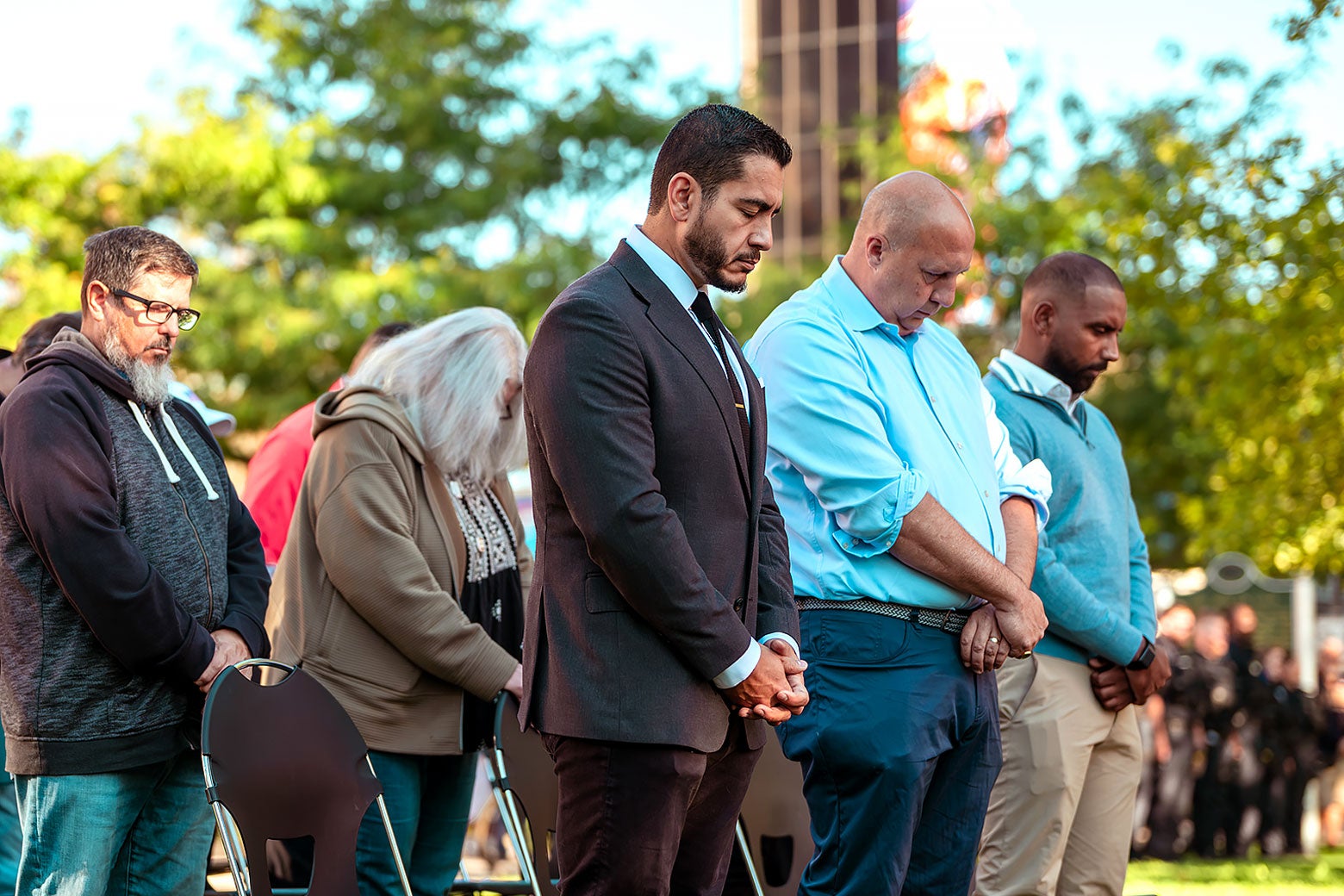
Politics What I saw shows what’s at stake. By Enter your email to receive alerts for this author. Sign in or create an account to better manage your email preferences. Unsubscribe from email alerts Are you sure you want to unsubscribe from email alerts for Aymann Ismail? Sept 17, 20265:40 AM Abdul El-Sayed at the 9/11 memorial in Lansing, Michigan, on Friday. Aymann Ismail Sign up for the Slatest to get the most insightful analysis, criticism, and advice out there, delivered to your inbox daily. I noticed Abdul El-Sayed only after he had already taken his place at a 9/11 memorial in Lansing, Michigan, last Friday, standing not far from a piece of steel from the World Trade Center site. A ceremony for the attack’s 25th anniversary was starting, and he had come in quietly, head down, free from the fanfare that usually follows the surging Senate candidate. Firefighters and police officers stood around the Michigan September 11 Memorial in Wentworth Park, where the tribute was built in a public space that has been used to mourn firefighters since 1934. A chaplain read the names of Michiganders killed in the attacks. El-Sayed’s campaign had already released a video condemning and memorializing 9/11 that morning. “Nothing can justify the murder of innocent civilians. Nothing,” he says in it. The absence of such a statement threatened to become a story in of itself on Fox News. For most politicians, calling the 9/11 attacks evil would be unremarkable. But if El-Sayed got the ritual wrong—or even appeared insufficiently eager to perform it—there was already a political apparatus waiting to tell voters what that says about him and Muslims around the world. In person Friday morning, El-Sayed mostly stood there and listened. Rep. Tom Barrett, a Republican congressman running for reelection in Michigan’s 7th District, was one of several speakers who talked about the unity that followed 9/11. Lansing fire chief Carrie Edwards-Clemons recalled Americans treating one another with “respect, compassion, and love that carried us through the days after 9/11.” Everyone seemed to remember the aftermath of the attack as a moment when Americans came together. I remembered it differently. I was 11, attending an Islamic school in northern New Jersey. I remember the attacks themselves. I remember not knowing the whereabouts of my father, who worked in Manhattan, and thinking he might be dead. But when people recall the weeks afterward as a time when the country came together, I remember another America arriving almost immediately. Our school shut down amid protests and hostility. Muslim families around me clung to American flags, afraid they would be subject to some kind of retaliation. There was the surveillance, the raids, the FBI showing up at my family’s door in Newark, my brother ending up on a no-fly list, and a government response abroad whose boundaries seemed to expand for years. The two memories have never been separable for me: the horror of what happened on Sept. 11 and then what happened because of it. El-Sayed, in less charged moments, has spoken of this duality in his own life. But in the campaign, the balancing act proved impossible. Since he won the Democratic primary, Republicans and conservative activists have increasingly used his religion against him. Donald Trump has called him a jihadist, and other figures on the right have called him an Islamist or menacingly emphasized his full Arabic name. Mike Rogers, his Republican opponent, has seized upon a clip of his once campaign partner, Hasan Piker, saying in 2019 that he believed America deserved 9/11. Piker later renounced the statement, saying it was wrong, but the fact that he said it once still continues to be brought up, again and again, in El-Sayed’s race. Questions about El-Sayed’s association with Piker are fair. But Republicans have tried to make the connection suggestive of something much more sinister. One pro-Rogers super PAC ad opened with footage of the burning towers, played Piker’s old comment, and then cut to El-Sayed campaigning with him. The narrator says El-Sayed gave “comfort” to the hatred behind 9/11. At the memorial, I wondered what was running through El-Sayed’s head. Everyone seemed to understand the gravity of his presence, a Muslim Senate nominee whose name, faith, and relationship to the attacks had become part of the argument against him. It could feel like all eyes were on him. But when Iater asked El-Sayed what he was thinking in that moment, he more or less demurred. He said he thought about “pangs of pain and sadness of that day” but quickly moved on to a broader view of what happened on 9/11. “They attacked the idea of an America that’s big enough for all of us, and the idea of an America where people can come together beyond their differences to build something that’s greater than the sum of its parts. And so much of what our campaign is about is the antithesis of what those hijackers and those terrorists believed,” he said. “I’m a lot more focused on the future and where we go from here.” While he is focused on the future today, five years ago, before he was running for office, he commemorated this day a little differently, tweeting that he hoped there was space to mourn the lives lost on 9/11 and the lives lost in the horrific wars that followed. It’s an argument that is easy to defend, though of course the resurfacing of these tweets has caused its own firestorm. When I pressed him on how the anniversary had been weaponized against him, he finally became more forceful. “There’s this sad and tragic irony to very small men trying to use this moment to tear us apart in the form of just these hideous attacks that try to blame me, in effect, for this moment. I was a junior in high school when it happened,” he said. “The idea that simply because of my face or my name, you think you can use those things to divide us—it rhymes with the exact logic of the people who attacked us that day.” Aymann Ismail After the memorial service, El-Sayed lingered for a bit to shake the hands of people in attendance. A man wearing a veteran’s cap for the Iraq War told me El-Sayed’s presence “elevates my experience,” and that we need “anti-war candidates.” I caught up with Barret and asked him if he had any thoughts about El-Sayed’s presence there. “Anybody who comes out today to pay respect for what happened on 9/11 is something we should all appreciate,” he said. “Today is not really a day for politics. I’ve got disagreements with a lot of different people, obviously. Politics is going to continue, and we’re 50 and whatever days [out from the election] and the political division steepens the closer you get. But I hope today we cannot make it about politics. We should make it about remembering the lives lost both on 9/11 and the wars that followed.” About 700 miles away around the same time, a momentary greeting between New York City Mayor Zohran Mamdani and Rep. Alexandria Ocasio-Cortez at ground zero became a dayslong online uproar. Another rising Muslim political star, people said, was “celebrating” 9/11. A few hours later, at Michigan State University, El-Sayed did his best to change the subject, just as he later did with me. The line for his “Students vs. Billionaires” town hall wrapped around the second floor of the MSU Union and down two staircases even after the ballroom hit capacity. The room was packed with students, the vast majority of whom had not yet been born on Sept. 11, 2001. He asked the room for a moment of silence for the victims. Hundreds of students went quiet. Aymann Ismail The town hall commenced as planned. The questions were more interesting than the usual questions from reporters. A student from the Upper Peninsula asked about rural hospitals closing. A medical student pressed him on how one senator could actually enact the sweeping things he was promising. Another student challenged his plan for public participation in A.I. companies, asking whether the government would then have its own financial incentive to encourage the technology’s growth. Someone talked about issues specific to households suffering from domestic violence. Others asked about housing, data centers—but it was mostly health care. At some point, El-Sayed pointed toward the row of reporters at the back of the room. “You know what I always get asked? Hasan Piker,” he said to the students. “All you in the press! You hear? These folks are talking about health care. Stop asking me about a streamer in California.” The town hall ended and the press gathered around him. None of the questions were about health care or policy. El-Sayed was asked to respond to the man who said he “should be shot” at the Republican convention in Dallas one day earlier. “Democracy is supposed to be about solving our disagreements peacefully,” he said. “It’s sad. It’s really sad for all of us who believe in the democratic process.” “The thing that they’re attacking isn’t really me,” he told me later. “If America—as America has always been—is a place where any and all of us can build together something greater than the sum of its parts, that’s the thing that they’re attacking. And as an American, I’m affronted, not just as a Muslim American.” Aymann Ismail From MSU, he was off again, this time to a friendly crowd where he once again repeated his brief 9/11 speech before moving on to more familiar applause lines. (“You can keep saying my name. Doesn’t change the fact that at some point you’re going to learn to say my name with the word senator in front of it.”) The grind continued, and it started to feel like another day on the trail. But I tried once more to get El-Sayed to engage with the different kind of gravity that I and so many people I know felt—for some recognition that this part of the memory belonged inside the anniversary too. Maybe even permission. He challenged me to widen the scope. “I think all of us are worth protecting,” he said. “I think about rising Islamophobia and rising antisemitism and, frankly, just rising attitudes of hate and xenophobia like a fire. And I hope that I will always be the kind of person who runs into the fire to try and do something about it. So this is me running into the fire and trying to do something about it. And the best argument I can offer is to prove, right?, to show that actually all of us have a stake in this place. “I’m asking to be judged on my merits as a public servant, without an asterisk about what my name is or what my faith is,” he said. Then he did what he had been doing all day: He started talking about health care, rent, groceries, schools, roads. “I will ask to be judged on my service to America and Americans. And so that’s what I’m doing. I’m trying to run into the fire and trying to address it in the best way that I know how, which is to serve my fellow Americans,” he said. The answer that finally clarified what I’d been seeing came a few minutes later. “My job is not to make myself or my own experience the main character,” he said. “My job is to always be centering folks in the work.” In truth, I found this a bit cagey. But I thought back to Wentworth Park, where I had interpreted his quietness as something happening to him. Maybe that was partly true. A Muslim Senate nominee does not have the same ability I have to talk freely about what the United States did after 9/11. I can write about surveillance and war, and the consequences are an argument in the comments section. El-Sayed’s words—even his old tweets about 9/11—are becoming television ads with the towers burning behind them. That’s not hypothetical. That’s actually happening. But reducing his restraint to fear or campaign calculation also gives him too little agency. He appears to sincerely dislike the idea that his candidacy should be a story about his identity at all. People keep assigning him symbolic roles: first Muslim senator, Muslim socialist, proof of Democratic radicalism, proof of Muslim political progress. He keeps trying to make himself less symbolically powerful, and more practically useful. And yet, I had spent the day doing something to El-Sayed that his opponents were also doing in a very different way: insisting that the most revealing thing about him was his Muslimness. Republicans are betting millions of dollars that voters will only see one thing when they look at him. El-Sayed is betting that enough people will tune it out as noise. Near the end of our conversation, he told me that foregrounding his own experience was most easily distilled by his ambitions. “I’m out here trying to get people health care,” he said. “We built our campaign to speak to everyday people in the places that they actually are, having the conversations they actually want to have. We proved out that you can throw a whole lot of money at this, but your money doesn’t buy you a message. It doesn’t buy you a movement, particularly when your campaign is built around Mike Rogers, who is a corrupt coward.” In Michigan, it went on like that: on message. But I realized El-Sayed didn’t have to process that day the way many of us were. He has his job. I have mine. Donald Trump Senate Islamophobia Michigan Islam Sept. 11 2026 Midterms
I Spent 9/11 With Abdul El-Sayed on the Trail in Michigan. What I Saw Shows What’s at Stake.
Full Article
Original Source
Read the full article at Slate →KhanList aggregates and links to publicly available news content. We do not host full articles from third-party sources. Always verify important information with original sources.