
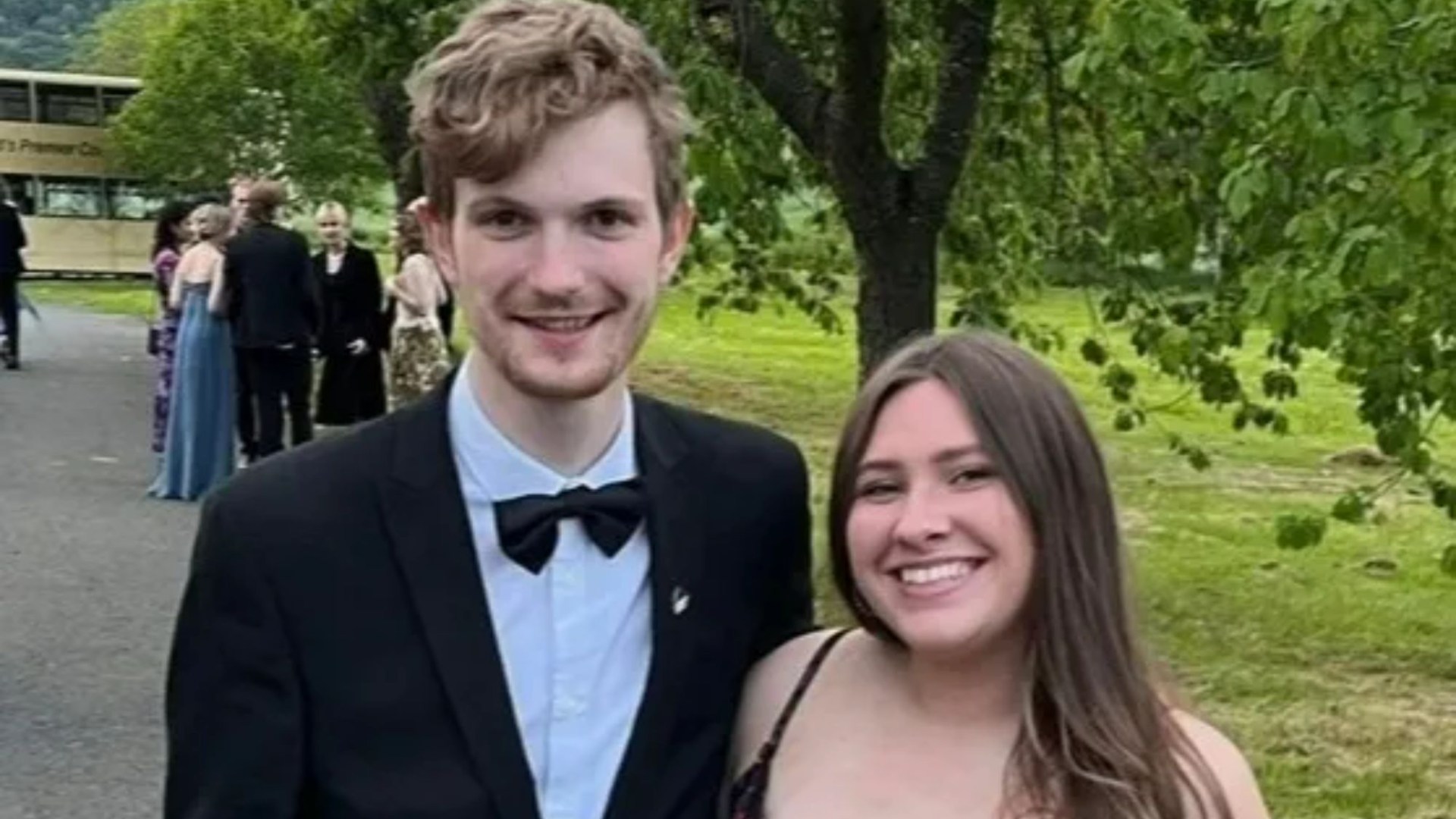
GRIPPING the edge of the bathroom sink, Ellie Johnstone shouted to her boyfriend Tom for help. “One minute I’d been brushing my teeth, the next my vision had suddenly become distorted and blurred, as if I were looking through a kaleidoscope,” says Ellie, 26, from Macclesfield. Ellie Johnstone was brushing her teeth after a date night when she started experiencing double vision Credit: Supplied Ellie’s boyfriend Tom thought she was having a stroke so he called 999 Credit: Supplied “I couldn’t feel the floor beneath my right foot and one side of my face had drooped.” She didn’t know it yet, but the then 24-year-old was having a stroke. A date night one sunny spring evening in April 2024 took a frightening turn for Ellie, who works as a researcher for a health company. “After a busy week, we’d been out for a pizza and a glass of wine,” says Ellie. “The sun was shining for what felt like the first time in months. “Feeling tired, I decided to have an early night and it was as I was getting ready for bed, I was suddenly overcome by weakness down one side of my body and I was struggling to see clearly. “Tom took one look at me and said, ‘I think you’re having a stroke, I’m calling for an ambulance’. “It was only when I told him he was being ‘silly’, and I was ‘just tired’ that we realised my speech was slurred too. “I knew then something was seriously wrong, and felt scared.” Things only worsened when Tom dialled 999 and began describing Ellie’s symptoms to the call handler. He fainted due to the stress of the situation – which led medics to initially fear the couple were suffering from carbon monoxide poisoning. Ellie says: “Tom’s super fit, a keen cyclist, he does 100km rides regularly. Ellie experienced weakness on one side of her body, trouble with her vision and slurred speech Credit: Supplied The situation only got worse when Tom fainted while on the phone to 999, making medics think the couple were suffering from carbon monoxide poisoning Credit: Supplied “But because he fainted on the call, the call handler thought maybe something was going on that was affecting us both. “Thankfully, he was only out cold for about thirty seconds before he came round and we were told an ambulance was on the way – for us both. “The call handler said we should both leave the house in case it was carbon monoxide poisoning. So we sat outside, on the floor in our front yard, while we waited for paramedics to arrive. “By now, I only had some peripheral vision, I couldn’t stand and my head was aching. “Seeing how worried Tom was, but not being able to comfort him because I felt so disorientated and in pain, it was awful.” Ellie and Tom, a teacher, had been starting their life together when their ordeal began. “After graduating six months previously, I was enjoying settling into working life as a health company researcher, and living in Macclesfield,” says Ellie. Now, they were facing doctors who worried something potentially fatal could happen. The couple were blue lighted to Macclesfield District General Hospital where Tom was checked over and given a clean bill of health. But Ellie was repeatedly asked if she had been drinking or taken any drugs. “‘It’s ok, you can tell us if you’ve taken anything, we need to know’, the doctor said – but I insisted I’d had one glass of wine. “Whatever had happened to me, it wasn’t caused by a substance. Doctors initially thought Ellie’s symptoms might have been caused by alcohol or drugs, before they discovered she’d had a stroke Credit: Supplied “Although my symptoms had eased and I was able to walk and talk more normally, my vision also returning, I was taken for a CT scan and other tests.” Around 3am the following morning, Ellie was given the shocking news that she’d had a stroke caused by a clot in the thalamus, deep inside her brain. She says: “Until that moment, I’d always pictured stroke patients as elderly and frail – not a twenty-something graduate who enjoyed running and was fit and healthy. “I really struggled to process it, and at that point, doctors had no idea why this had happened to me.” Ellie was transferred to the stroke unit at the nearby Stepping Hill Hospital, where she was in a bed next to another girl in her late twenties. “It helped me feel less alone as the other patients were all decades older,” she says. “Although physically I was much improved, I was suffering from fatigue and still experiencing bouts of confusion. “I was convinced I had diabetes and kept asking the nurses for my insulin, and I also repeatedly asked Tom how my pet meerkat was. “We can laugh about it now but at the time it was frightening for us both that my brain was clearly so jumbled from the stroke.” Further tests revealed the cause of Ellie’s stroke, and it was another shock. She says: “I had a small hole in my heart that had been there since birth, known as a PFO (patent foramen ovale).” Around one in four people are born with a PFO. After recovering, Ellie ran her first marathon to raise money and awareness for Different Strokes, a charity which supports young stroke survivors and their families Credit: Supplied Don't delay... if you spot signs of a stroke dial 999 immediately A STROKE is a medical emergency, that’s why knowing the signs and symptoms is vital. It happens when the blood supply to the brain is cut off, killing off cells. The damage caused can affect how the body works, and the effects depend on where in the brain a stroke strikes. There are three different types of stroke: Ischaemic stroke – where a blockage, like a blood clot, cuts off the blood supply to the brain Haemorrhagic stroke – caused by a bleed in or around the brain Transient ischaemic attack – also known as a ‘mini stroke’, this is a big warning sign of a full-blown stroke. It’s similar to a stroke but symptoms are shorter lived. Every stroke is different but they can affect a patient’s ability to speak, move, think and feel. They can cause behavioural changes as well as emotional challenges. They can happen to any of us, regardless of our age. That’s why it’s important to educate yourself on the warning signs. The faster you get medical help and treatment, the more likely it is that the damage caused can be reversed and stopped in its tracks. There’s a handy acronym that helps identify the symptoms of a stroke. If you spot these yourself, or in a loved one, do not delay – dial 999 immediately, and tell the call handler you suspect a stroke. ACT Fast: Face weakness – can the person smile? Has their mouth or eye drooped? Arm weakness – can the person raise both arms? Speech problems – can the person speak clearly and understand what you’re saying? Time to call 999 – if you see any of these signs, get help. This test helps spot three key signs, but there are other symptoms to be aware of too. They include sudden weakness or numbness on one side of the body, difficulty speaking, sudden blurred vision or loss of sight, sudden confusion or memory loss, dizziness or a sudden fall and a sudden, severe headache. When it comes to a stroke, the bottom line is take these symptoms seriously. It may well be something more minor, but it pays to be alert and act fast. Not only could it save your life, but it could save you, or a loved one, from long-term, devastating side effects. For more information about stroke, visit the Stroke Association or the NHS website In most cases it is completely harmless and causes no symptoms, which means many people live their entire lives without ever knowing they have one. However, it is found in up to 40–50 per cent of younger adults who experience an unexplained stroke. Ellie says: “It causes a stroke by allowing a blood clot to cross from the right side of the heart to the left, where it can travel to the brain. “What reassured me was being told how common they are – around one in four people have one – and that it could be resolved by surgery, so I was no longer at increased risk from stroke.” Ellie admits that while waiting for that op, she struggled emotionally. “With time to reflect on what had happened, I suffered from anxiety,” she says. “If I could have a stroke out of the blue, what else could happen to me? “I also was still suffering from exhaustion and it was hard seeing friends on social media out living their lives and taking holidays, while I was at home in bed with no energy for fun. “I had counselling which helped me, and also had support from a charity called Different Strokes, which helps young stroke survivors and their families.” Ellie had surgery in November 2024 and other than taking blood-thinning medication and statins, she was able to start ‘getting back to normal’, with Tom and her family’s support. “It has taken time and I still suffer from fatigue and have to take care I don’t burn out,” she says. “I also do still experience health anxiety – a simple headache can send me into a spiral of worry it’s another stroke. “Running has helped greatly – it clears my mind and I’ve slowly built up my stamina and strength post stroke. “Earlier this year, I even ran my first marathon to raise funds and awareness for Different Strokes. I felt so proud as I crossed the finish line about how far I’d come, in every sense.” Ellie says that people tend to react with shock when she reveals she had a stroke in her early twenties. “Nobody associates the condition with someone my age, but it can happen to anyone,” she says. “Recovering has meant accepting what happened to me, but not allowing it to hold me back as I move forward with my life.”
I slurred my words and saw double after date night – I couldn’t stand as my boyfriend called 999 but then HE collapsed
Full Article
Original Source
Read the full article at Thesun →KhanList aggregates and links to publicly available news content. We do not host full articles from third-party sources. Always verify important information with original sources.