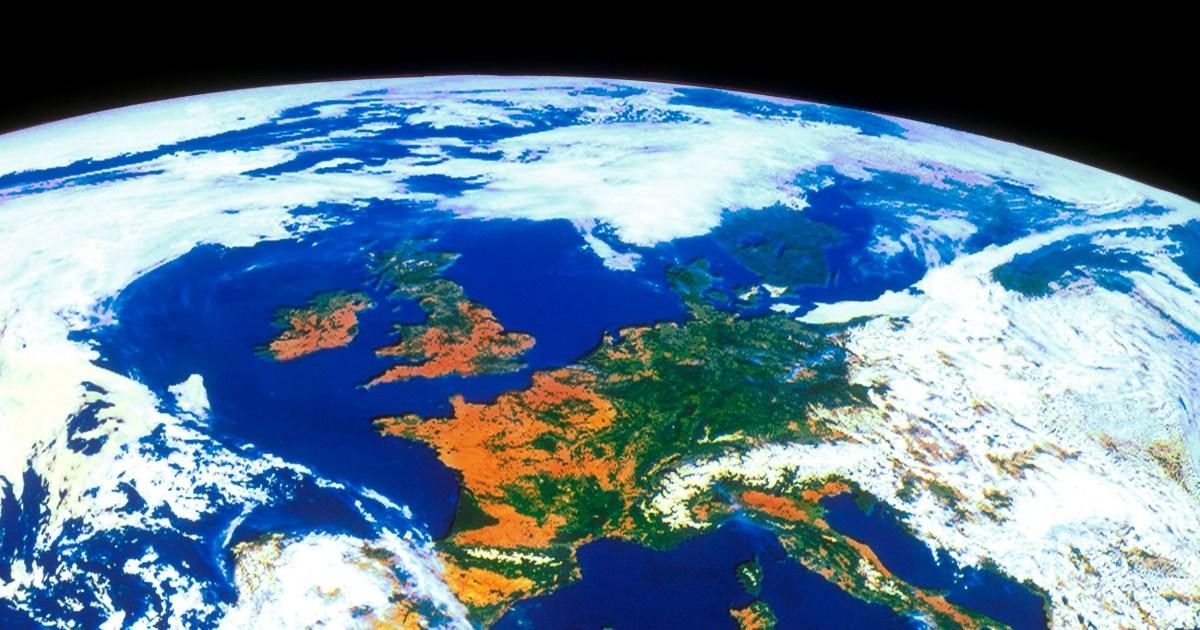
It’s not a globe, apparently, like many of us believe, but as flat as a pancake (Picture: Marka/Universal Images Group via Getty Images) ‘I could show you weather balloon footage from 120,000 feet, and it’s absolutely table-top flat!’ Mark Sargent, one of the Flat Earth movement’s most recognisable faces, said this to Philip Schofield on This Morning in a now-infamous 2020 video, when discussing his belief that the world is in fact flat. It’s not a globe, apparently, like many of us believe, but as flat as a pancake. Surrounded by ice. Sargent is the central figure of 2018 documentary Behind the Curve from director Daniel Clark, where he tells us that he has explored almost every conspiracy. From fake moon landings, 9/11 as an inside job, to a mysterious cabal dictating a new world order – but none lit him up quite like the Flat Earth. While watching the documentary, I realised that there was something unexpectedly sad about it all. I found myself wondering what drew a seemingly ordinary person into one of the most easily disprovable conspiracies – one so silly that it has itself become a byword for ignorance. I found myself wondering what drew a seemingly ordinary person into one of the most easily disprovable conspiracies (Picture: Alex Moneypenny) So, to find out, we did what any upstanding citizen would do with that question: I, alongside my friend Adam Tuffrey, wrote a musical about it called The Shocking Truth About Flat Earth. But I didn’t expect to find out what I did – that Flat Earthers, and probably other conspiracy theorists – are quite simply incredibly lonely. Adam and I were actually exploring how to write a show about the different ways people carry grief, when we stumbled onto Sargent, who once told his local newspaper ‘most people get married and have kids – but if you don’t, you have a huge amount of free time on your hands.’ The more we dug into the theory and the community around it, the more we realised these people offered a near-perfect window onto the things we’d wanted to write about all along: grief, loneliness and the very human need to belong. Flat Earth, it turned out, became the obvious choice through which we could tell that story. Adam and I were actually exploring how to write a show about the different ways people carry grief (Picture: Alex Moneypenny) It’s easy to shrug them off as another internet rabbit hole, with a group of ‘weirdos’, but Mark Sargent and his community aren’t alone. A 2018 YouGov survey found that 84% of US adults believed the Earth is round – with that number dropping to 66% among millennials. Despite the junk science and cult-like undertones, Sargent comes across well. He’s funny, even charismatic – which helps explain how so many people are drawn to him. He lives with his mother despite rapidly approaching 50, but he’s also the 1994 Digital Pinball Champion of the World. Which I guess some would see as an achievement. First and foremost, our show is a comedy, but to get it right we had to do our research – and we found patterns. We started by trawling the internet, and found ourselves on Reddit, reading through various conspiracy threads. The Flat Earth community there draws more than 70,000 visitors a week, and the further we scrolled, the more of these moments of sadness surfaced between the diagrams and the arguments. We found someone who hinted about how they were drifting away from their partner amongst the chatter. In one, slightly extreme, case, we saw a post from a mother who had started homeschooling her daughter with flat earth children’s books. Here was someone so embedded in the belief that it fed into how she was raising her child – it became the lens a whole family now saw the world through. What do you think about conspiracy theories like Flat Earth? They are harmless and entertaining.Check They can be dangerous and misleading.Check They reveal deeper societal issues.Check I'm indifferent to them.Check Sign up to Metro's Puzzles Newsletter and get your favourite puzzles sent directly to you every day! In one hour-long YouTube debate, the rapper Lord Jamar argued the earth was flat while the science educator Professor Dave took the theory apart, point by point. The more thoroughly Lord Jamar was proven wrong, the more fiercely he seemed to dig in. We watched and read countless times that a flat earther’s belief survived every fact thrown at it; it made us think deeper about why people joined, and stayed in, the community. Even in the documentary Behind the Curve, there was a heartbreaking moment where convention attendees described their beliefs arriving alongside major relationship breakdowns. While doing this research, we realised the story we wanted to write needed to be relatable for a UK audience. We realised the story we wanted to write needed to be relatable for a UK audience (Picture: Alex Moneypenny) We realised that Sargent, by comparison, felt almost too polished to be our hero. Until it hit us – growing up in sleepy, ageing Bournemouth, we had ample examples of the dangerous combination of too much free time and a limited understanding of technology. Once one of my mum’s friends said the phrase ‘algae rhythms’, we knew who our heroine needed to be. And so The Shocking Truth About Flat Earth follows 40-something Sharon Hargreaves, a recent convert to the cause, on a mission to settle the question herself – though not before she’s caught Adele’s Vegas residency. The Shocking Truth About Flat Earth follows 40-something Sharon Hargreaves (Picture: Tyler Whiting) None of this felt as distant as you might think – Adam’s own mother-in-law is convinced to this day that the moon landings never happened. We didn’t want to scoff or laugh at conspiracy believers – our show is about understanding why they believe it and acknowledging that they’re real people wanting to belong to something. When things feel uncertain, it’s human nature to seek certainty and community, rationalising those deeper emotional truths we dare not face. But we’re certainly not arguing that conspiracy theories deserve blanket sympathy – some of the more dangerous, radicalising movements are a different conversation entirely, and one we steered clear of for a musical. Flat Earth, as one of the relatively harmless conspiracy theories, helped us explore something much bigger: why people seek certainty when life becomes uncertain. Sargent’s search itself reveals that Flat Earth was not the spark that illuminated him all those years ago; it was simply the answer to a lifelong search of belonging. Understanding that ultimately felt far more interesting than arguing about the shape of the Earth. Deals of the Day Parents can save up to 30% on Kickers school shoes ahead of the new term The back-to-school hack that's helping parents avoid queues and sold-out sizes Could your hair be wavy rather than straight? This brand thinks so Could your star sign improve your skincare routine? This new beauty launch thinks so Best skincare for menopausal skin? This dermatologist-created treatment is tailored to you We made our musical, and after it all, we realised it brought us closer to humanity. Do you have a story you’d like to share? Get in touch by emailing Ross.Mccafferty@metro.co.uk. Share your views in the comments below. Arrow MORE: Ignore James Bond frontrunners – the next 007 should be a complete unknown Arrow MORE: I don’t care what people say — I’ll never stop using my hotel buffet hack Arrow MORE: The school summer holidays need to be 2 weeks shorter Puzzles Newsletter Get your favourite puzzles when they are ready to play on the website sent directly to you every day and track your daily streak!
I researched Flat Earthers – and found something unexpected
Full Article
Original Source
Read the full article at Metro →KhanList aggregates and links to publicly available news content. We do not host full articles from third-party sources. Always verify important information with original sources.