
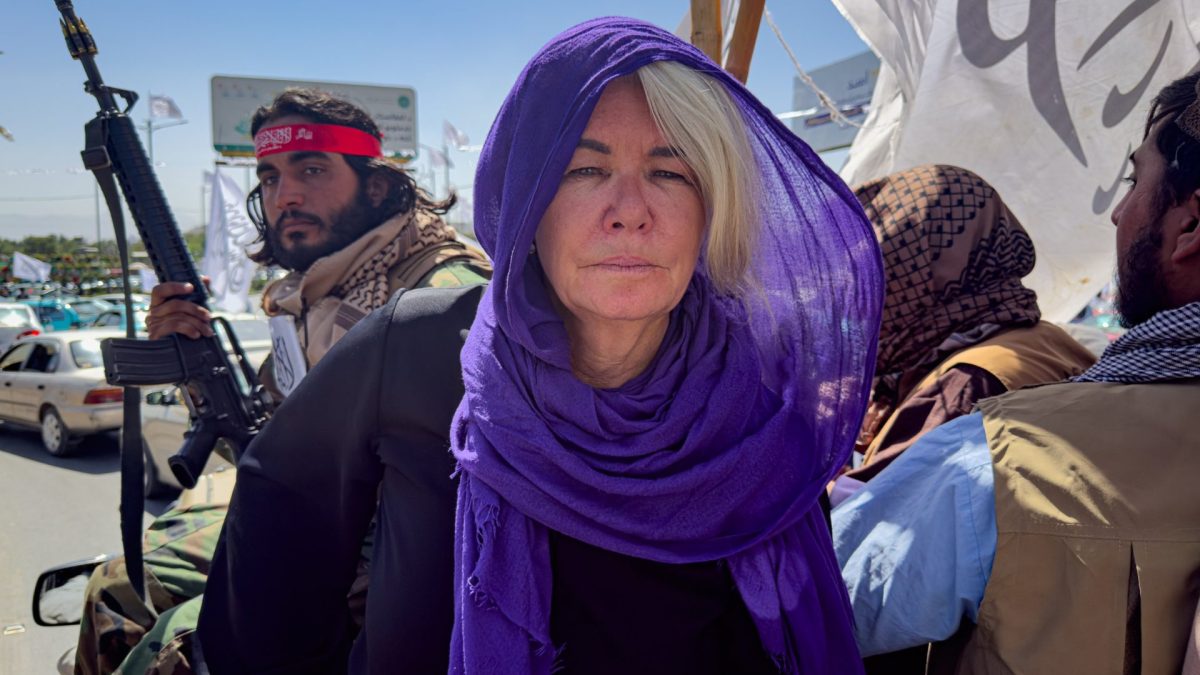
The women of Afghanistan are screaming into a void of silence. Mariam* asks me: “Why don’t people care?” I try to reassure her they do but in truth, I know she’s right. Five years of Taliban rule and the collective noose the regime has around the necks of millions of women and girls is a terrifying chokehold. The slow strangulation of Afghan women and the indoctrination of Afghan men show no sign of stopping. Quite the opposite. Abdul told me in Nuristan province: “My mother is just a simple woman. She’s uneducated and she’s happy like this.” I have so many questions. Did he ever ask her? In a country where men have absolute power and decide everything, is she able to voice her wants and needs? Taliban gaslighting is a skilful domestic weapon of control and their most significant export right now. When I walk down the main street in the eastern province’s capital, Parun, I am the only woman. When I report on the five-year anniversary celebrations of Taliban rule, thousands turn out in Kabul. I count a handful of women. I’m constantly ordered to adjust my hijab so it covers my hair by boys as tall as my waist. Surrounded by thousands of men, many armed, is wildly intimidating. I’m constantly hassled and groped by men and boys who melt into the crowd when I spin round to remonstrate. My male crew are also physically manhandled. Yet every checkpoint we go through, armed Taliban guards lean into our windows saying: “Welcome to Afghanistan.” I get the impression there’s a Taliban round robin saying: “Welcome the foreigners, our image is important.” Shorts I see women-run, women-owned “businesses”. There are a few thousand country-wide, a handful in a country of more than 45 million. They’re small outfits, run from home out of sight and generally involving highly educated women now trying to survive in this harsh economic environment. Tahmina was a senior lawyer before the Taliban returned. Now she’s managing a dress-making shop. She and her female staff can’t go out to buy fabric without a man’s permission to leave their homes and a male relative to take them. “I sold all my jewellery to set this up,” she tells us. “My husband is a good man. He agreed to help.” Man is king in every household in Afghanistan now. What a man decides determines every aspect of a female’s life. Several Taliban officials tell me on and off camera about their “successes”. They boast of improved security. Kabul streets I could not drive down in the 20 years before without suicide bombs going off, are now comparatively “safe”. Poppy growing, which fuelled the massive heroin trade, is now all but gone. “Tell these positive stories,” Taliban officials told me, “not fake news about how we are bad towards women”. When I speak to former president Hamid Karzai, himself under effective house arrest in Kabul, he tells me: “There are no positives while girls’ schools are closed.” Since the Taliban returned to power in August 2021, they’ve issued more than 200 edicts, most of them stripping away the basic rights of women (Photo: Chris Cunningham) To Afghan women, nothing effective is being done to stop this butchering of human rights and basic freedoms. And that should horrify us. The regime is holding the entire country hostage and is gripping on to power with an AK-47 slung around its shoulders. They’ve issued more than 200 edicts, most of them stripping away the basic rights of women. They are rights you and I take for granted: the right of women to wear what we want; to go where we want to go, to learn, to work, to do sport, to meet people outside our families. I asked Zahra Joya, founder of Rukhshana Media and now in exile in the UK, to list some of the edicts that affect every aspect of life. She was still going 10 minutes after my request. Faith* runs a string of secret schools for girls, constantly at risk of being raided by the Taliban enforcers. “We’re made to feel like criminals,” she told me from hiding. “For what? For trying to learn?” Afghanistan remains the only country in the world banning the education of girls and women beyond the age of 12. Please don’t skim over those words written so easily but with lifelong consequences. If you’ve convinced yourself what happens in Afghanistan has nothing to do with you, think again. Those policies are having worldwide impact. Afghans have long fled their homeland to safety in Europe to escape war and persecution, but that exodus has sped up with these Taliban policies. Yet scores of European countries are re-engaging with the Taliban, cutting deals to return unsuccessful asylum seekers. The toxic issue of migration is being used by the Taliban to gain seats at top political tables where once they were shunned. The Taliban officials are using refugees as bargaining chips demanding more aid, more help with development, to take them back. That flies in the face of five years of sanctions intended to exact policy changes and International Criminal Court arrest warrants against Taliban leaders accusing them of crimes against humanity. Some girls are able to study, but only in secret underground schools after the Taliban banned education of girls beyond the age of 12 (Photo: Chris Cunningham) Social media influencers with millions of followers are being invited in droves by the Taliban. One told me he got his visa in two days. My journalist version took me four years because I was told I was obsessed with the “woman issue”. But the influencers are being used like an army of Taliban propagandists producing uncritical sanitised versions focusing on how friendly Afghans are, how beautiful the country is and how it is safe. “I’m just here trying to add a bit of levity,” travel “vlogger” Brent Timm told me. It’s another effective Taliban method of normalising what the UN has called gender apartheid where millions of women are trapped in their homes unable even to raise their voices in protest. The international community needs to wake up to this manipulation by Taliban leaders who’re using powerful contemporary tools with the potential of influencing wider audiences than most traditional media. One British lawmaker told me she’d met Taliban representatives and “they seemed quite reasonable”. “Reasonable” is not how Tamana Paryani sees the Taliban. She filmed herself in 2022 as Taliban police thumped on her door with weapons to arrest her and her sisters for taking part in protests demanding the right to work and study. I sat alongside Tamana in Geneva last month as her voice quivered with fear at the memory years on. “You can’t negotiate with the Taliban,” she urged UN and EU policymakers and ambassadors. The Taliban’s leaders have imposed archaic policies beyond most people’s imaginations in the West but they’re employing the most modern-day fear tactics and sophisticated techniques to whitewash their image internationally. It seems to be working. Alex Crawford is Sky News’ special correspondent. Banished: The Taliban’s War on Women, commissioned by Full Story Films, Sky News’ in-house documentary unit, airs at 9pm on 4 November on Sky Documentaries
I reported from Afghanistan – this is how the regime is whitewashing its brutality
Full Article
Original Source
Read the full article at Inews →KhanList aggregates and links to publicly available news content. We do not host full articles from third-party sources. Always verify important information with original sources.