
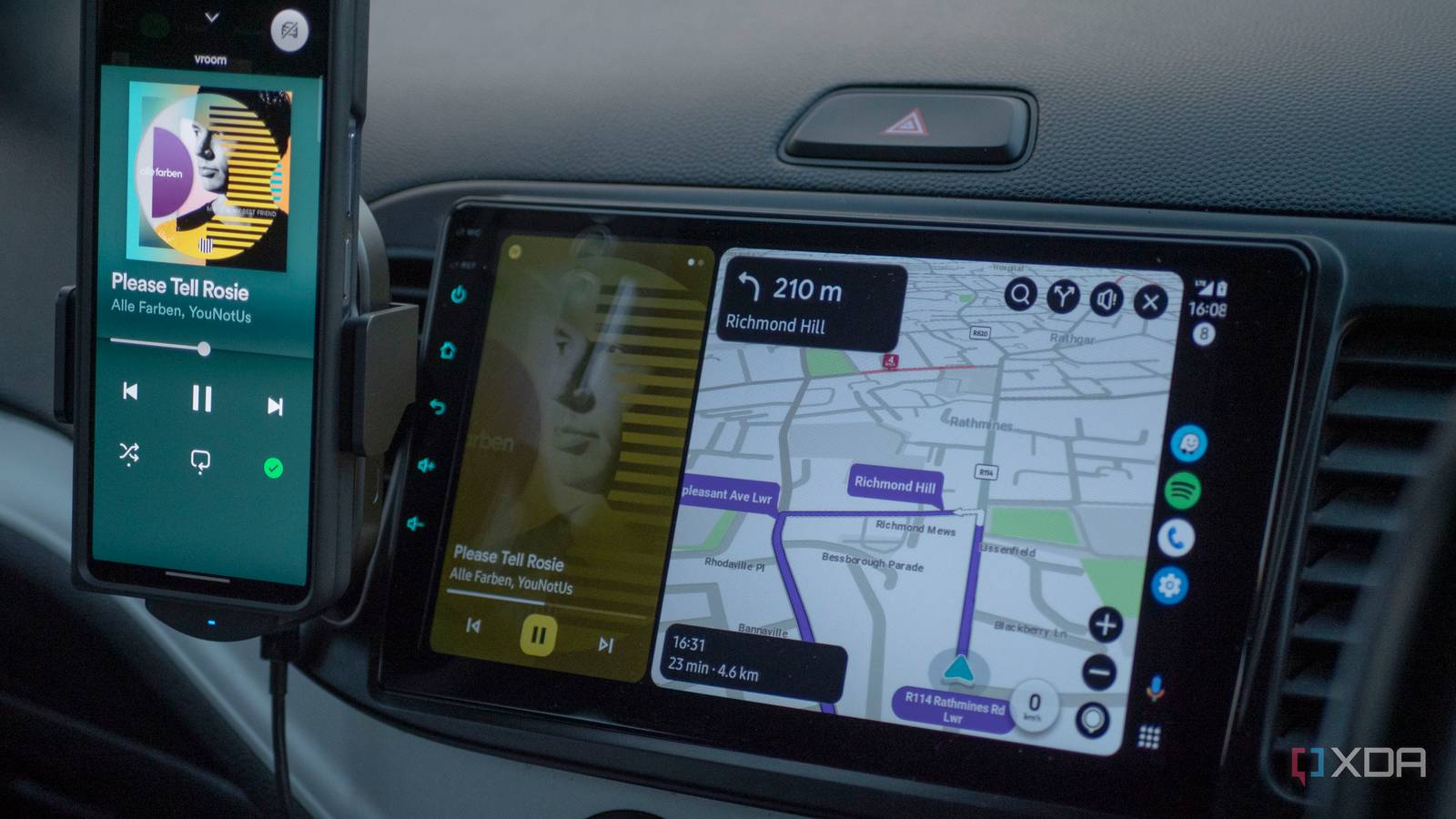
Published Sep 1, 2026, 8:30 AM EDT I’m Adam Conway, an Irish technology fanatic with a BSc in Computer Science and I'm XDA’s Lead Technical Editor. My Bachelor’s thesis was conducted on the viability of benchmarking the non-functional elements of Android apps and smartphones such as performance, and I’ve been working in the tech industry in some way or another since 2017. In my spare time, you’ll probably find me playing Counter-Strike or VALORANT, and you can reach out to me at adam@xda-developers.com, on Twitter as @AdamConwayIE, on Instagram as AdamConwayIE, or u/AdamConwayIE on Reddit. Sign in to your XDA account A car radio is one of the parts anyone can typically pull out of a car, and my car is old enough that head unit was a radio with a CD player and Bluetooth added as an afterthought. I'm not a car person in the slightest, but I am a tech person, and that realization bothered me rather quickly when I got the car. There are obvious fixes, but none of those really work on a car like mine. A wireless adapter like AAWireless or a Motorola MA1 take the wired Android Auto that your car already has and makes it wireless, but when there's nothing there in the first place, they have nothing to do. That means swapping the entire unit, which sounded like something I'd have to take it to a garage to do. I still wanted to give it a try, though. Turns out, it was fairly easy, and it took me just under two hours to remove the old head unit, wire up the new one, and get everything slotted back into place. What actually runs Android Auto is an app on an uncertified Chinese Android tablet that I have to launch every time I get in, but two years later, it's still the best thing I've done to that car. Getting the old head unit out was the hardest part of the job It was a struggle I watched a lot of videos before ordering the head unit and, while waiting for it to arrive, mostly to get to grips with which connector did what and in what order things came apart. The unit came as a bundle with a SIM card reader, a GPS antenna (which a tablet stuck behind a dashboard genuinely needs), and a reversing camera that runs inside the frame of the car and sits above the license plate, so there was a bit more to route than just the radio. Though, two years on, I still haven't hooked up that last part. The factory head unit was incredibly hard to remove, and prying it out without cracking any of the surrounding trim probably took about half as long as the setup. I really didn't want to have to go through all of that again, so the most stressful part, once it was out, was making sure every connector was clicked in properly before I put the new head unit back in. As an aside, installing this was a pretty funny experience in itself. Because the parking complex is underground, it's fairly dimly lit, so I drove the car to a nearby public car park to do the swap. It was quiet, and I noticed that the parking enforcement officer had walked by me several times. I said hello and kept doing what I was doing, before realizing that it probably looked like I was stealing the car. Oops. They never said anything to me, but the myriad of cables and wiring sticking out from inside the car probably looked... a bit suspect, in hindsight. For preparation, it turned out that buying the unit and its shell together, locally, was very important. Cars in Ireland drive on the left, so the steering wheel is on the right, and the plastic surround is a molded part that has to match an asymmetric dashboard. The electronics inside are identical either way, but importing one from a country that drives on the right would have got me a shell mirrored the wrong way round, which is why these are sold as right-hand-drive and left-hand-drive SKUs in the first place. On top of that, no-name units have a reputation for running slightly oversized, to the point that retailers selling the proper vehicle-specific fitting kits will tell you outright that a Chinese head unit may need the fascia modified before it sits right. The whole thing works because car radios were standardized in 1984 The plastic wasn't, though My dashboard is a standard size because of ISO 7736, which was originally the German DIN 75490 and was picked up by ISO in 1984. Single DIN is a 180mm by 50mm panel, and double DIN is 180mm by 100.3mm, which is what my car has. The standard covers the opening rather than how deep the chassis behind it is allowed to be, so "double DIN" gets you most of the way there but doesn't fully cover the specification. In this setup, the 9-inch screen isn't a DIN size either, as it's a double DIN body with a display in the center. That's why it needs a car-specific shell instead of a generic metal cage. The wiring is standardized too, under ISO 10487, which is two keyed blocks, one for power and one for speakers. On the power block, A4 is the permanent 12V feed that keeps the clock and the presets alive, A7 is the switched feed that comes on with the ignition, A8 is ground, and A5 sends 12V out to an antenna or an amplifier. The speaker block is just four pairs. Some manufacturers reverse A4 and A7, which is why some replacements like this can kill your battery overnight, but the unit matches what my car has rather than feeding it two live wires. Everything not covered by the standard is harder: for example, there's a reversing pin on block A, but it's a signal, not a video feed, so the camera still needs its own cable run and a trigger wire spliced into the reverse lamp. The steering wheel buttons aren’t a data bus at all; each button shorts a different resistor across a two-wire pair, so the head unit really just measures resistance and looks up which value corresponds to which button. With the two lines wired up, you open a learning screen, press each button on the wheel in turn, and tell the unit what it should do. Newer cars put those presses on the CAN bus as network messages instead, and then you need a decoder box in between to translate them, along with reverse, illumination, and the speed pulse. My car being old is the reason it's easier to work on. Wireless Android Auto isn't just Bluetooth, either. Bluetooth handles the introduction, but my phone connects to it over RFCOMM, the unit sends two small Google protobuf messages back, and the phone joins its Wi-Fi network. Everything you see and hear on the screen runs over that. That's also why Google's requirement is a phone on Android 11 or newer with 5GHz Wi-Fi rather than anything to do with Bluetooth versions. Separately, there's a bit of a European oddity here as well, because 5150 to 5350 MHz is restricted to indoor use, and whether a car counts as indoors was an open question until a Commission decision in November 2022 confirmed the band covers wireless networks inside road vehicles. None of this is certified by the head unit, as Android Auto support is something licensed by Google, and generic units like mine usually don't have it. That's why they come with an app that implements the head unit side of the protocol, rather than the real deal. In this case, the app is called Tlink, but others have apps like ZLink or Autokit, and they're all doing the same thing under the hood. It's not screen mirroring, and it is the real protocol, but it is an uncertified implementation. Two years on, and I still love it The best car upgrade I ever made My day-to-day usage of this display has Waze filling most of the screen with Spotify in the left pane, and I can talk to it rather than touching the screen. Making calls and sending texts by voice is there if I need it, and I mostly don't, but getting directions and skipping a track without needing to take a hand off of the wheel is an incredibly nice quality-of-life upgrade. I even have Android Auto report its sensors back to Home Assistant, so my home knows when I'm driving, and I have automations that rely on it. I didn't buy the head unit for that kind of thing, but it's something I'd genuinely miss. Separate from wiring, and already mentioned earlier, there has been no impact to the battery whatsoever since I've been using this. The unit monitors voltage and shuts down rather than going into sleep once it drops below a threshold. If I drive anywhere on a given day, it'll sleep for several days without a problem after that. I've seen a lot of complaints about Tlink being flaky, but that hasn't been my experience. I connect over Bluetooth, launch the app, and my phone takes it from there. It's an extra tap every time I start the car, which is mildly annoying but still much better than the alternative of not having it at all. There are no guarantees of updates on a unit like this, though, and the underlying Android version is old. In fact, just recently, Kaspersky documented the first malware campaign built specifically for Android car head units, delivered through TWCore, the legitimate over-the-air updater on units built by a Chinese supplier called DoFun. It doesn't need any user involvement, and it turns your car into a proxy botnet module that sends out the unit's model, resolution, Wi-Fi SSID, and MAC address to a command server every ninety minutes. I’ll be honest, though: I have zero clue who actually built this. It's a cheap Android device with a 12V feed, a SIM slot, and a Bluetooth pairing to my phone, and the most sensible thing to do with one is treat it as untrusted, which I do. It's a real trade-off, but it's the trade-off that got Android Auto into a ten-year-old car for an evening's work, and I'd make it again, no questions asked.
I replaced the radio in my 10-year-old car in one evening, and it finally has wireless Android Auto
Full Article
Original Source
Read the full article at Xda-developers →KhanList aggregates and links to publicly available news content. We do not host full articles from third-party sources. Always verify important information with original sources.