
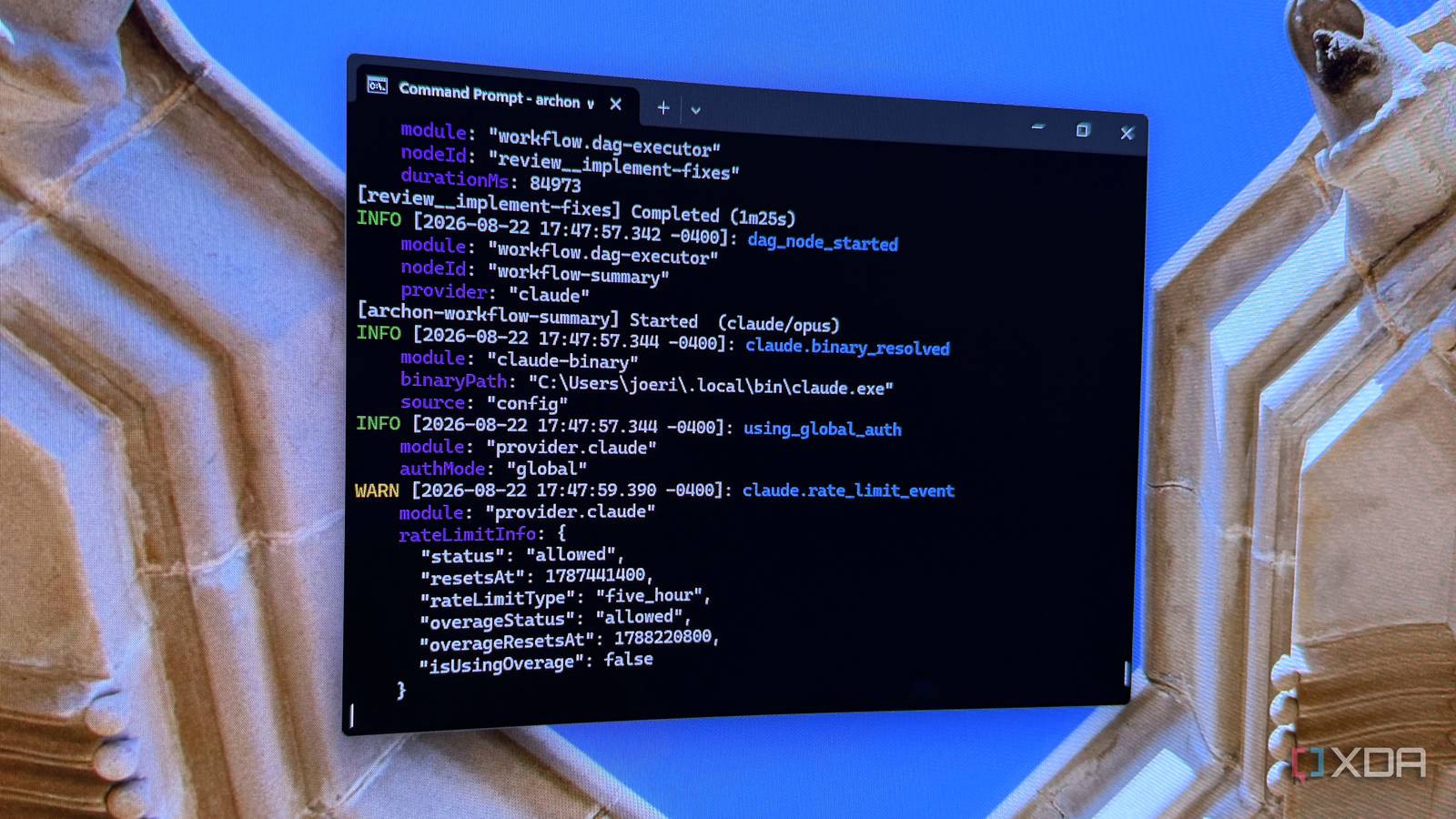
Published Aug 24, 2026, 2:00 PM EDT Maker, meme-r, and unabashed geek, Joe has been writing about technology since starting his career in 2018 at KnowTechie. He's covered everything from Apple to apps and crowdfunding and loves getting to the bottom of complicated topics. In that time, he's also written for SlashGear and numerous corporate clients before finding his home at XDA in the spring of 2023. He was the kid who took apart every toy to see how it worked, even if it didn't exactly go back together afterward. That's given him a solid background for explaining how complex systems work together, and he promises he's gotten better at the putting things back together stage since then. I’m no stranger to letting Claude Code run rampant in my devices. It’s made sense of my years of Event Viewer logs, and written much of the code holding my Proxmox stack together. Then I noticed something; it never gives the same answer in quite the same way if you ask twice. And that’s where harnesses like Archon come in. I already use it to build things because it promised to fix the gaps Claude had shown me. But I trusted it in the same way I trusted Claude Code, and I hadn’t actually tested if it worked as advertised. That gnawed at the back of my mind, and the more I thought about it, the more I knew I had to test things. I ran the same bug six times, and the variance I expected never showed up My test failed but not in the way I thought it would The test was simple. A small repo with a rigged API bug, and a small script to build a scorecard. One prompt, three runs in both Claude Code and Archon. The bug is one I could have fixed in my sleep. An off-by-one issue with a date field. A script ran the final fix against the starting files and created the scorecard for me, so the agent wasn’t the one proving its own homework. I expected Claude Code to be more variable in how it created the fix or how long it took. But I was surprised when all six runs landed with nearly the same number of changed lines. The differences weren’t in what was fixed, but in how. Things like variable names and the pull request title. The only run with an appreciable difference was an Archon run, when the agent decided the date boundary needed its own tests and added three. The fix was still the same; it just decided that the plan I’d made wasn’t enough. Archon Archon makes your AI workflows repeatable, with guardrails and receipts. The run that failed is the best argument for the harness Agents can be unpredictable It took four Archon runs to get my three scores because one failed. Not because the harness didn’t work, but because it did. Archon is supposed to run through a predictable series of steps, and the investigate phase is designed to create a plan for the downstream agents to work from. Instead, it found the bug, fixed and validated it, and then wrote a summary. The next gate checked for the plan document, didn’t find it, and stopped the run. bridge-artifacts: neither investigation.md nor plan.md exists in [...]The investigate/plan phase produced no specification — implement has nothing to work from. Every phase after that refused to start. The unspecified change never left the worktree, and that’s exactly what the harness is supposed to do. The agent, and by extension the LLM, were the unknown part, and the harness is set to fail if any output isn’t as expected. Claude Code doesn’t have the same protections, and you might not find out until much later. In this case, it was a simple bug fix, and the end result didn’t matter as much. But this is for example and shows the guardrails in action. The Archon workflow opens fixes as drafts against a branch-protected main, and it needs a human to merge them. The same thing happened with the archon-idea-to-pr workflow on a pagination feature. Claude Code was still building the feature, but Archon did the management layer. Interestingly, because I hadn’t merged the bug fix before I added the new feature, the validation checklist had 20 of 21 items passed. The one that failed was the bug fix that was fixed but not merged. Repeatable workflows cost more time and tokens But that’s worth it to me I expected the new harness to take longer, because it has additional steps. I didn’t expect it to take six times as long for simple tasks, and the PR to add a feature took nearly 35 minutes to appear. Now, I appreciate some of the steps, like validation loops and a multi-agent review to ensure accuracy. The web research step seemed unnecessary for the bugfix, since the off-by-one date bug is common, but I can see where it would be handy for anything more complex. Some things are still a little rough. The failed run couldn’t be recovered because it treated a completed step as successful. The resume button hit the same classifier, and failed for the same reason. Moving back one step might have cleared the breakpoint, but Archon isn’t set up to do that. It’s also worth noting that the harness did not make the produced code repeatable. The shape of the work is what’s repeatable, the research and validation stages, among others. Things like variable names and comment phrasing come out differently because that’s just how LLMs work. No amount of prompting will change the underlying structure, but it can push it into where you need it. Archon won’t be the tool I reach for every time, because it’s overkill for simple fixes. Any small bug fix can be done by Claude Code without any other tools in the mix, and it’s faster. For adding features or long-tail coding tasks, the harness is the whole point: to make decisions while I’m not around and stop on anything that might cause issues. The fix was never the problem After a day of running the same bugfix on repeat, I realized I’d been asking the wrong thing about Claude Code. I wanted the model to be predictable, and it was already more consistent than I gave it credit for. What I really needed was a predictable pipeline around it, so agents couldn’t break things if they went off-script. And that’s what Archon gave me with its built-in workflows: my main branch ended a day of coding with 21 tests passed and every change accounted for. That’s as repeatable as my own coding, and the variances are on small conventions, not on the overall shape of the code.
I ran Claude Code against Archon on the same bug six times, and the run that failed told me the most
Full Article
Original Source
Read the full article at Xda-developers →KhanList aggregates and links to publicly available news content. We do not host full articles from third-party sources. Always verify important information with original sources.